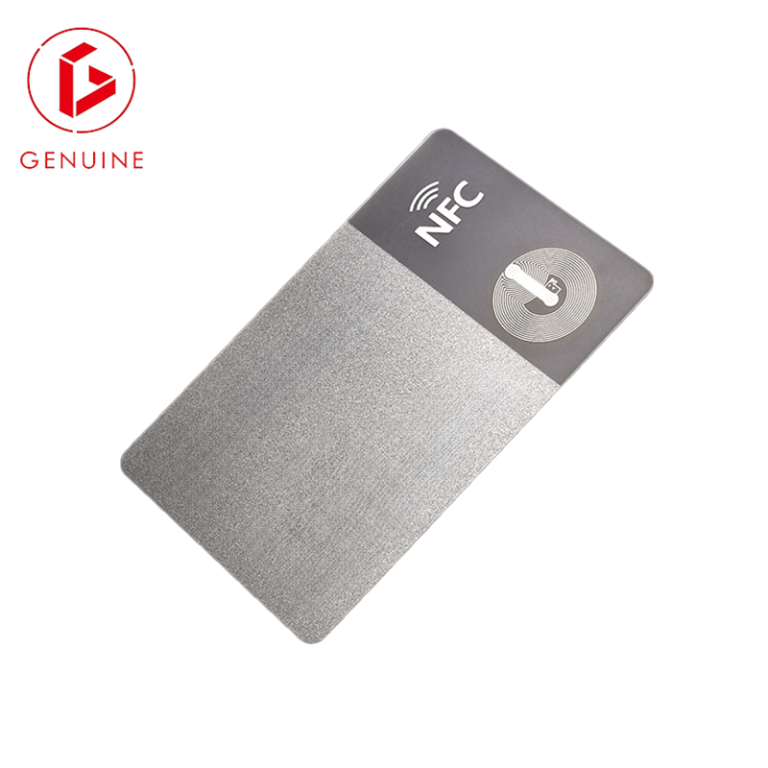
You inherited a drawer full of cards — some with a black stripe, some with a gold chip, some you just tap — and now you have to decide which one opens which door. For a facilities manager or a system integrator, that decision is rarely about the card itself. It is about risk, reader environment, lifecycle cost, and how painful the next upgrade will be. This guide compares magnetic stripe, contact-chip, and contactless credentials on the dimensions that actually matter to a buyer, then gives you a portable checklist to match each technology to the right door.
What Each Credential Actually Is — and What It Isn’t
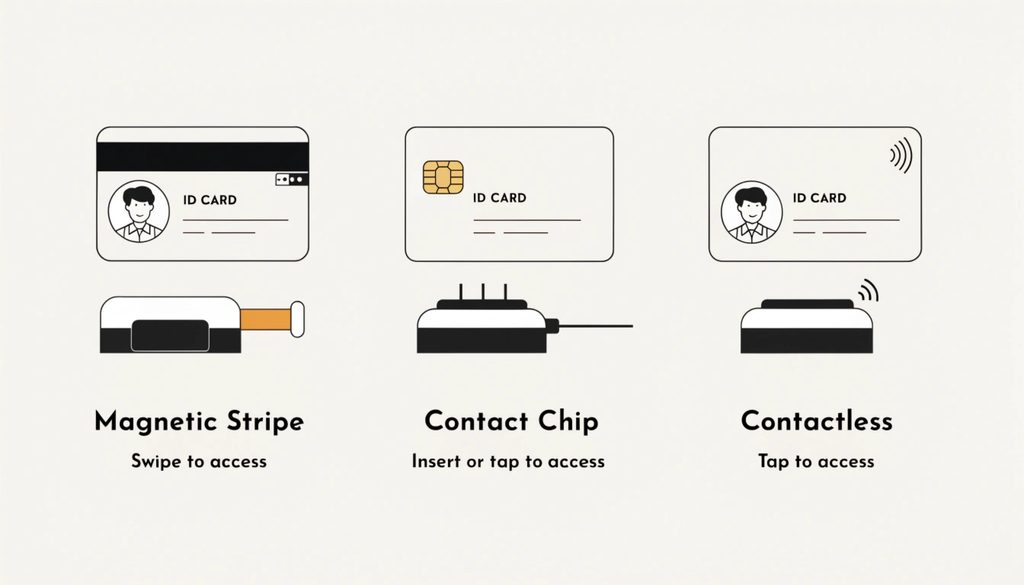
Most “which card” debates collapse once everyone agrees on what the three technologies are. Start with the mechanics:
- Magnetic stripe (magstripe). An analog band of iron oxide on the card back, read by contact swipe or insert. It carries static data and costs almost nothing per card — which is exactly why it is everywhere, and exactly why it is fragile.
- Contact smart chip (ISO/IEC 7816). A gold contact module with a secure element that performs on-card cryptography. The card must be inserted or placed on a contact pad. Data is never exposed statically; each session can be authenticated dynamically. Specifications for this class are maintained by bodies such as GlobalPlatform.
- Contactless / proximity (ISO/IEC 14443, 13.56 MHz). The card talks to the reader over radio — you tap or present it. Modern contactless credentials use encrypted hops and, in many enterprise programs, a secure element similar to the contact chip. A dual-interface card carries both a contact chip and a contactless antenna, so one card serves both readers.
For the chip and antenna side of contactless, our MIFARE vs NTAG vs ICODE chip comparison breaks down how the common silicon families differ for B2B buyers.
Security Posture: Cloning, Skimming, and Replay Risk
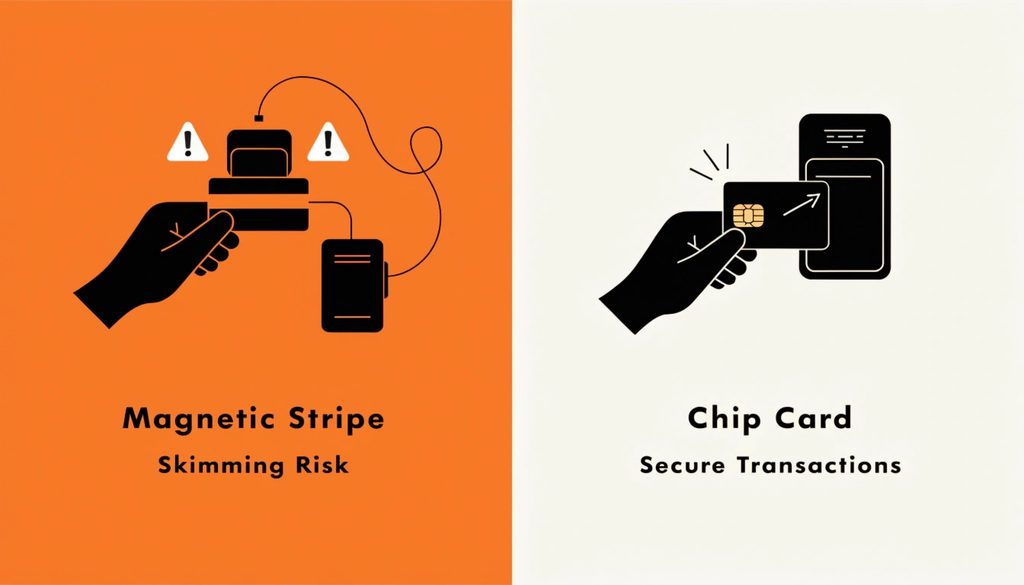
The single most important buyer question is: how hard is this credential to copy or hijack?
- Magstripe is the weakest link. The data on the stripe is static and unauthenticated, so it can be copied in seconds with a reader that costs a few dollars, then replayed or re-encoded onto a blank card. Any program that still relies on magstripe alone for a sensitive door is carrying avoidable risk.
- Contact chip raises the bar sharply. Because the secure element performs dynamic, cryptographically authenticated exchanges, a copied data dump is useless without the key material inside the chip.
- Contactless sits between convenience and a different threat model. The radio surface enables fast throughput (turnstiles, bus gates) but introduces relay and remote-read concerns. Modern implementations mitigate this with encryption and, where needed, distance-binding or tap-confirmed transactions; the underlying standard families are documented by organizations such as the Secure Technology Alliance.
US federal ICAM guidance has long steered credential programs toward PIV and away from magnetic stripe for exactly this reason — a useful benchmark even for commercial buyers (see idmanagement.gov).
Matching the Credential to the Door and Reader Environment
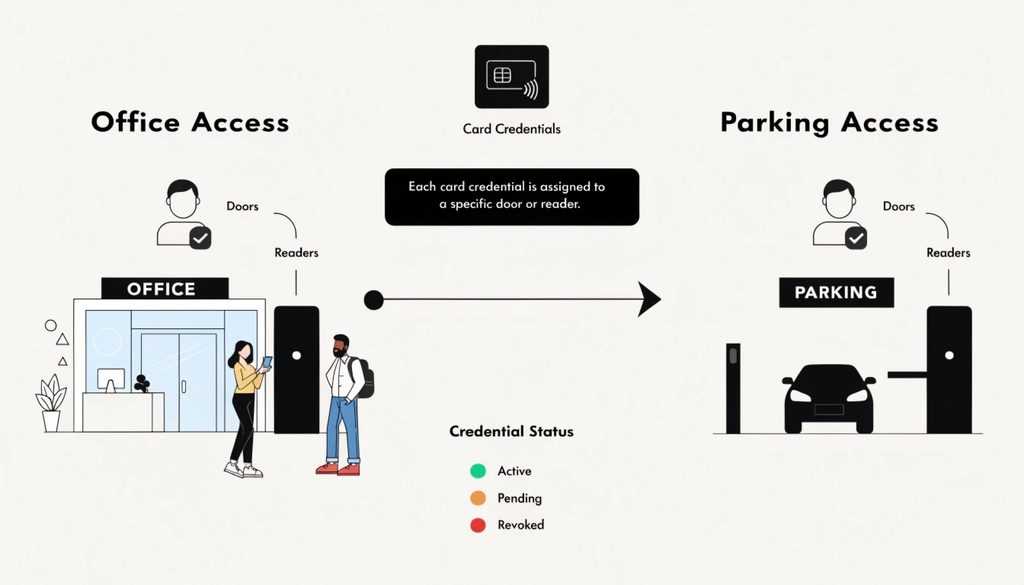
Technology choice should follow the door, not the catalog. A simple decision frame:
- Low-risk interior doors (staff break rooms, non-sensitive floors): magstripe or basic contactless is often “good enough” on a tight budget — but weigh it against the migration note below.
- Perimeter and high-security doors (server rooms, R&D labs, cash handling): contact chip or high-assurance contactless with mutual authentication. This is where a cloned magstripe is an actual breach, not an inconvenience.
- High-throughput points (turnstiles, cafeteria, parking gates): contactless, because swipe/insert cannot sustain the flow.
- Mixed fleets: deploy dual-interface cards and hybrid readers so one credential works everywhere during a transition.
| Criterion | Magnetic stripe | Contact chip | Contactless |
|---|---|---|---|
| Relative security | Low | High | Medium–High (encrypted) |
| Read method | Swipe / insert | Insert / contact | Tap (radio) |
| Throughput | Slow | Medium | Fast |
| Durability concern | Stripe wears / demagnetizes | Contact pad wears | Robust (no moving contact) |
| Best fit | Low-risk, legacy | High-security, assured | High-throughput, modern |
If you are scoping the wider system, start with our Access Control Systems (PACS) 101 buyer primer. For genuinely harsh or outdoor locations, our industrial and outdoor RFID card guide covers temperature, chemical, and enclosure ratings.
Durability and Lifecycle: What Survives Daily Use
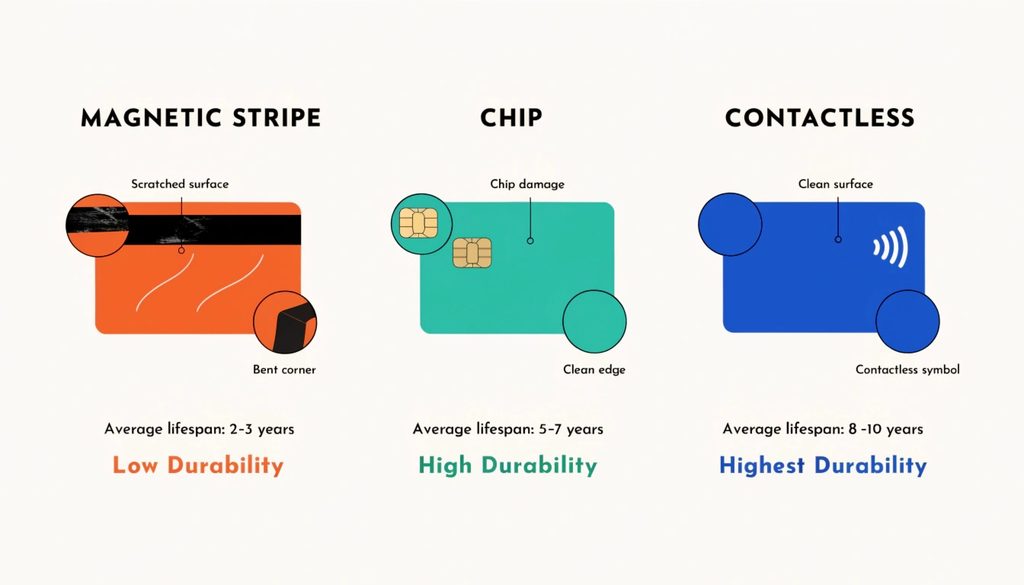
Cards get dropped, bent, swiped thousands of times, and left in the sun. The dominant failure modes are not the same:
- Magstripe degrades physically — the oxide band scratches and demagnetizes, and a single bad swipe locks a user out.
- Contact chip is mechanically fragile at the pad; heavy insert/remove cycles eventually crack the module, though the card body lasts.
- Contactless has no wear surface on the read path, which is why transit and industrial programs favor it. For outdoor or manufacturing sites, specify cards built for the environment — our industrial and outdoor RFID card guide covers what to specify.
Migration and Interoperability: Hybrid Readers and Dual-Technology Cards
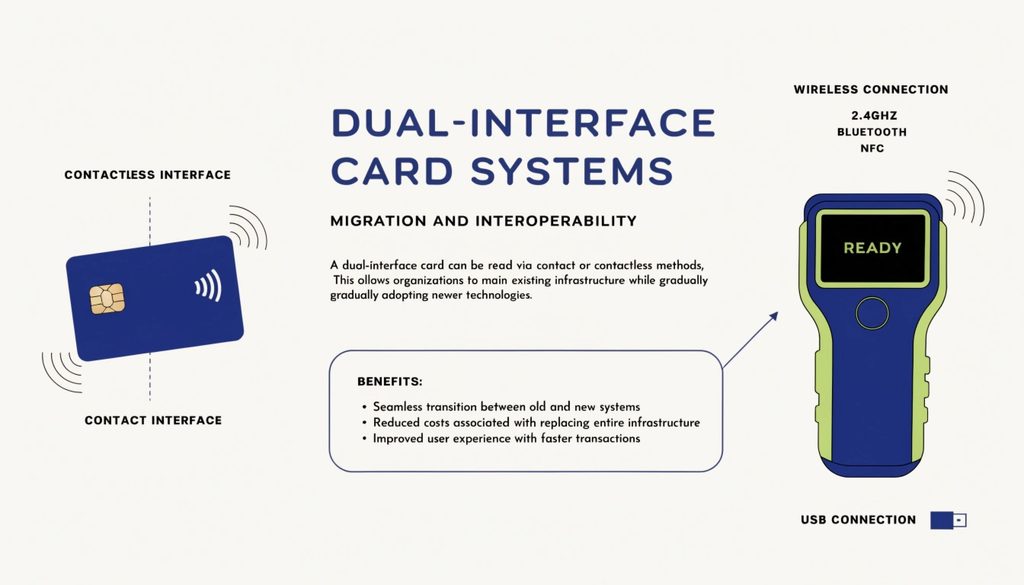
You rarely replace a credential fleet in one day. The buyer’s real job is to avoid lock-in while you migrate:
- Prefer OSDP over Wiegand at the reader-to-controller link. Wiegand is unencrypted and pin-limited; OSDP (IEC 60839-11-5) is encrypted, bidirectional, and lets you remotely configure readers. Federal ICAM programs explicitly recommend OSDP — a useful benchmark even for enterprise buyers (see idmanagement.gov).
- Standardize on dual-interface cards so the same credential works on legacy contact readers and new contactless ones.
- Watch HID and other proprietary families. They are widely supported, but confirm the exact credential format and any facility-code constraints before you commit a multi-year program — our HID smart card and credentials guide walks through the compatibility matrix.
Cost and Procurement: What to Specify in Your Next Order
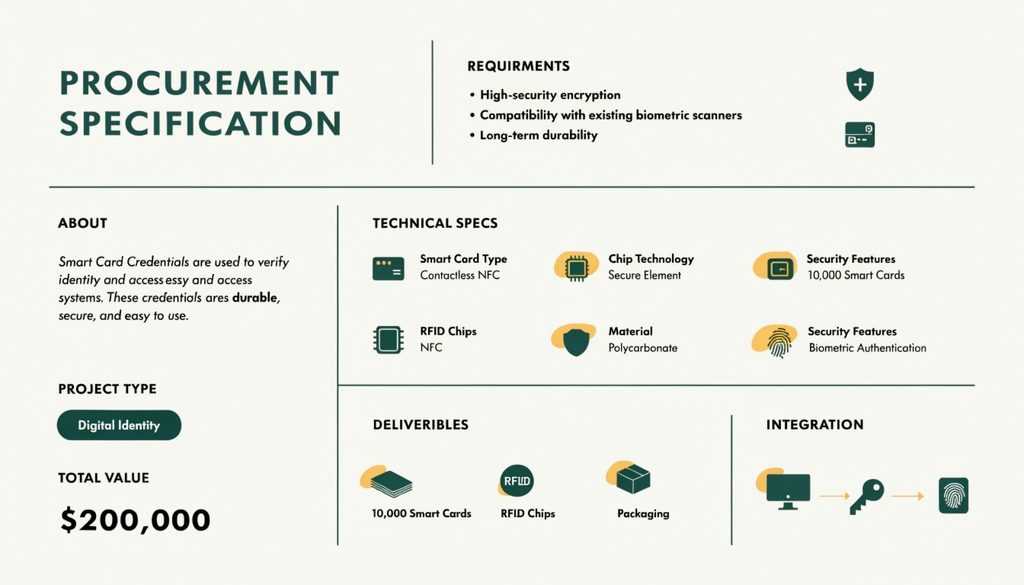
Price per card is the least interesting number. Specify the things that protect you later:
- Technology and encoding — magstripe, contact (T=0/T=1), contactless (ISO 14443 Type A/B), and whether dual-interface.
- Security level — plain UID vs secure element vs mutual authentication; state the assurance you need per door class.
- Personalization — offset/digital print, overlay, and variable data; request samples before a full run.
- MOQ, lead time, and coding — get these in writing; our smart-card RFQ specification template lists every field a supplier should quote.
- Migration path — dual-interface + OSDP readers so today’s buy does not become tomorrow’s stranded asset.
For the rollout itself, our ID card issuance program guide covers design, personalization, and enrollment workflow.
Frequently Asked Questions
Can one card do all three technologies?
Yes. A dual-interface card carries a contact chip and a contactless antenna, and you can still print a magstripe on the back. It is the standard answer for mixed fleets and migrations.
Is contactless less secure than a chip?
Not necessarily. Modern contactless credentials use encrypted, often mutual-authentication exchanges; the risk profile differs (radio surface vs physical contact), it is not simply “worse.” High-assurance programs combine contactless convenience with secure-element-backed authentication.
Why move off magnetic stripe at all?
Because the data is static and trivially copied. For any door tied to real risk, that is an avoidable vulnerability; contact or high-assurance contactless removes it.
What reader-to-controller protocol should I specify?
OSDP over Wiegand wherever you can — it is encrypted and remotely manageable, which matters for both security and lifecycle cost.
Ready to specify your next credential program? Tell us the door classes, reader types, and volumes, and we will return a dual-interface + OSDP-ready recommendation with samples. Start from our smart-card RFQ specification template, or reach the factory directly via our contact page to request a quote and free samples.