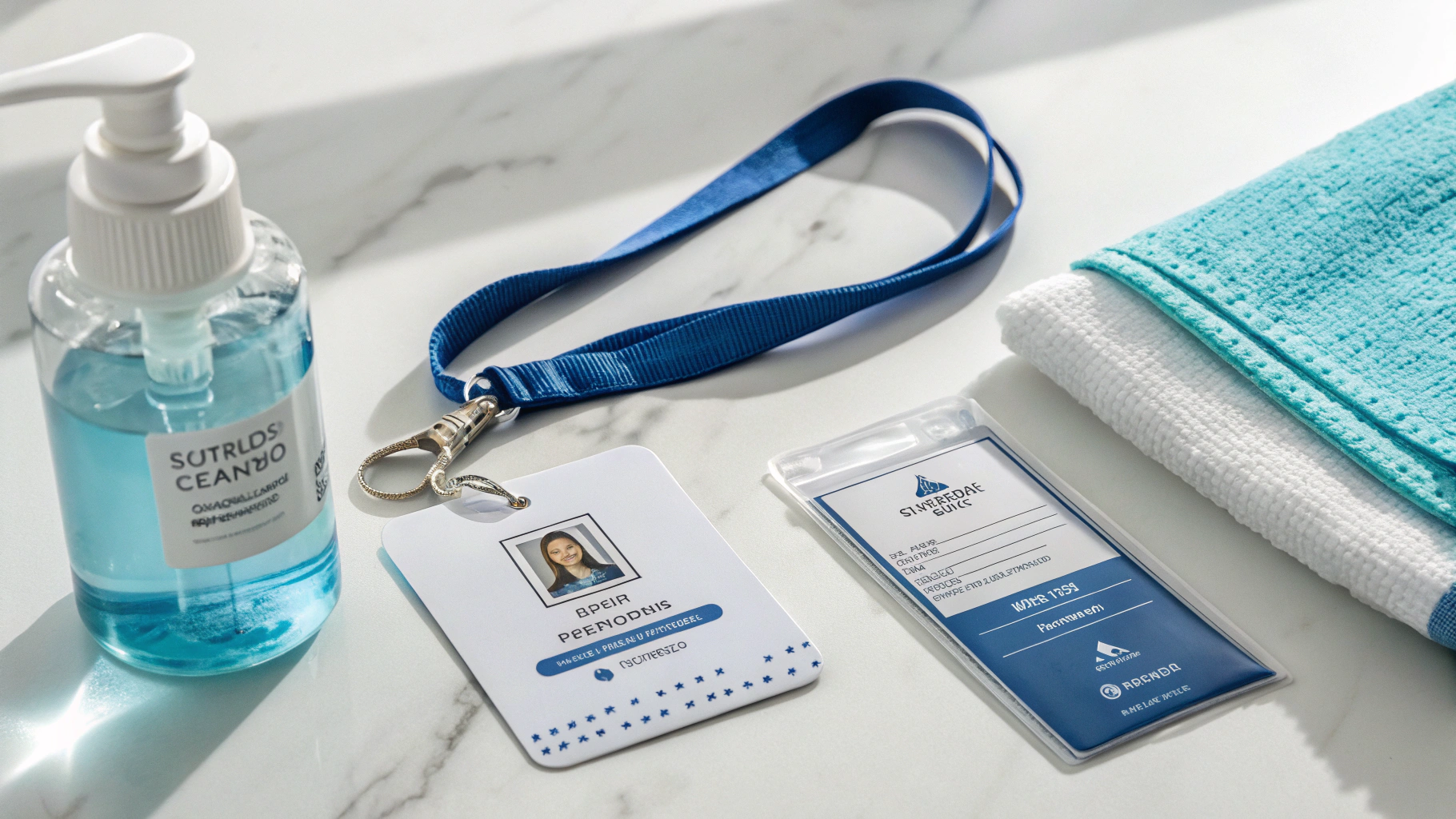
If your ID cards, access badges, or hotel key cards live in a hospital ward, a clinic, a kitchen, or a front desk, they get wiped with sanitizer more often than they get looked at. And that is exactly where ordinary PVC cards start to fail. This guide explains when standard cards break down under disinfection, which materials and surfaces actually survive, and how to specify a card that keeps working after thousands of wipe cycles.
Why Constant Disinfection Quietly Destroys Ordinary ID Cards
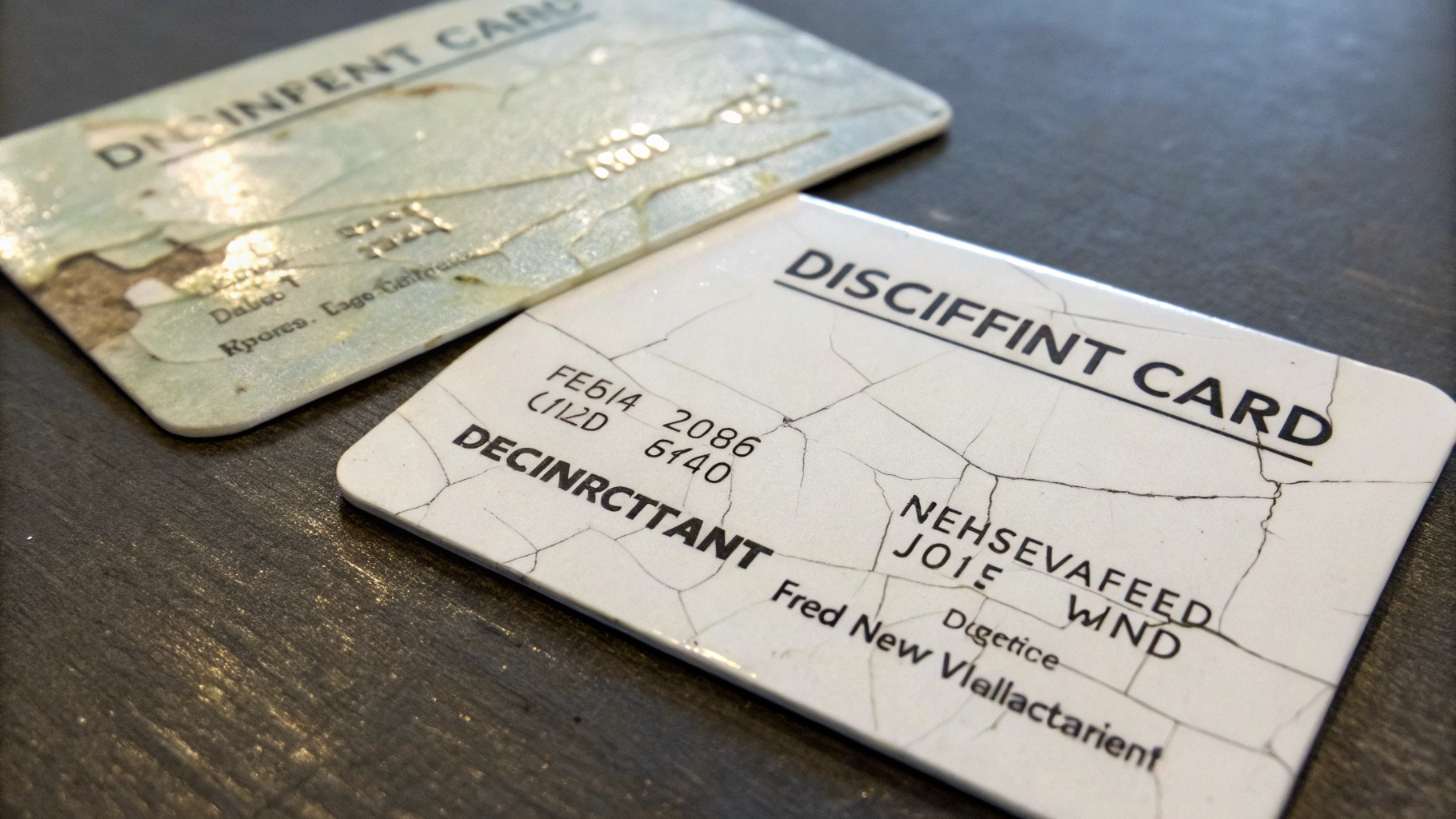
The problem is chemical, not cosmetic. Isopropyl alcohol (IPA) — the active ingredient in most surface disinfectants and wipes — is a solvent for PVC. A single pass may look fine, but repeated exposure softens the laminate, clouds the printed layer, and loosens the edge bond between the core and the overlay. In high-turnover environments we routinely see ordinary PVC cards begin to fail after as few as a few dozen disinfection cycles: the magstripe or printed panel goes milky, the chip module lifts, and the card reads intermittently or not at all.
For a buyer, the hidden cost is not the card — it is the re-issue labor, the help-desk tickets, and the access failures at the exact moment staff need to move. The fix is not “wipe less.” It is specifying a card whose chemistry matches the cleaning chemistry it will face every shift.
What “Antimicrobial” Actually Means on a Card (and What It Doesn’t)
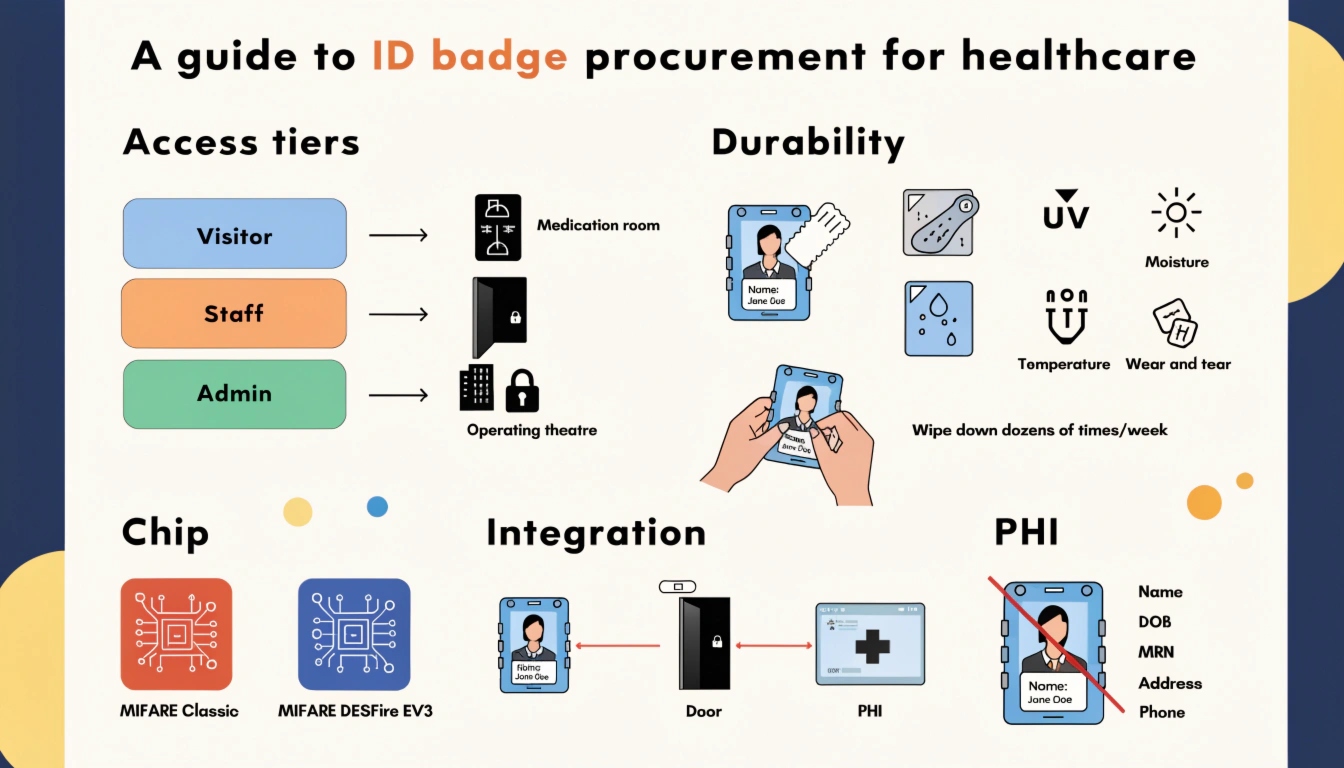
An antimicrobial card is not “self-cleaning.” In practice it means a silver-ion (Ag⁺) or zinc-based additive is embedded in the card surface or overlay, where it inhibits the growth of bacteria on the card itself between cleanings. The performance of such claims is measured by ISO 22196 (the international version of JIS Z 2801), which quantifies antibacterial activity on plastic surfaces.
Two things buyers must keep straight. First, an antimicrobial surface reduces bacterial load on the card — it is not a substitute for disinfection. You still wipe the card; the additive simply slows re-colonization on a high-touch object. Second, in the United States, any “kills 99.9% of germs” style claim is regulated by the EPA under FIFRA, so the supplier’s antimicrobial claim must be backed by a registered master-label or test report — not marketing language. See the EPA antimicrobial pesticide guidance for how these claims are controlled.
Chemical-Resistant Card Materials: PVC vs PET, PET-G, Composite, and Polycarbonate
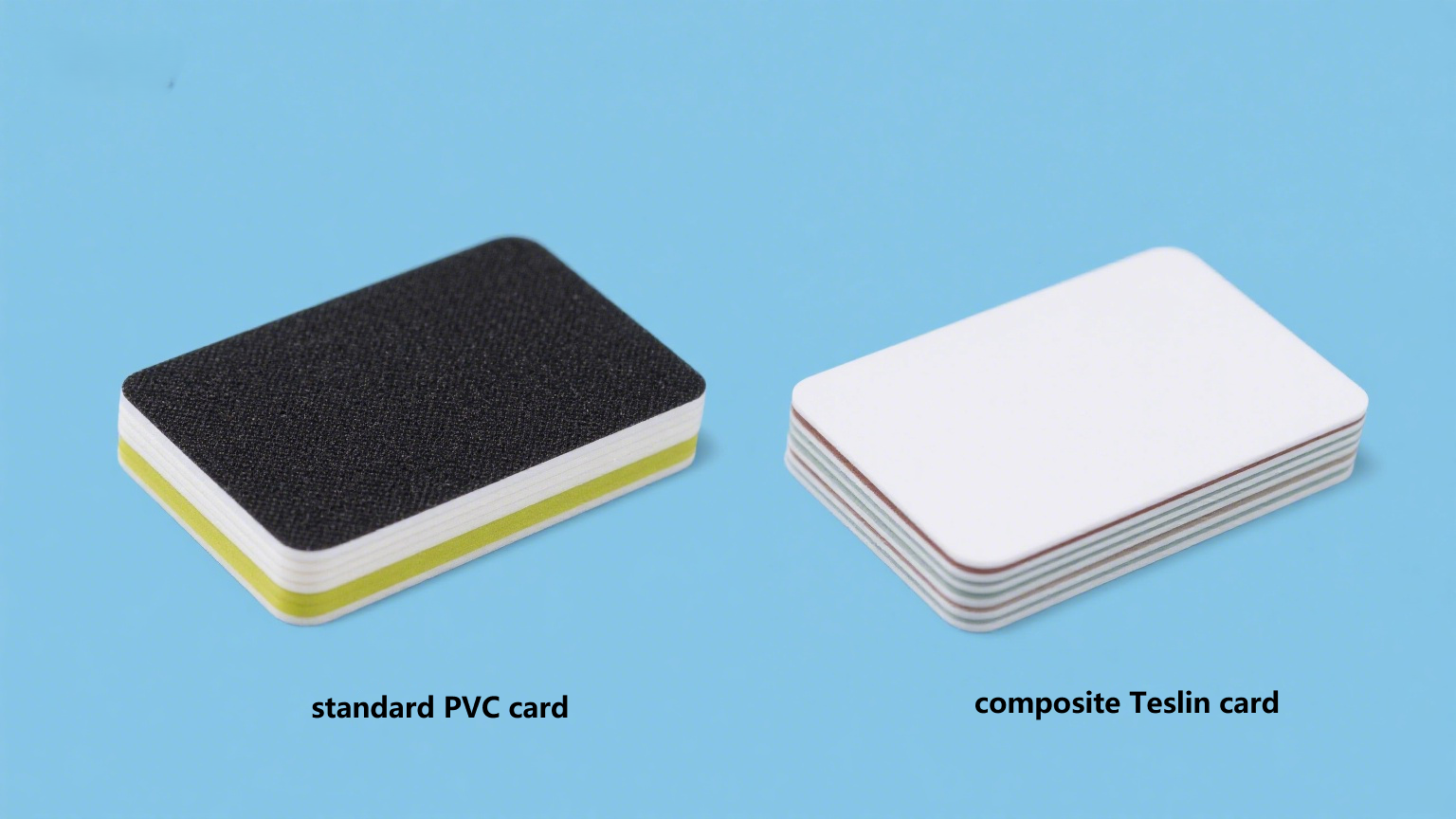
The substrate is the real defense against cleaners. Here is the short version for buyers:
- PVC — cheapest, but the weakest against alcohol and solvent-based wipes. Fine for low-touch office badges; poor for clinical or hospitality use.
- PET and PET-G — noticeably more chemical-resistant than PVC, hold print better under IPA, and stay flexible. A sensible mid-tier upgrade for daily-disinfected cards.
- Composite (PC/PET or PVC/PET layers) — combines a tough outer layer with a stable core, improving both flex life and solvent resistance at moderate cost.
- Polycarbonate (PC) — the highest chemical resistance and the longest service life. It is the material of choice for e-passports and national ID programs precisely because it survives harsh handling. Highest unit cost, but lowest total cost of ownership where cards are cleaned constantly.
Material choice also interacts with card construction. Our breakdown of polycarbonate vs PVC vs PET-G for government ID goes deeper on why PC wins on durability even when PVC wins on price.
A Buyer’s Decision Matrix: Matching Material to Wipe Frequency
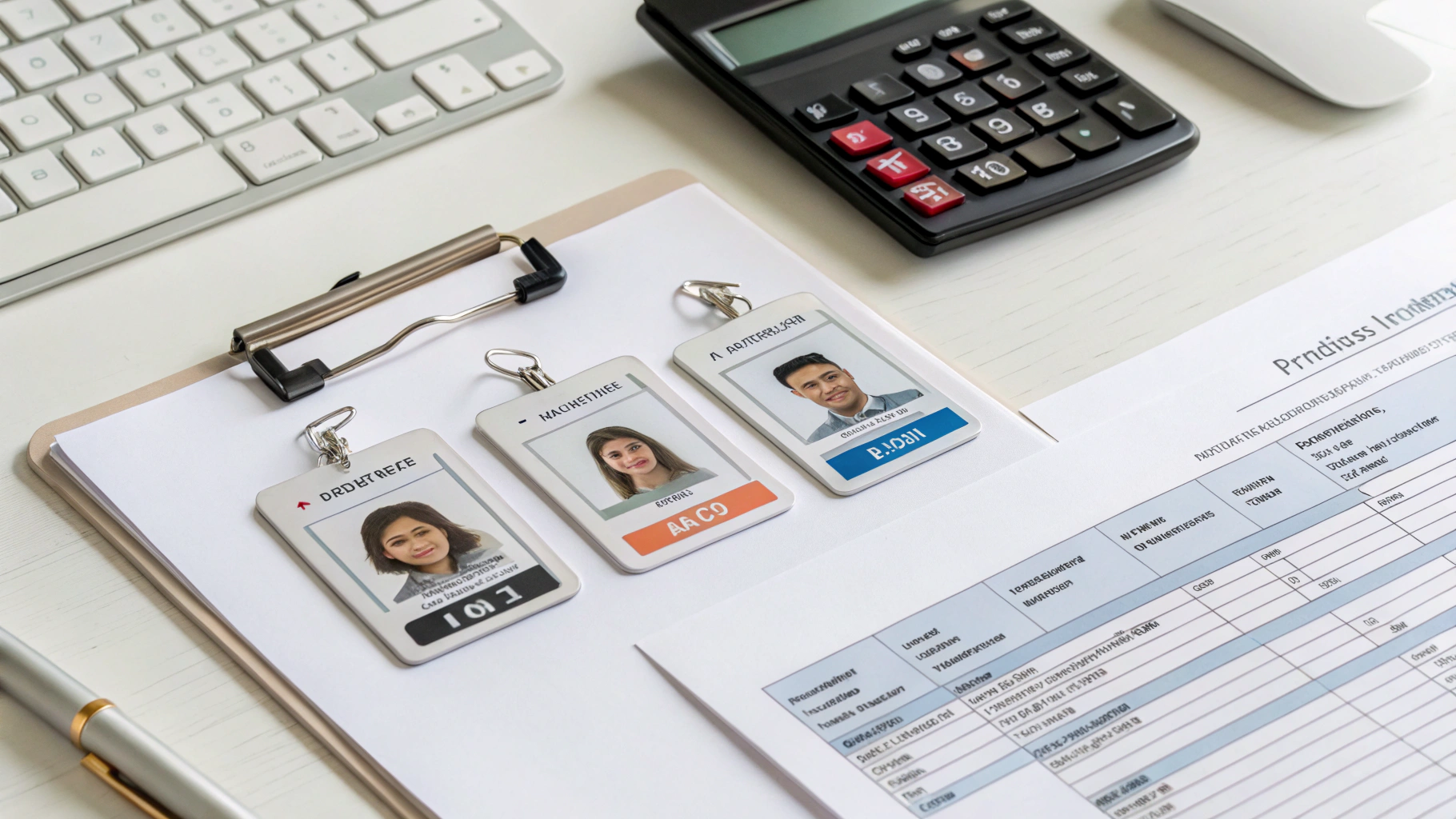
Translate the material story into a procurement decision. The variable that matters most is how often the card is wiped.
| Environment | Typical wipe frequency | Recommended substrate | Why |
|---|---|---|---|
| Office / low-touch badge | Weekly or less | PVC or PET | Cost-led; chemical exposure minimal |
| Hotel front desk / key card | Daily | PET or PET-G | Resists alcohol wipes; keeps print legible |
| Clinic / aged-care | Several times daily | PET-G or composite | Handles repeated IPA without clouding |
| Hospital ward / surgical | Constant (per-shift+) | Polycarbonate + overlaminate | Maximum solvent resistance and edge integrity |
Rule of thumb: if a card is disinfected more than once a day, PVC should be off the table. That single line in your specification prevents most field failures.
Surface Finish and Overlay Choices That Extend Card Life
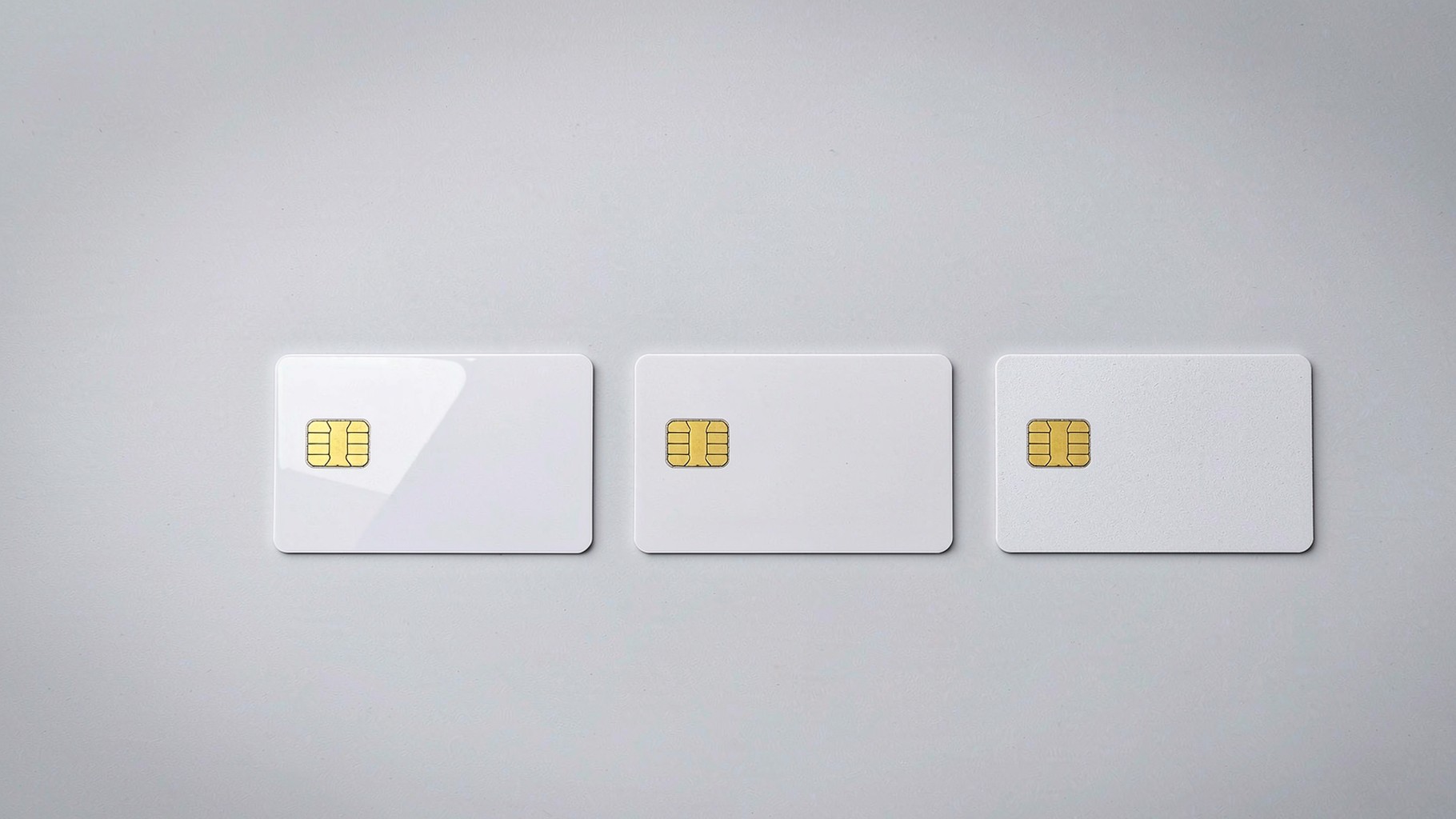
Even with the right substrate, the printed layer is the weak point. Three choices protect it:
- Protective overlaminate (overlay). A clear laminate film — applied at the factory or via a patch laminator — sits over the print and absorbs the wipe abuse instead of the ink. This is the single biggest lifespan lever for disinfected cards.
- Edge sealing. Sealing the card edge prevents disinfectant from wicking between the core and overlay, which is what causes delamination. Ask specifically for edge-sealed construction.
- Finish. Matte and frosted finishes hide micro-scratches and cleaning hazes better than high gloss, which shows every smear. For clinical cards, a satin or matte overlay reads cleaner for longer.
The chemistry of finishes and laminates is also governed by standards such as ISO 2812-1, which defines how coatings are tested for resistance to liquids — a useful citation when you ask a supplier to prove a finish’s solvent tolerance. See ISO 2812-1 for the method.
Matching the Card to the Environment: Ward, Kitchen, and Front Desk

The same “antimicrobial chemical-resistant card” spec does not fit every room:
- Hospital ward / surgical. Highest disinfection load plus potential exposure to stronger agents. Specify polycarbonate or composite, edge-sealed, with an antimicrobial overlay. Pair with a durable issuance program — see our healthcare staff badge procurement guide.
- Kitchen / food service. Grease, heat, and sanitizers combine. PET-G or composite with a matte overlay resists both fingerprints and cleaners.
- Hotel front desk / key card. Daily alcohol wipes from guests and staff. PET or PET-G with a protective overlay keeps the card looking new through hundreds of check-ins. Our ID card issuance program guide covers how to roll these out at scale.
For infection-control rationale on why surfaces get cleaned this often, the CDC environmental infection control guidelines are the authoritative reference buyers cite in tender documents.
How to Specify Antimicrobial and Chemical-Resistant Cards in Your RFQ

Vague specs produce vague cards. Put these lines in your request for quotation so suppliers quote to the same standard:
- Substrate: name it (e.g., “PET-G core, 760 micron” or “polycarbonate”). Avoid “standard PVC” for disinfected use.
- Wipe-cycle rating: require a stated number of IPA / disinfectant cycles with no delamination or print loss (e.g., “≥ 500 cycles, 70% IPA”).
- Antimicrobial: if specified, require ISO 22196 / JIS Z 2801 test data and the EPA master-label reference where claims are made.
- Finish & edge: “matte protective overlay, edge-sealed.”
- Sample first: always order and test a sample batch under your actual wipe regime before committing volume.
Verification and Certification: What to Ask Your Supplier For

Claims are cheap; test reports are not. Before you approve a bulk order, ask for:
- Chemical-resistance test report referencing ISO 2812-1 or an equivalent wipe-cycle protocol, with the cycle count and pass criteria stated.
- Antibacterial test report to ISO 22196 / JIS Z 2801, naming the organism (typically E. coli and S. aureus) and the reduction rate.
- Substrate certificate confirming the core material you specified, not a substitute.
- Dimension and interoperability conformance to ISO/IEC 7810 so the card fits readers and printers.
Our smart card certifications guide explains how to read these documents, and the shipment inspection checklist tells you what to verify on arrival. Both help you close the loop between spec and delivered card.
Frequently Asked Questions
Do antimicrobial cards still need to be wiped? Yes. The additive slows bacterial regrowth on the surface; it does not replace disinfection. Treat it as a supplement, not a substitute.
Is polycarbonate worth the higher price? For cards disinfected multiple times per day, yes — the lower re-issue rate and fewer access failures usually make PC the cheaper option over a year. For low-touch badges, PET or PVC is fine.
Can I add an antimicrobial overlay to existing PVC cards? A patch laminator can apply a protective overlay, but it will not change the PVC core’s solvent sensitivity. For genuinely chemical-resistant cards, start with the right substrate.
What wipe-cycle number should I specify? Match it to reality: daily wipes in healthcare suggest specifying ≥ 500 cycles with 70% IPA as a defensible minimum.
Ready to put numbers on paper? Contact our team for a sample pack of PET-G and polycarbonate cards tested against your disinfectant, or share your RFQ and we will flag the specs that prevent field failures before you order.