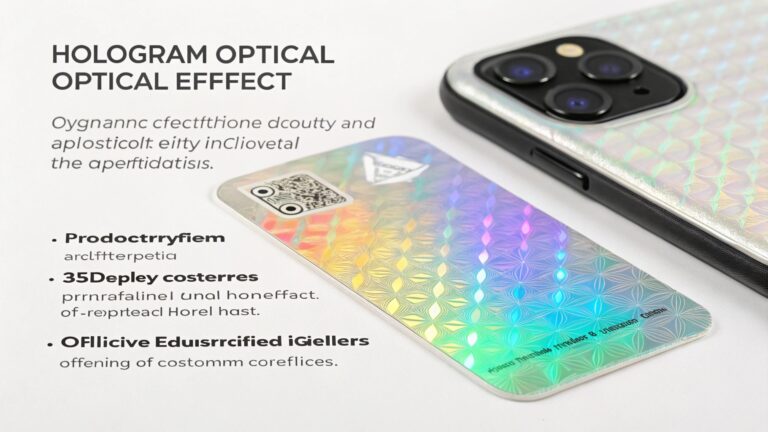
Choosing a hologram sticker supplier is not a catalog purchase — it is a brand-protection decision. The wrong supplier ships you a stock pattern any counterfeiter can also buy, or quietly resells another factory’s design under their own label. If you are responsible for authentication in 2026, the question is not “who is cheapest?” but “who can actually originate, secure, and trace the hologram my brand depends on?” This procurement checklist walks a buying team through the six checks that separate a true hologram sticker manufacturer from a middleman.
Start With Your Threat Model, Not the Catalog
Before requesting a quote, define what you are protecting and from whom. A pharma excise stamp, a luxury hangtag, and an automotive spare-parts seal face completely different counterfeit threats, regulatory obligations, and verification audiences. The international guideline ISO 22383:2020 — the current replacement for the withdrawn ISO 12931 — frames this as a counterfeiting risk analysis first, technology selection second. You should be able to answer three questions before any supplier conversation:
- Who verifies? Customs officers, distributors, or end consumers? Overt (eye-visible) features matter if the checker has no tools.
- What is the loss per fake? A $2 component and a $20,000 device justify very different security budgets.
- What does regulation require? Pharmaceutical and tobacco supply chains may mandate specific traceability that a plain decorative hologram cannot satisfy.
Buyers who skip this step end up over-paying for features they cannot use, or under-protecting a high-risk SKU. A disciplined understanding of holographic overlay and microtext security only pays off once it is matched to a documented risk.
Verify the Origination Capability — Can They Make, or Only Resell?
The single most important supplier question is: do they own origination, or are they a trader? A genuine factory-direct supplier controls the master shim (the bespoke optical origin) and embossing, so your design is unique and cannot be reordered by a competitor. A reseller buys generic patterns from a marketplace and re-labels them — which means a counterfeiter can buy the identical artwork downstream.
Red flags that you are talking to a trader, not a manufacturer:
- They cannot show the origination process or a secure production facility.
- Lead times are suspiciously short for a “custom” design (real origination takes days to weeks).
- Pricing is identical across “custom” and “stock” — a sign the “custom” art is library clip-art.
Ask directly: “Can you register a brand-exclusive master shim to my company, and will you contractually confirm it is never reused or resold?” A manufacturer will say yes in writing; a trader will hedge.

Demand the Right Security Features for Your Risk Level
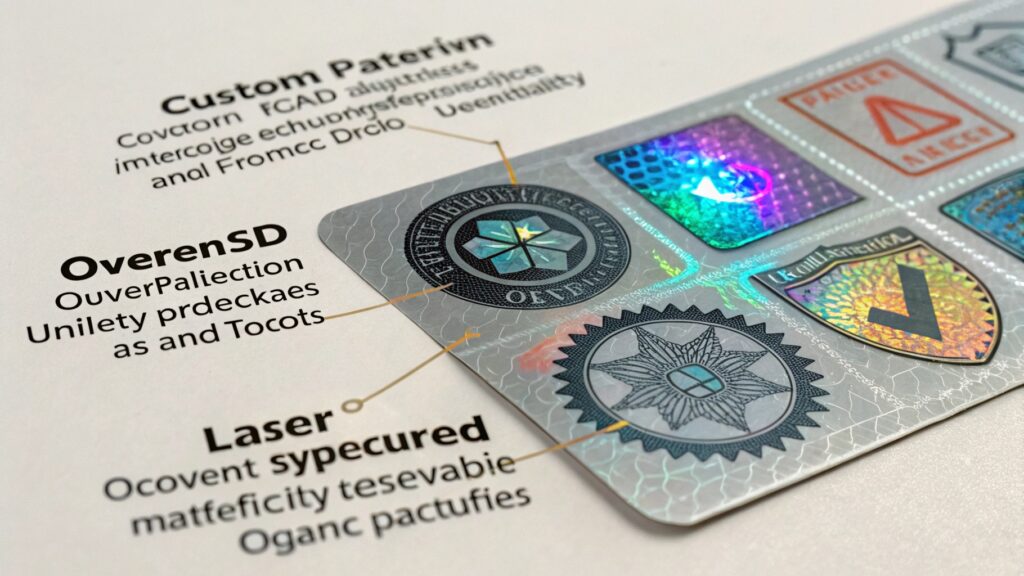
Protection comes from feature depth, not rainbow shine. A capable hologram sticker manufacturer should offer a layered stack mapped to ISO 22383’s authentication categories:
- Overt — custom 2D/3D origination, microtext, guilloché patterns, kinetic effects visible to the naked eye, with no tools.
- Covert — UV/IR inks, nano-text, laser-readable marks checkable only by trained inspectors or field devices.
- Forensic — taggants (e.g., DNA or isotopic markers) for laboratory confirmation in litigation.
- Tamper-evidence — void-release or fragile substrates that self-destruct on removal, preventing transplant onto fakes.
For most B2B programs, overt + tamper-evidence is the minimum bar; add covert and forensic layers as product value and litigation exposure rise. This is exactly the feature logic used in professional security printing for institutions — the same discipline applies to self-adhesive holograms.
Check Certifications and Quality Systems
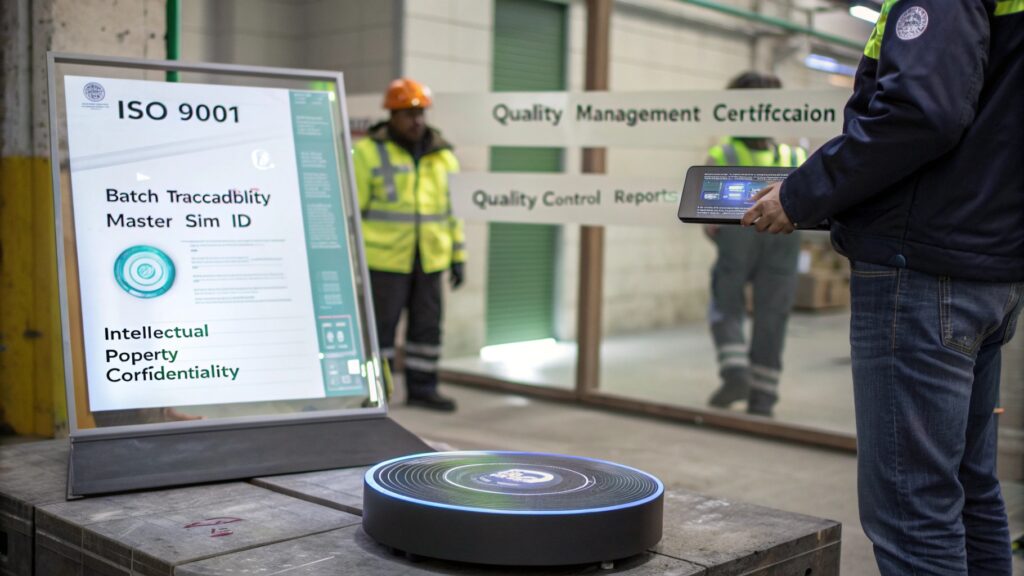
A hologram is a security device; its consistency is the security. Require evidence of a managed quality system — at minimum an ISO 9001 quality-management certification whose scope explicitly covers holographic production (not just a generic trading office). Beyond the certificate, ask for:
- Batch traceability — every roll tied to a production lot, master shim ID, and QC report.
- Sample and gold-master policy — a retained reference sample so future shipments can be compared.
- IP and confidentiality clauses — your artwork and shim are never used for another client or shown in a public catalog.
If a supplier cannot produce a QC report for a past batch, treat that as a disqualifier — you would have no way to prove a seized counterfeit differs from your genuine stock.
Evaluate Tamper-Evidence and Serialization Options
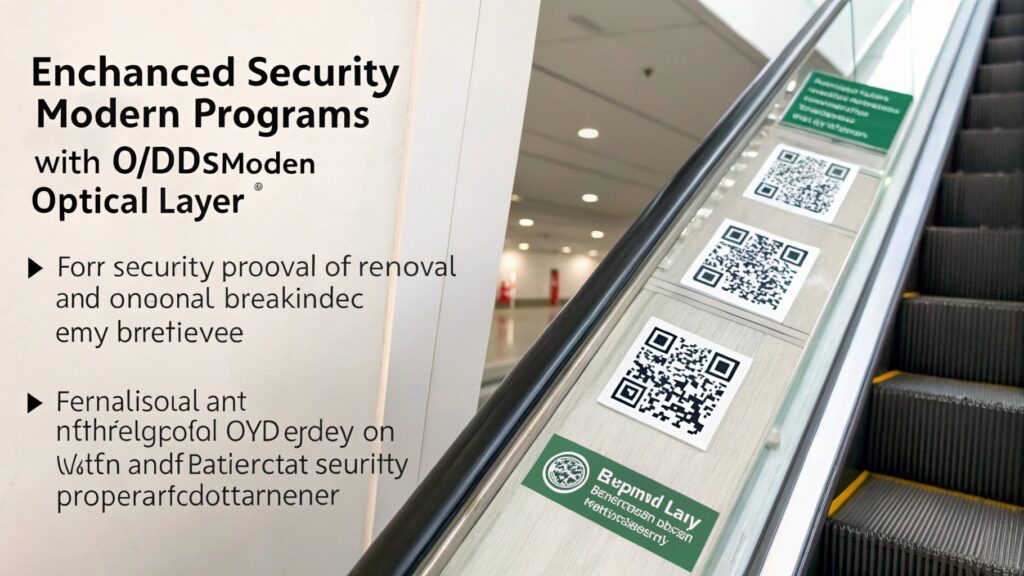
Modern programs rarely stop at the optical layer. Two options materially raise the bar, and a capable supplier should support both:
- Tamper-evident construction — void/breakage adhesive so removal is visible and the sticker cannot be reused.
- Serialization + QR — sequential or random numbering, optionally with a QR resolved through GS1 Digital Link, giving each unit a smartphone-verifiable identity tied to your authentication backend.
Serialization turns a static hologram into a unit-level authentication channel: a distributor or customer scans and gets an instant yes/no, while you collect scan telemetry on diversion and counterfeits. The OECD/EUIPO Global Trade in Fakes study shows counterfeit networks exploit exactly the gaps that unit-level traceability closes.
Run a Supplier Scorecard Before You Commit
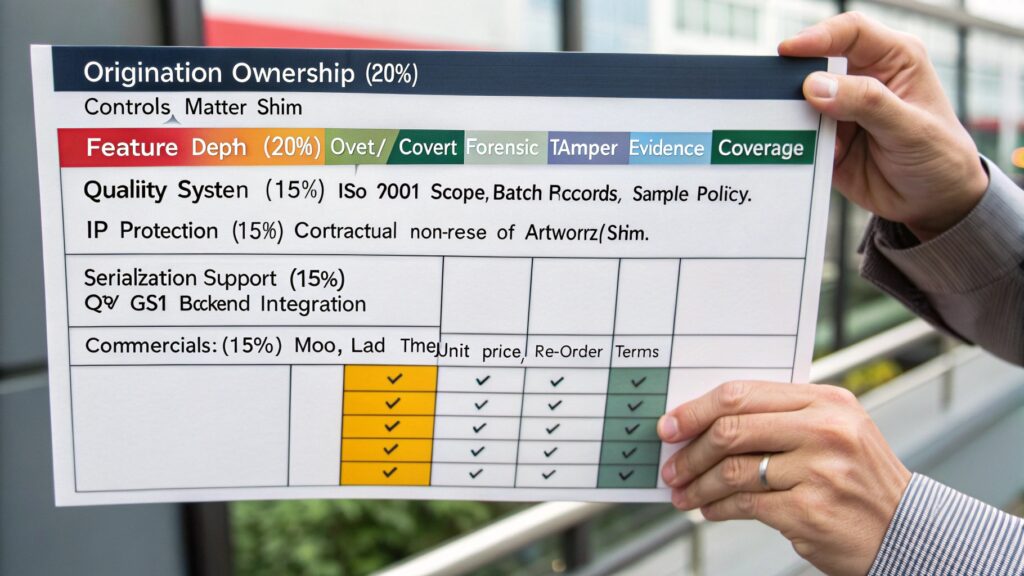
Turn the checks above into a scored scorecard so selection is defensible to procurement and legal. Weight by your risk model; a typical starting split:
- Origination ownership (20%) — do they control the master shim?
- Feature depth (20%) — overt/covert/forensic/tamper-evidence coverage.
- Quality system (15%) — ISO 9001 scope, batch records, sample policy.
- IP protection (15%) — contractual non-reuse of your artwork/shim.
- Serialization support (15%) — QR/GS1, backend integration.
- Commercials (15%) — MOQ, lead time, unit price, re-order terms.
Price is only 15% of the decision. A supplier that wins on cost but fails origination or IP protection is a liability, not a saving. The same caution applies when choosing any secure-card or document manufacturer — process discipline, not quotes, is what protects the brand.
Supplier Type Comparison
| Factor | Trade-Only Reseller | Converting Factory | Origination-Grade Manufacturer |
|---|---|---|---|
| Custom master shim | No (stock only) | Sometimes | Yes (brand-exclusive) |
| Typical MOQ | Very low | Low–medium | Medium (origination setup) |
| Lead time (custom) | Days (reships stock) | 1–2 weeks | 2–4 weeks (incl. origination) |
| Feature depth | Overt only | Overt + basic covert | Overt + covert + forensic + tamper |
| IP reuse risk | High | Medium | Low (contractual) |
| Serialization/QR | Rare | Optional | Native + backend-ready |
| Unit cost at volume | High (margin stacked) | Medium | Lowest at scale |
Frequently Asked Questions
How much does a custom hologram sticker cost?
Unit price depends on area, feature stack, and volume. Origination is a one-time setup fee; at volume, a tamper-evident serialized label typically lands in the low-cent-to-few-cents range per unit. Request a broken-down quote (origination + per-unit) so you can compare suppliers fairly.
What MOQ should I expect from a real manufacturer?
Expect a higher minimum than a trader because of origination setup — often in the tens of thousands of units for a fully custom shim. If someone offers “fully custom” at a 500-piece MOQ, they are almost certainly reselling stock art.
How do I confirm the supplier isn’t reselling stock patterns?
Require a brand-exclusive master-shim agreement in writing, a retained gold master, and a facility/origination demonstration. A genuine manufacturer welcomes this; a trader avoids it.
Can holograms be combined with QR codes and serialization?
Yes. A capable supplier prints sequential numbering and a GS1 Digital Link QR onto or beside the hologram, giving each unit a smartphone-verifiable identity — the strongest practical layering for 2026.
How long does origination take?
Real custom origination (design, shim, proofing) usually runs 2–4 weeks. Treat any “custom” promise under a few days as a stock-pattern resale.
Get a Verified Sample Before You Scale
The fastest way to qualify a hologram sticker manufacturer is to request a physical sample built to your risk model — custom origination, tamper-evidence, and optional serialization — and score it against the checklist above. GENUINE operates a 20-year secure printing facility with in-house origination and ISO-aligned quality control. Request a sample pack and a factory quote, and we will return a scored recommendation rather than a generic catalog.