If you manage a brand, chances are you have already seen a copy of your own product — same box, same colours, wrong contents. Counterfeiting is no longer a niche risk: U.S. Customs and Border Protection seized counterfeit goods worth billions of dollars in recommended retail price in a single fiscal year (CBP Intellectual Property Rights data). Holographic stickers remain one of the most cost-effective ways to make your genuine products instantly recognisable — and painfully difficult to fake. This guide explains how hologram stickers work, which type fits your product, and what to check before you place a purchase order.
What Are Holographic Stickers and How Are They Made?

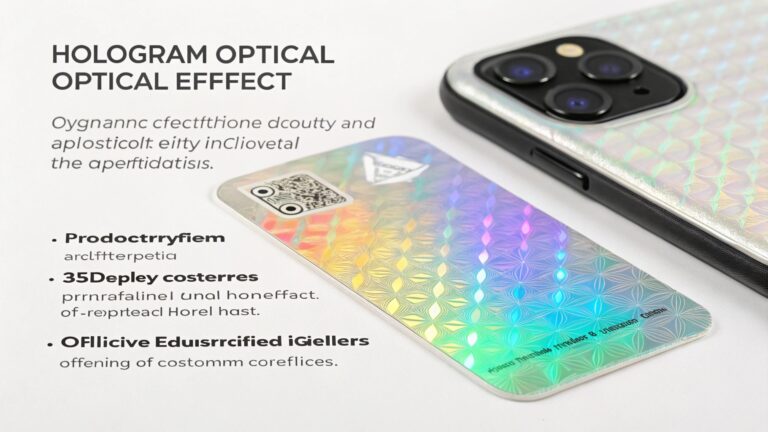
Holographic stickers (also called hologram labels or holographic labels) are pressure-sensitive labels that display a shifting, three-dimensional image created by the interference and diffraction of light rather than by ink. The process starts with laser origination: a master hologram is recorded onto a photosensitive plate, converted into a metal shim, and then embossed at scale onto metallised polyester film before adhesive coating and die-cutting.
Why does this matter to a buyer? Because the security of a hologram lives in its origination, not its printing. A counterfeiter with a normal printing press cannot reproduce a diffraction pattern — they would need your master shim. That is why reputable manufacturers keep origination masters under controlled custody.
The short video above shows the embossing and converting stages in practice — useful context when you compare supplier quotations, because tooling (origination) is usually a one-time cost while replication drives your unit price.
Why Hologram Stickers Deter Counterfeiters

From a procurement standpoint, a hologram sticker buys you three concrete outcomes:
- Overt authentication in under two seconds. Customers, distributors and customs officers can tilt the product and verify the colour-shift effect without any device. International guidance on selecting authentication tools — ISO 22383:2020 — classifies this kind of overt element as the first line of defence precisely because inspection requires no training or equipment.
- A high replication barrier. Dot-matrix patterns, micro-text and hidden laser-readable images require six-figure origination equipment. Copying a well-designed hologram is economically irrational for most counterfeiters — they simply move on to an easier target.
- Tamper evidence. Destructible base films or VOID-residue adhesives ensure the sticker cannot be peeled off one carton and reused on another, protecting you against refilling and warranty fraud as much as against outright fakes.
There is also a commercial upside that pure security features lack: the rainbow diffraction effect reads as “premium” on a shelf. Our article on why holographic stickers are a must for your business looks at this branding effect in more depth.
Choosing the Right Type of Holographic Sticker

Not every hologram is equal, and paying for the wrong grade wastes budget. Use this quick decision ladder:
- 2D/3D holograms — layered flat artwork with depth between layers. The workhorse for branding plus baseline security; lowest origination cost.
- Dot-matrix holograms — computer-generated micro-diffraction dots producing kinetic movement effects. Harder to replicate; the right choice when your product already attracts counterfeiters.
- Combined / encrypted holograms — dot-matrix plus micro-text, hidden images or laser-readable elements for two-level (overt + covert) verification. Recommended for pharmaceuticals, certificates and government work.
- Tamper-evident variants — any of the above on destructible film or with VOID residue. Specify this whenever the sticker doubles as a seal.
- Serialised holograms — sequential numbering or QR codes printed over the hologram, enabling track-and-trace and one-scan consumer verification.
If you need the hologram to protect an ID card or document surface rather than a package, a holographic overlay is usually the better construction — same optics, different carrier.
Where Holographic Stickers Deliver the Most Value

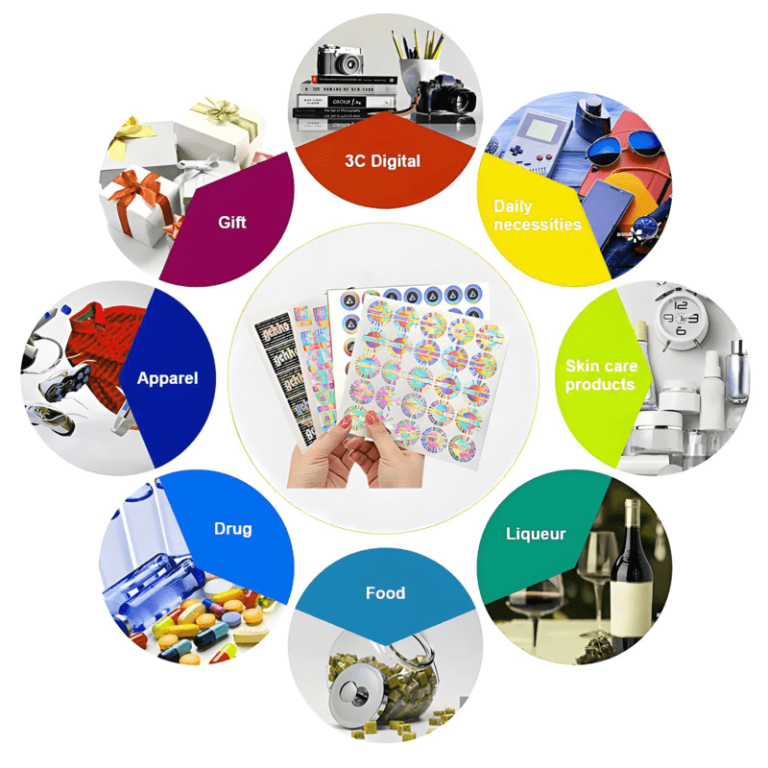
Across our B2B customer base, four scenarios consistently justify the investment:
- Pharmaceuticals and supplements — carton seals that prove first-opening integrity and authenticity where patient safety and regulatory liability are at stake.
- Cosmetics and personal care — high-margin products with heavy grey-market exposure; serialised holograms let distributors verify authorised stock.
- Electronics and spare parts — warranty seals that stop return fraud and protect service networks from counterfeit components.
- Certificates, licences and event tickets — a hologram plus security paper raises document trust immediately; see our top 10 anti-counterfeit packaging solutions for how holograms combine with other layers.
How to Evaluate a Hologram Sticker Supplier

Before you send artwork or sign a purchase order, run through this checklist — it is the same one our project managers use during onboarding:
- Origination custody: who holds the master shim, and is it contractually exclusive to you? An unprotected master is a counterfeiting risk in itself.
- Security feature menu: can the supplier combine dot-matrix, micro-text, hidden images and serial numbers in one label, or only offer stock patterns? Stock (shelf) holograms provide branding shine but little real protection.
- Adhesive and film options: confirm tamper-evident (VOID / destructible) availability and test on your actual packaging substrate.
- Sampling policy: insist on physical samples — screen previews cannot show diffraction. A credible partner such as our Genuine Hologram Stickers line ships samples before any tooling decision.
- MOQ, lead time and reorder terms: custom origination typically means a few thousand pieces minimum and a tooling lead time on the first order only; reorders should be faster and cheaper.
Frequently Asked Questions
How much do custom holographic stickers cost?
Budget for two components: a one-time origination fee (dependent on complexity — 2D/3D is cheapest, encrypted dot-matrix highest) and a per-unit replication price that falls steeply with volume. On repeat orders you pay replication only, which is why unit prices drop significantly after the first run.
Can a holographic sticker be copied or scanned?
Ordinary printing and scanning cannot reproduce diffraction structures — a photocopy shows a flat grey patch. Determined counterfeiters would need to re-originate the hologram, which custom micro-text and hidden laser-readable elements make prohibitively expensive in practice.
What is the difference between a hologram sticker and a holographic overlay?
A hologram sticker is an opaque, self-contained label applied to packaging or cartons. A holographic overlay is a transparent film laminated over an ID card or document so the underlying data stays readable while gaining protection. Choose the format based on whether the hologram sits on a product or over printed data.
What artwork do I need to supply for a custom hologram?
Vector files (AI/PDF/EPS) of your logo and any text, plus your preferred size and shape. Your supplier’s origination team will translate the artwork into hologram layers and send a proof — and should advise which covert features to embed based on your risk profile.
Ready to see the difference a genuine security hologram makes? Contact our team for free samples and a same-week quotation tailored to your product, volume and threat level.