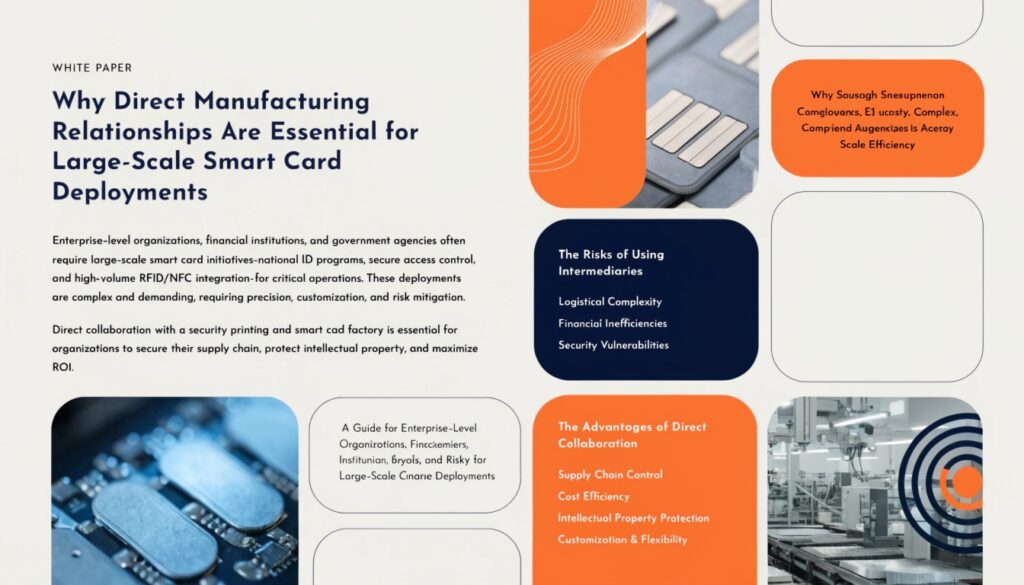
For enterprise-level organizations, financial institutions, and government agencies, the deployment of large-scale smart card initiatives—ranging from national ID programs and secure access control to high-volume RFID/NFC integration—presents a complex web of logistical, financial, and security challenges.
While sourcing through intermediaries, brokers, or local trading companies may seem convenient during initial procurement phases, large-scale deployments demand a level of precision, customization, and risk mitigation that only a direct manufacturing relationship can provide.
This white paper examines why eliminating the middleman and collaborating directly with a security printing and smart card factory is the most effective strategy to secure your supply chain, protect intellectual property, and maximize ROI.
1. Absolute Design Control and Government-Grade Customization
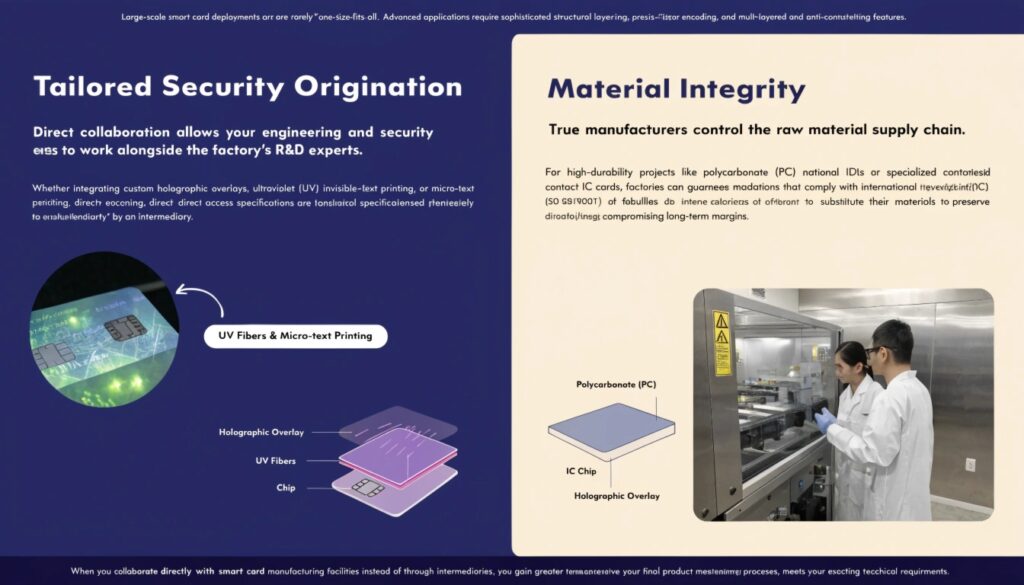
Large-scale smart card deployments are rarely “one-size-fits-all.” Advanced applications require sophisticated structural layering, precise chip encoding, and multi-layered anti-counterfeiting features.
- Tailored Security Origination: Direct collaboration allows your engineering and security teams to work alongside the factory’s R&D experts. Whether integrating custom holographic overlays, ultraviolet (UV) invisible fibers, or micro-text printing, direct access ensures technical specifications are translated perfectly without being “lost in translation” by an intermediary.
- Material Integrity: True manufacturers control the raw material supply chain. For high-durability projects like polycarbonate (PC) national IDs or specialized contactless IC cards, factories can guarantee specific material formulations that comply with international standards (such as ISO 9001/14001). Intermediaries often substitute materials to preserve their margins, compromising long-term card durability.
2. Uncompromising Security and Strict Data Confidentiality
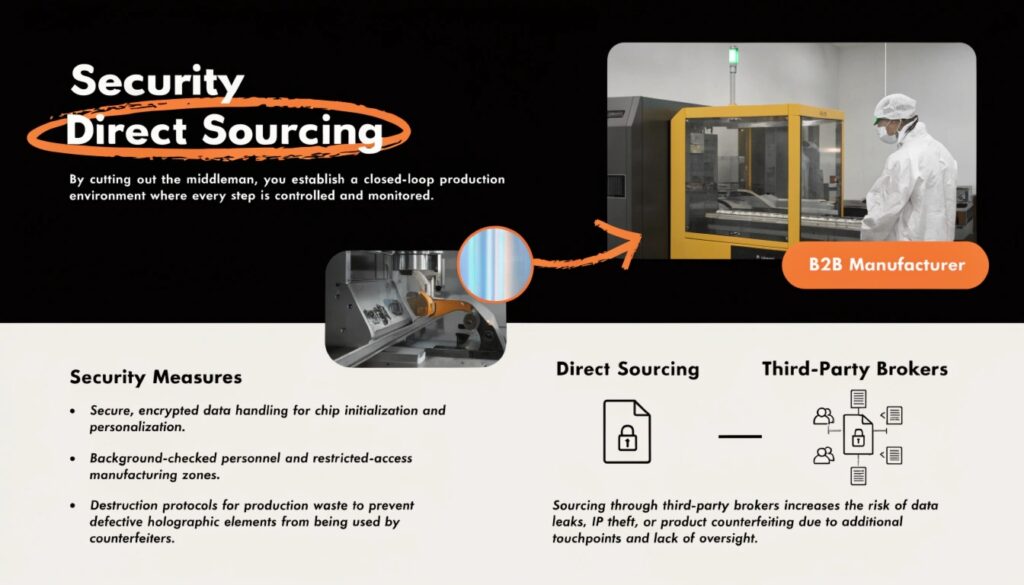
When deploying millions of smart cards, security isn’t just a feature—it’s a legal and operational mandate. Sourcing through third-party brokers introduces unnecessary touchpoints, dramatically increasing the risk of data leaks, IP theft, or product counterfeiting.
The Security Principle of Direct Sourcing: > Every intermediary added to a high-security supply chain represents an unmonitored point of vulnerability for sensitive intellectual property and proprietary cryptographic data.
By cutting out the middleman, you establish a closed-loop production environment. A dedicated B2B manufacturer implements strict facility-wide security measures, including:
- Secure, encrypted data handling for chip initialization and personalization.
- Background-checked personnel and restricted-access manufacturing zones.
- Destruction protocols for production waste, ensuring no defective holographic elements or smart card components fall into the hands of counterfeiters.
3. Supply Chain Agility and Accelerated Time-to-Market
In large-scale rollouts, a delay of even a few days can result in massive operational bottlenecks and financial penalties. Intermediaries naturally slow down communication, acting as a bottleneck for technical feedback and production updates.
[Traditional Sourcing]: Buyer ⇄ Broker ⇄ Trading Co. ⇄ Factory (High Latency)
[Direct Sourcing]:      Buyer ⇄ Factory R&D & Production (Real-Time Agility)
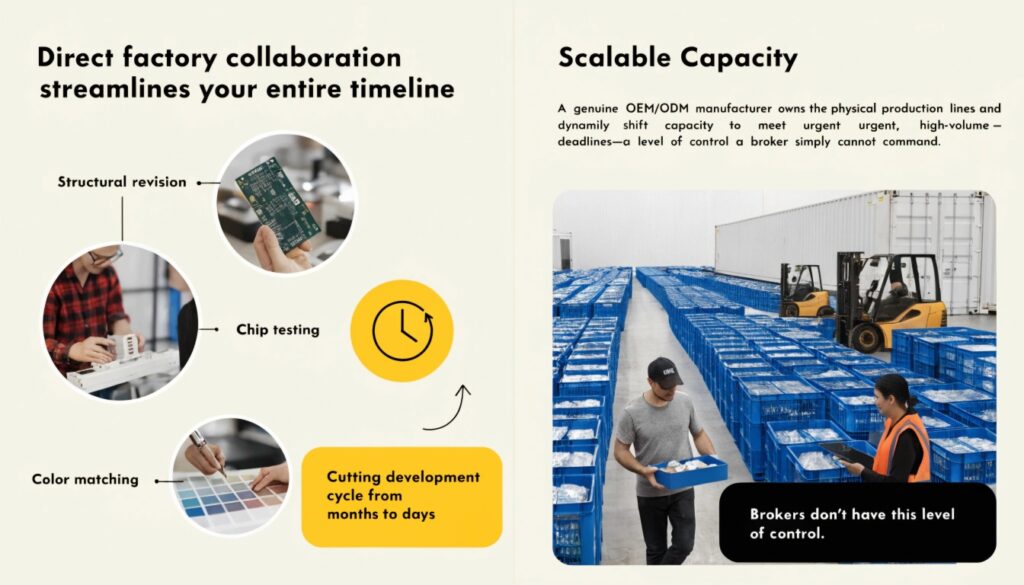
Direct factory collaboration streamlines your entire timeline:
- Rapid Prototyping: Structural revisions, chip testing, and color-matching adjustments happen in real time, cutting development cycles from months to days.
- Scalable Capacity: A genuine OEM/ODM manufacturer owns the physical production lines and can dynamically shift capacity to meet urgent, high-volume deadlines—a level of control a broker simply cannot command.
4. Total Cost Optimization (TCO) and True Value Engineering
While the most obvious benefit of eliminating the middleman is the removal of broker markups, the financial advantages of direct factory sourcing run much deeper.
| Sourcing Variable | Through Intermediaries / Brokers | Direct Factory Collaboration |
| Unit Pricing | Inflated by compounding agent commissions. | Factory-direct, optimized high-volume economies of scale. |
| Value Engineering | Standard catalog items only; cannot modify processes. | Can redesign card structures to lower costs without sacrificing security. |
| Quality Control Costs | Relies on third-party inspection; high risk of high defect rates. | Internal, rigorous testing (RFID testing, durability testing) at source. |
When scaling to hundreds of thousands or millions of units, saving even a fraction of a cent per card through factory-level optimization equates to significant capital savings that can be reinvested into project features or infrastructure.
Conclusion: Partnering for Strategic Success
Sourcing smart cards for a global brand or a national infrastructure project is not a simple transactional purchase—it is a long-term strategic partnership.
By bypassing trading entities and establishing a direct relationship with an experienced, certified security manufacturing facility, organizations gain full control over their product’s security, quality, and cost structure. Direct factory collaboration transforms your supply chain from a point of vulnerability into a powerful competitive advantage, ensuring your large-scale deployment is executed seamlessly, securely, and within budget.