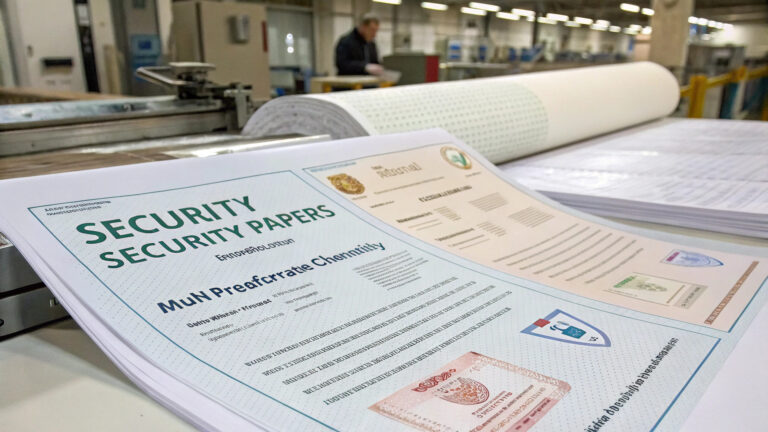
For most procurement teams, security paper is just another line item — until a batch of non-compliant stock fails a tender’s technical review, a counterfeit slips past your authentication check, or a regulator flags a document that was supposed to be tamper-evident. Specifying and sourcing anti-counterfeiting paper is not a purchasing formality; it is a control that protects your brand, your tenders, and your legal standing.
This 2025 buyer’s guide distills what a security-paper buyer actually needs to know: the national standards you should reference in a spec, the physical security features worth paying for, and a practical checklist for separating qualified suppliers from the many who simply resell commodity stock. If you are building or re-auditing a supply chain for certificates, banknotes, tax stamps, or brand-protecting documents, start here.
Why Compliant Sourcing Is a Procurement Risk, Not a Formality

The cost of getting security paper wrong rarely appears as a single invoice. It shows up as a rejected government or enterprise tender because the substrate could not demonstrate the required certifications, as counterfeit copies that pass a casual visual check, or as a liability event when a document meant to be tamper-evident is quietly altered. Counterfeiting and product fraud remain a multi-billion-dollar global problem that, according to Interpol’s intellectual-property crime programme, hit documents, labels, and certificates especially hard — exactly the items security paper is meant to protect.
For the buyer, the lesson is blunt: the cheapest quote is almost never the lowest risk. A supplier that cannot show the right license and test data is a future recall, not a saving. The sections below turn that risk into a checklist you can hand to any vendor.
The 2025 Standards You Must Spec Against

Before you write a request for quotation, anchor the spec to the standards a reviewer will check. In China, the relevant framework is published through the State Administration for Market Regulation’s National Standards Platform, with CQC certification covering many security-printing products. The three specifications most buyers should cite are:
| Standard | Scope | What it forces you to verify |
|---|---|---|
| GB/T 22258-2008 | General anti-counterfeiting product specs | Tamper-proof design and machine-readable features |
| GB/T 23808-2025 | Security films (windowed threads, laminates) | Alignment tolerance for embedded threads |
| JR/T 0153-2022 | Banknote / voucher durability | Fold endurance and fibre integrity |
Pair these with an internationally recognised process standard such as ISO 14298 (Management of security printing processes) if your output is banknotes, tax stamps, or certificates that cross borders. The goal is not to memorise the numbers — it is to demand, in writing, that each lot conforms to the specific standard your use case requires.
Core Security Features to Demand

Standards describe the bar; features are how you clear it. For most official-document and certificate applications, specify at least these three layers:
- Fixed watermarks — a design, logo, or portrait formed in the paper itself. A real fixed watermark is visible only when the sheet is held to light and is effectively impossible to photocopy or scan convincingly. See our explainer on what a security thread is and how it works for how threads and watermarks combine.
- Embedded security threads — windowed or fully embedded metallic or colour-shifting threads that can be magnetic or machine-readable. These are the elements durability standards such as JR/T 0153 implicitly rely on for authentication.
- Chemical and UV responses — fibres or coatings that react under UV light, giving inspectors a low-cost, high-confidence check at the point of use.
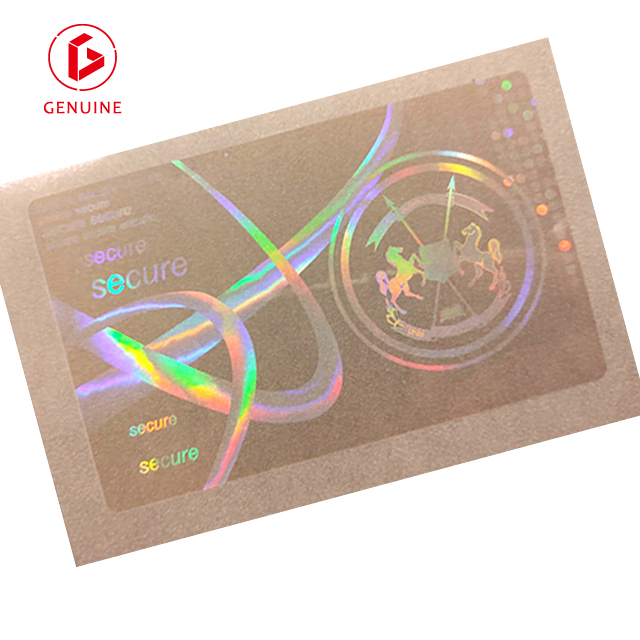
For brand-protecting labels and laminates, add a holographic or optically variable layer. Done well, it delivers a colour shift no flat print can match and acts as a public, self-checking authentication cue.
The substrate itself matters too: many certificates and vouchers still rely on cotton-based security paper for the tear and age resistance a wood-pulp sheet cannot deliver.
How to Vet and Audit a Security-Paper Supplier

A license file is easy to photograph; a capable, compliant factory is not. Use this three-step framework before you commit volume:
- Qualification check. Require a valid anti-counterfeiting manufacturing license and the relevant CQC certificate, plus evidence of conformance to the specific standard your product cites. Treat any supplier who cannot name the standard as a red flag.
- On-site or virtual audit. Ask for defect-rate reports (top-tier suppliers run at or below 0.3%), confirm in-line inspection equipment, and request recent client references you can actually call.
- Sample validation. Run accelerated-aging and UV-fluorescence tests on delivered samples before release. A supplier unwilling to ship test stock for third-party verification is telling you something.
If you want a broader view of the solution landscape before shortlisting, our top-10 anti-counterfeit packaging solutions guide maps the options worth comparing, and our certificate-paper customization guide covers specifying paper for credentials specifically.
Frequently Asked Questions
What certifications should a security-paper supplier hold?
At minimum, a valid anti-counterfeiting manufacturing license and the CQC certificate covering the product type (for example, holographic or security-printing products). For cross-border or high-value documents, ask for evidence of conformance to the specific GB or ISO standard your spec names.
Which security features give the best return for certificates?
A fixed watermark plus an embedded security thread is the cost-effective baseline for official documents. Add UV-reactive fibres for a cheap, public authentication check, and a holographic layer where brand protection or tamper evidence is the priority.
How do I verify a supplier’s claims without a full audit?
Start with certificates checked against the CQC database and the national standards platform, then request test samples for independent aging and UV testing. A credible supplier will ship samples willingly.
Is cotton-based security paper worth the premium?
For documents that must survive years of handling — banknotes, certificates, vouchers — yes. Cotton fibre resists tearing and aging far better than wood pulp, which is why it remains the substrate of choice for currency-grade stock.
Next Steps
Sourcing compliant security paper is ultimately about transferring risk off your desk and onto a supplier you can evidence. If you are scoping a new tender, re-auditing an existing chain, or just want a second opinion on a spec, talk to our security-printing specialists — we will review your requirements and ship evaluation samples so you can test before you commit.