A certificate is only as credible as the paper it is printed on. If your training center, university, or awarding body issues certificates on generic office stock, you face two costs that rarely show up on a budget line: forged credentials circulating under your name, and a brand that looks cheaper than the achievement it certifies. Customizing certificate paper fixes both — and done right, it costs far less than the reputational damage of a single counterfeit scandal.
This guide walks you through the decisions that actually matter when you customize certificate paper: the base stock, the security features worth paying for, the design elements that carry your brand, and how to vet a supplier before you commit to a print run.

Why Custom Certificate Paper Pays for Itself
Fake credentials are not a fringe problem. The U.S. Department of Education maintains a public warning system on diploma mills and credential fraud precisely because forged certificates undermine the institutions that issue real ones. For a business, the calculation is simple: every certificate that can be photocopied or reproduced in a design app is an invitation to counterfeit.
Custom certificate paper gives you three concrete returns:
- Verification you control. A custom watermark or registered security feature lets your staff — or an employer checking a credential — confirm authenticity in seconds, without a database lookup.
- Perceived value. Recipients keep, frame, and photograph certificates that feel substantial. That is free, durable brand exposure.
- Brand consistency. Paper tone, texture, and printed livery become part of your visual identity, the same way a banknote is recognizable before you read it.
Choosing the Base Paper: Weight, Fiber, and Finish
The base stock is where most buyers under- or over-spend. Three variables drive the decision:
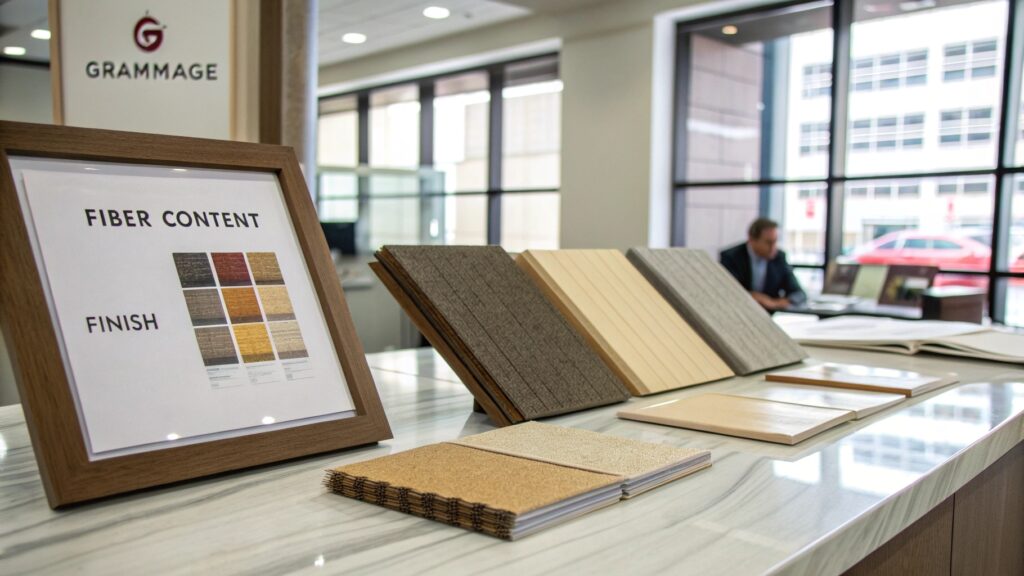
- Grammage. Certificates typically run 120–200 gsm. Below 120 gsm the document feels disposable; above 200 gsm you may pay for rigidity you don’t need and complicate folder or frame fit.
- Fiber content. Wood-pulp stock is economical for high-volume course certificates. For diplomas, share certificates, or anything meant to last decades, cotton or cotton-linen blends resist yellowing and tearing far better — the same reason currency is printed on cotton substrates. See our overview of custom features available for cotton and linen paper.
- Finish. Uncoated and laid finishes take embossing, foil, and wet-ink signatures cleanly. Glossy coated stock photographs well but can reject fountain-pen ink and feel commercial rather than ceremonial.
If you are still comparing stocks, our guide to choosing certificate paper breaks down the trade-offs by use case and budget.
Security Features That Actually Stop Counterfeits
Security is not one feature; it is layers. International guidance on authentication — including ISO 22383, the standard for selecting authentication solutions against counterfeiting — recommends combining overt features anyone can check with covert features only you can verify. For certificate paper, the practical menu looks like this:
- True (mould-made) watermarks — embedded during papermaking, visible against light, impossible to photocopy. The single strongest deterrent for the money.
- Security threads and UV fibers — invisible under normal light, instantly checkable with a UV lamp at your registrar’s desk.
- Holograms and foil seals — overt, tamper-evident, and hard to replicate without industrial origination equipment.
- Microprinting and guilloché borders — fine-line patterns that degrade visibly when scanned or reprinted, a technique borrowed from banknote and passport design standardized in documents like ICAO Doc 9303.
A realistic budget rule: two layers minimum — one overt (watermark or hologram) plus one covert (UV fiber or microprint). That combination defeats office-grade forgery, which is where most certificate fraud actually happens.

Design and Branding: Where Customization Shows
Security keeps forgers out; design makes recipients care. The elements worth specifying with your printer:
- Layout and hierarchy — recipient name and achievement should dominate; institutional livery frames rather than crowds them.
- Typography — engraved-style faces for tradition, restrained sans-serifs for modern programs; avoid more than two families.
- Color and foil — match brand colors in ink, and reserve foil for seals and borders where it reads as craftsmanship, not decoration.
- Pre-printed vs. print-on-demand zones — have the secure livery pre-printed on security stock, leaving a laser-safe zone for names and dates you print in-house.
For inspiration on standing out without sacrificing formality, see our design ideas for certificate paper.
How to Vet a Certificate Paper Supplier
The supplier decision carries more risk than any design choice, because security printing depends on process discipline you cannot inspect from a website. Before you commit, verify:
- Genuine security-paper capability — can they produce true watermarks and embedded threads, or do they only surface-print imitations?
- Controlled production and custody — ask how misprints and overruns are destroyed. Uncontrolled waste is how blank security paper leaks to forgers.
- Sampling policy — a serious supplier provides physical samples of your stock and features before full production.
- Advisory depth — good partners challenge your spec when a cheaper feature achieves the same protection.
Our checklist for finding the best certificate supplier covers the full due-diligence sequence, including the questions that expose resellers posing as manufacturers.

Frequently Asked Questions
What is the minimum order quantity for custom certificate paper?
It depends on the feature set. Surface printing on standard security stock can start at a few hundred sheets, while a custom mould-made watermark typically requires larger runs because the papermaking setup is amortized across the order. If your annual volume is modest, ask suppliers about stock watermark designs or combining orders across departments.
Can I print names and dates on security paper with a normal office printer?
Yes — this is the standard workflow. The security livery, watermark, and foil are produced by the supplier; the variable data zone is left clear for your laser or inkjet printer. Confirm the stock is rated for your printer’s fuser temperature, especially with foil or hologram elements near the print area.
Which security feature offers the best value if I can only afford one?
A true watermark. It is embedded in the paper itself, cannot be reproduced by scanning or photocopying, and requires no equipment to verify — just hold the certificate to the light. Holograms are a strong second choice where visual deterrence matters most.
How long does custom certificate paper production take?
Plan for two to six weeks depending on complexity. Surface-printed customization on existing security stock ships fastest; custom watermarks and origination of new holograms add lead time. Order well before graduation or award season, and keep a buffer stock for reprints.
Next Step: Put a Sample in Your Hands
Specifications only tell you so much — the weight of a 160 gsm cotton sheet and the snap of a real watermark have to be felt. Request a sample pack of certificate stocks and security features before you finalize any design, and bring your current certificate for comparison.
Tell us your volume, use case, and security concerns via our contact page, and we’ll recommend a paper and feature combination matched to your budget — with physical samples to prove it.