Your product ships on Monday. By Friday, a counterfeit version — same box, same logo, cloned photos — is selling under your name in a market you have never entered. For most B2B brands, a genuine hologram sticker is the fastest and lowest-cost authentication layer you can add: it gives distributors, customs officers and end customers a one-second visual check that no photocopier or desktop scanner can reproduce. This guide explains what security holograms actually protect you from, which features matter, how customization works, and what the ordering process looks like from artwork to delivery.
Why Hologram Stickers Are Still a First Line of Defense
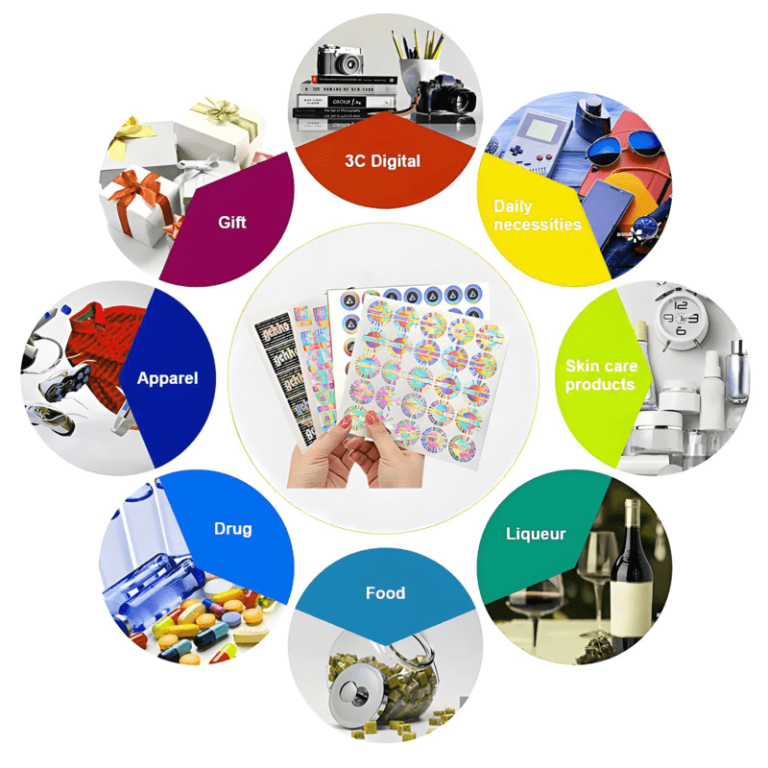
Counterfeiting is not a niche risk. According to the OECD and EUIPO, global trade in counterfeit goods reached an estimated USD 467 billion — about 2.3% of world imports, touching everything from cosmetics and electronics to spare parts and pharmaceuticals. If your product carries margin, someone is already studying how to copy it.
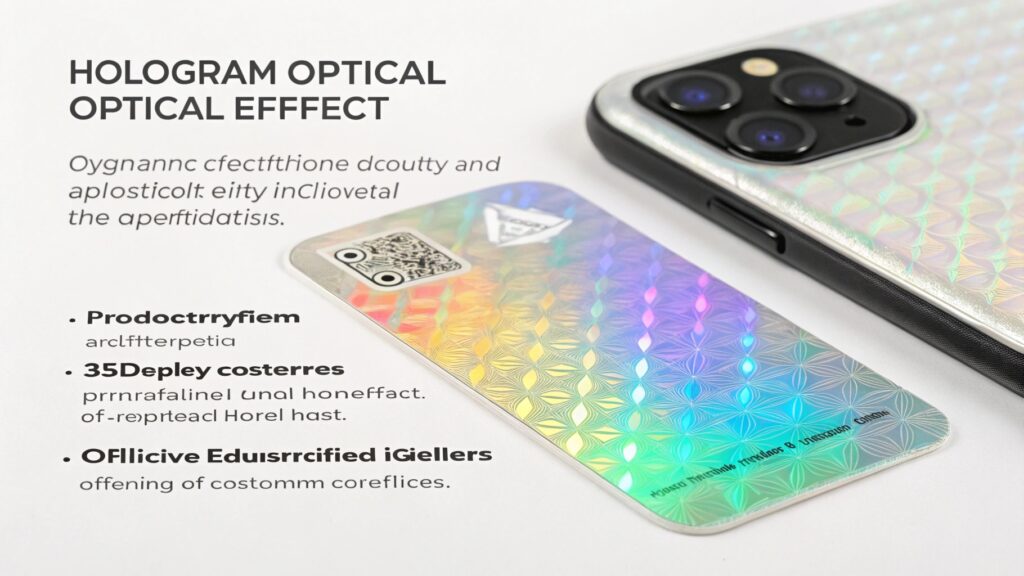
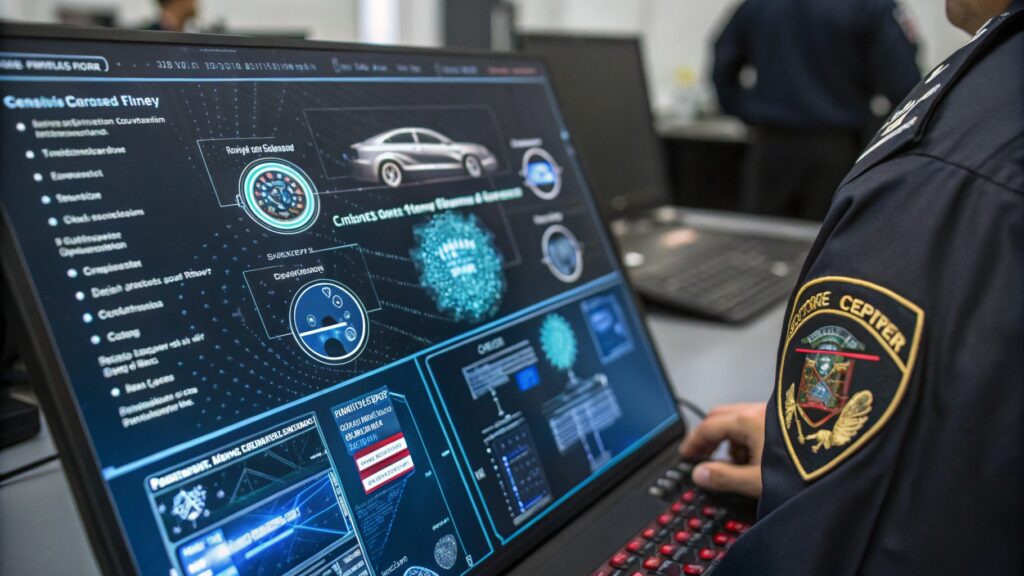
What a hologram sticker buys you is verification speed. Unlike batch codes or plain labels, a custom hologram cannot be reproduced by scanning or reprinting — the diffraction structure that creates its dynamic color shift and 3D depth only exists in the original master. That means:
- Distributors and retailers can confirm authentic stock on sight, without devices or training.
- Customs and market inspectors get an immediate visual cue when screening shipments.
- End customers associate the shifting optical effect with “the real thing” — which protects repeat sales, not just the single unit.
At volume, unit cost typically lands at a fraction of a cent to a few cents per label — one of the best cost-to-deterrence ratios among anti-counterfeit packaging solutions.
Three Layers of Security: Overt, Covert and Forensic
A well-designed security hologram is not a single effect but a stack of features aimed at different verifiers. International guidance — ISO 22383 — recommends selecting authentication elements by who will check them and under what conditions. In practice that means three layers:
- Overt features — dynamic color change, true 3D depth, kinetic movement, flip images. Verified by the naked eye in one or two seconds; this is what deters casual counterfeiters and reassures buyers.
- Covert features — microtext, hidden images, laser-readable elements visible only with a loupe, filter or laser pointer. These give your field inspectors and legal team evidence a copycat will not even know to fake.
- Forensic features — nano-scale structures and encrypted patterns that can be verified in a laboratory when a dispute reaches litigation or customs seizure.
The practical takeaway for buyers: never rely on a single overt effect. A hologram that combines all three layers costs only marginally more to originate, but multiplies the difficulty of imitation. If you are comparing formats, our guide to holographic labels and stickers breaks down which construction fits which product type.
Customization That Makes Copying Impractical
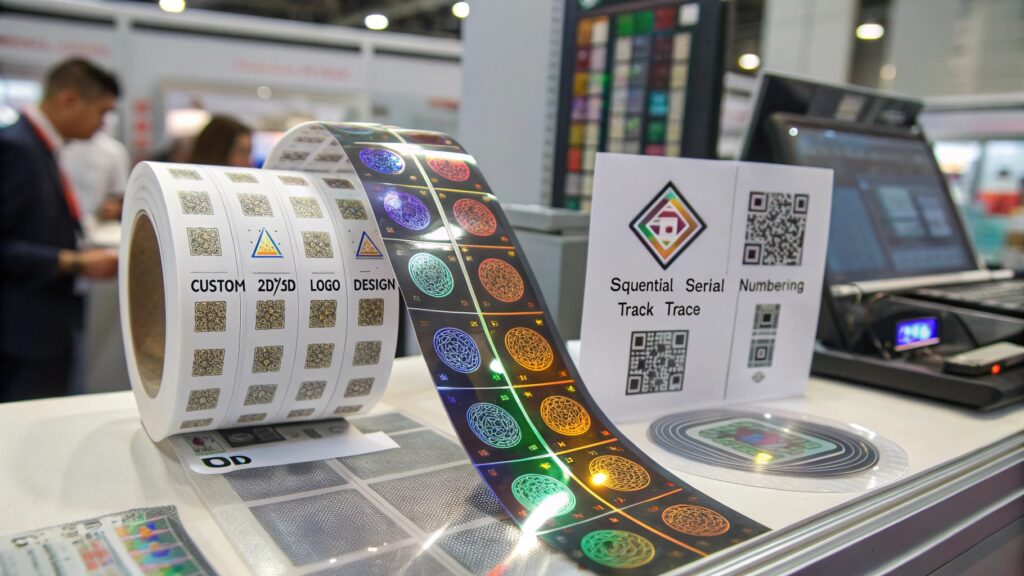
Generic “stock” holograms bought off the shelf offer little protection — counterfeiters can buy the same roll. Real security starts with custom origination: your logo and artwork are shot into a unique master that exists nowhere else. From that base, you can layer:
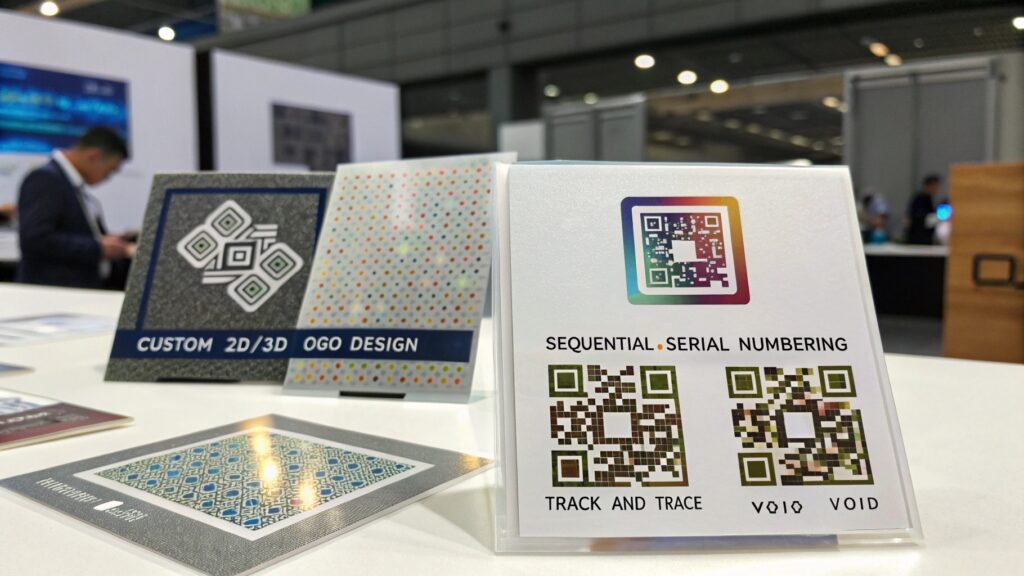
- 2D/3D and dot-matrix logo design — your brand rendered in depth and motion, doubling as a premium shelf cue.
- Sequential serial numbering — every sticker becomes individually identifiable, so a duplicated number exposes the fake batch.
- Printed QR codes for track and trace — each scan confirms authenticity and tells you where your product is being verified. Scan clusters in unexpected regions are an early warning of grey-market diversion.
- Tamper-evident release — VOID or honeycomb patterns that destroy the sticker on removal, so a seal cannot be transferred to a refilled or repackaged product.
Sample constructions from our production line:


If your documents or ID cards need protection rather than your packaging, a laminated hologram overlay may be the better construction — same optical security, different application method.
From Artwork to Delivery: What Ordering Actually Looks Like
Buyers new to security holograms often expect a complicated procurement cycle. The process is simpler than it looks:
- 1. Share your artwork and goals — logo files plus a short brief: what you protect, where it is verified, and by whom.
- 2. Security design proposal — our designers recommend the feature stack (overt/covert/forensic) and sticker construction for your risk level and budget.
- 3. Master origination and proofing — a unique hologram master is produced; you approve a physical or video proof before mass production.
- 4. Production and delivery — embossing, metallization, die-cutting and QC, then shipment worldwide. Direct shipping to your end customers or regional warehouses is available for resellers.
One vetting tip that saves buyers real money: check that your supplier operates under recognized security-printing management practices such as ISO 14298, and look for industry affiliations like the International Hologram Manufacturers Association (IHMA). A supplier without controlled master storage can become the leak that defeats your own security feature.
Frequently Asked Questions
Can you ship directly to my end customers?
Yes. If your customer buys through your local store or website, simply provide their address with your order and we ship to them directly — a practical option for resellers who prefer not to hold inventory.
I run a retail website. Can I use your product photos?
Yes. Contact us and we will send watermark-free product images and specification sheets you can publish on your own store pages.
What is the wholesale price for bulk orders?
Pricing depends on size, construction and security features, but as a factory outlet we quote direct production pricing with no trading-company margin. Email us your quantity and specifications for a same-week quotation; standard constructions are typically in stock for fast delivery.
Should I choose a hologram sticker or a hologram overlay?
Choose a sticker when you seal packaging, cartons or product surfaces and want tamper evidence. Choose an overlay when you protect printed data on cards or documents — it laminates over the surface. Many ID and certificate programs use both together; see our hologram overlay product page for specifications.
Get a Sample Pack Before You Commit
The fastest way to evaluate hologram quality is to hold it: tilt the sample, test the tamper release, check the covert features with a loupe. We provide sample packs of past constructions (with client-sensitive artwork removed) so your team can compare effects before originating a master. Request your sample pack and a free security design consultation here — tell us your product category and we will recommend a feature stack that fits your risk level and budget.