A shipment of RFID cards is sitting at the border while customs asks for radio-equipment documentation you never requested. A tender evaluation sheet lists CE and RoHS declarations as pass/fail criteria — and your shortlisted supplier cannot produce them. For B2B buyers, smart card compliance marks are not decorative logos: they are the paperwork that decides whether cards move, whether bids qualify, and who carries the liability when something goes wrong. This guide explains the four marks that come up most often — CE, FCC, REACH and RoHS — what each actually requires for smart and RFID cards, and how to verify a supplier’s declarations before you commit to an order.
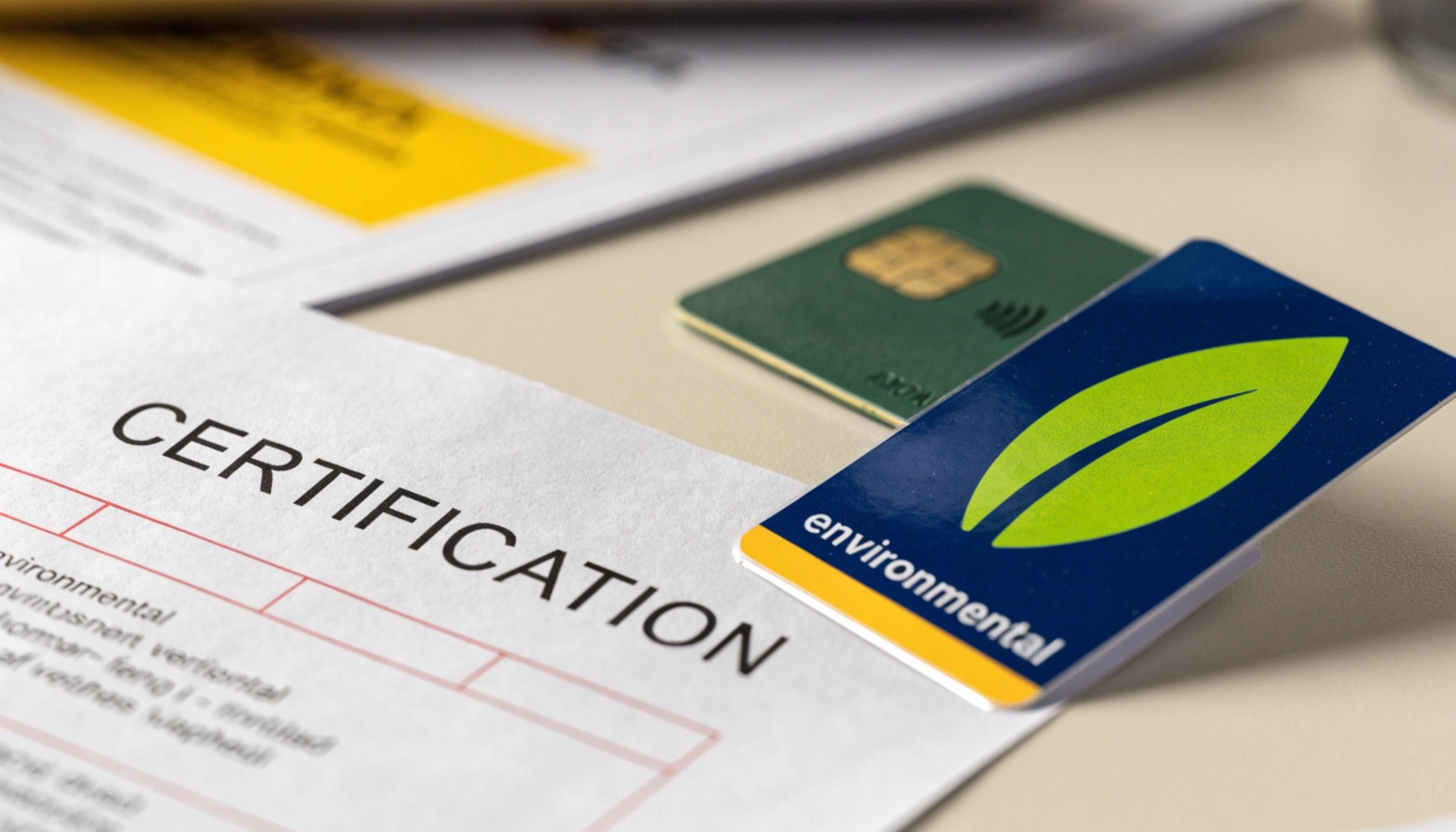
Why Compliance Marks Decide Whether Your Cards Clear Customs and Win Tenders
For a factory, a compliance mark is a stamp on a box. For you, the buyer, it is risk transfer. Three situations make the difference concrete.
First, import. Contactless cards contain an intentional radio transmitter — 13.56 MHz NFC or a UHF tag — and regulators treat them as radio equipment. Without the correct mark and its supporting declaration, shipments can be detained or refused at the border, and re-exporting a rejected batch is rarely cheap or fast.
Second, tenders. Public and enterprise procurement increasingly lists declarations of conformity as pass/fail evaluation criteria. Missing paperwork means disqualification, not a negotiation window.
Third, liability. If a non-compliant card causes interference or contains a banned substance, the importer of record — usually you, not the overseas factory — carries the legal and financial exposure.
The practical takeaway: treat compliance as a sourcing specification, not an afterthought. Request the relevant marks and declarations before you place the order, and write them into your acceptance criteria so a missing certificate becomes a rejected shipment — a problem with a remedy, and one your receiving team can catch with a structured shipment inspection checklist.

CE Marking: What the EU Requires for Smart and RFID Cards
The CE mark is the manufacturer’s declaration that a product meets applicable EU legislation. For contactless smart and RFID cards, the law that matters most is the Radio Equipment Directive (RED) 2014/53/EU, which covers any product that intentionally emits or receives radio waves — including 13.56 MHz NFC cards and UHF tags. Depending on the card’s electronics, the EMC and Low Voltage Directives may also apply.
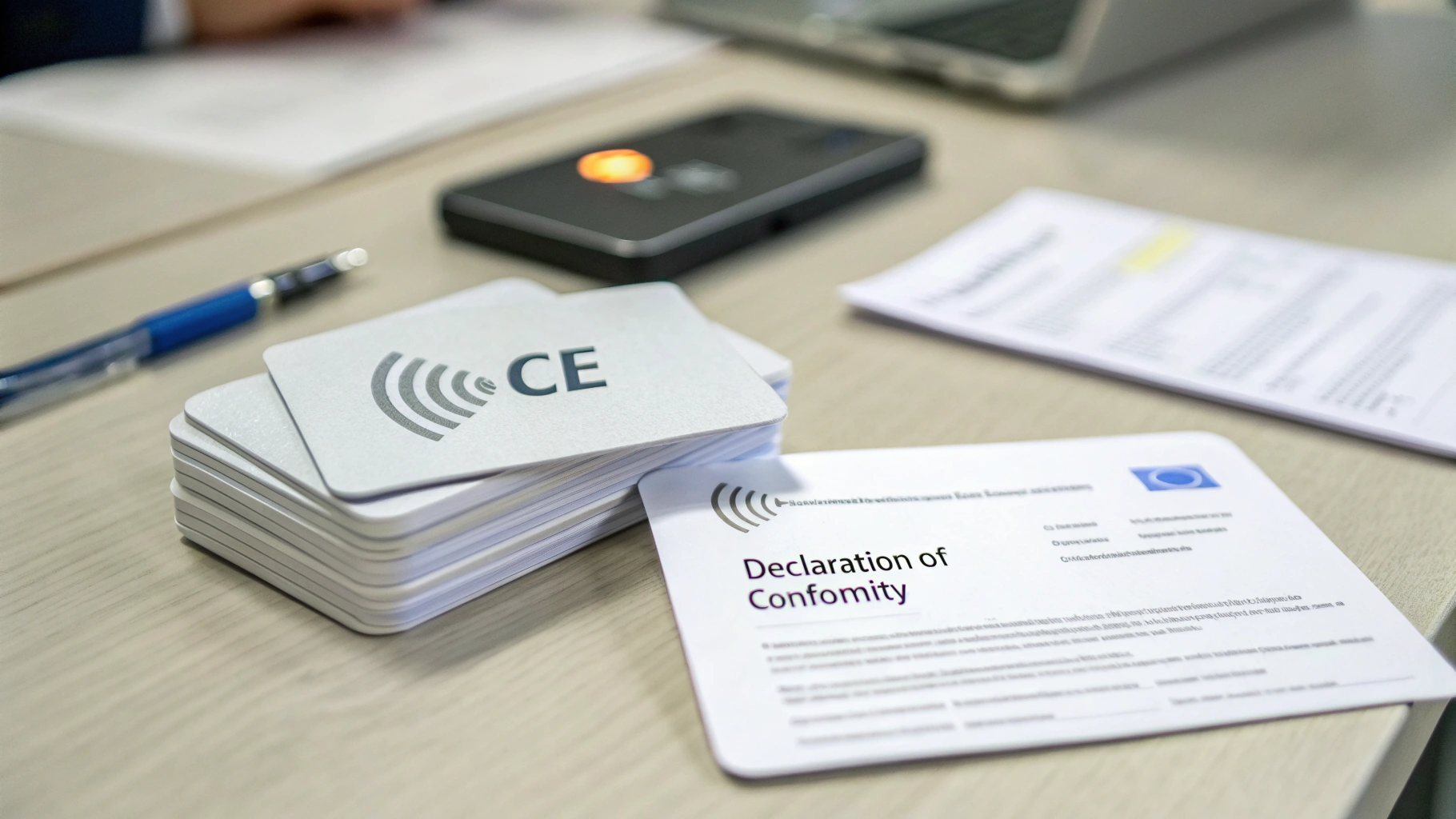
Here is what buyers most often get wrong: a CE mark on the card or its box is only valid if it is backed by a Declaration of Conformity (DoC) listing the applicable directives and the harmonised standards used — for 13.56 MHz proximity cards, typically EN 300 330 from ETSI. A logo without a matching DoC is not evidence of compliance; it is decoration.
When you specify CE for an EU-bound program, ask for the RED DoC and check that the referenced standards actually cover your card’s frequency and power class. The European Commission’s CE marking portal explains what a valid declaration must contain.
FCC Certification: Getting US-Bound Cards Past Part 15
In the United States, intentional radiators are regulated under FCC Part 15 (47 CFR Part 15). Most contactless cards fall under the intentional-radiator rules, and the compliance route depends on the device class: many low-risk devices qualify for a Supplier’s Declaration of Conformity (SDoC), while others require full FCC Certification with an FCC ID displayed on the product.
The part that catches importers out: responsibility for FCC compliance sits with the US-based responsible party or importer — not the overseas factory. If your cards arrive without an FCC ID where one is required, or without a valid SDoC backed by accredited test reports, the regulatory exposure lands on you, and US Customs can refuse entry.
For US-bound programs, confirm three things before ordering: which route applies to your card type, who will act as the responsible party, and that accredited-laboratory test reports exist and match your exact SKU.
REACH: The Chemical Rules Hiding Inside Your Card Body
REACH — the EU’s Regulation (EC) No 1907/2006 on chemicals — reaches far beyond laboratory substances. It covers the chemicals in plastics, inks, coatings and adhesives, which makes it directly relevant to anyone buying cards.
The provisions that bite are the Substances of Very High Concern (SVHC) candidate list and the phthalate restrictions that followed it. If a card body, overlay or inlay contains an SVHC above 0.1% by weight, that fact must be communicated to you as the downstream user. PVC softened with certain phthalates is the classic case: the plasticiser is legal in many markets but reportable — or restricted — in the EU.
In practice, ask for a REACH SVHC material declaration covering the complete card construction — core, overlay and inlay — not just the chip module. This matters for tenders with sustainability clauses, and it matters again at the end of the credential’s life, when restricted substances shape how retired cards must be destroyed and recycled.

RoHS: Keeping Restricted Substances Out of Your Electronic Cards
RoHS restricts hazardous substances in electrical and electronic equipment. The current version, RoHS 3 (Directive 2015/863), limits ten substances — including lead, mercury, cadmium, hexavalent chromium and four phthalates — to 0.1% by weight in each homogeneous material (0.01% for cadmium). The European Commission’s RoHS pages summarise the current scope.
A smart card with a chip and antenna is electronic equipment, so RoHS applies to it; a plain printed PVC card without electronics generally falls outside the directive. The trap is inconsistent scope: a buyer who assumes cards are exempt discovers too late that the RFID version of the same card is in scope.
Request a RoHS conformity statement and check that it names the exact SKU you are buying. A generic letter claiming that all products are RoHS compliant is worth very little in a customs audit or a tender review.

How to Read a Supplier’s Declaration of Conformity — and Spot the Red Flags
A DoC is only as strong as its weakest line. A credible declaration contains six things:
- The exact product model or SKU — not all smart cards
- The applicable directives with full references (RED 2014/53/EU; RoHS 2011/65/EU as amended by 2015/863)
- The harmonised standards with version numbers (for example EN 300 330)
- The manufacturer and, for CE, the EU authorised representative
- A dated signature from someone with authority to sign
- Traceability to accredited test reports the supplier can produce on request
Red flags worth rejecting a supplier over: a DoC that lists only CE with no directive; standards that do not match your card’s frequency; undated or unsigned documents; a template covering all products; or a factory that cannot produce the underlying test report. Treat a weak DoC as a procurement risk, not a formality — it is the first document customs officers and tender evaluators scrutinise.
The same document discipline applies to security credentials: our guide to evaluating a secure printing factory for tenders shows how to audit what a supplier claims, and our decode of Common Criteria, EMVCo and FIPS labels explains what those marks actually promise.

Baking Compliance Into Your RFQ and Acceptance Criteria
The cheapest place to fix a compliance problem is the specification, not the border. Put it into your RFQ and purchase order as explicit, checkable clauses:
- Required marks: CE (RED) for EU-bound shipments; the FCC route (SDoC or Certification) named for US-bound ones
- Required documents: Declaration of Conformity, REACH SVHC statement and RoHS statement — one per SKU, not one per catalogue
- Standards and frequencies named, so declarations cannot be generic
- An acceptance condition: missing or non-matching documents trigger rejection or replacement at supplier cost
- A named responsible party for FCC in the US market
Decide up front who pays for testing and re-certification, and verify the paperwork against physical samples before the bulk order — our card sample evaluation guide shows how, and the smart card RFQ template gives you clause structures you can copy directly.
Buyers who write compliance into the specification get cards that clear customs and pass tender audits. Buyers who assume the factory handles it are the ones whose shipments get held. If you would like a second pair of eyes on a supplier’s declarations — or compliant cards with the paperwork to match — talk to our team.