Most security programs spend years getting card issuance right and almost no time getting card retirement right. That gap is where credentials quietly leak. A decommissioned ID badge, access card, or smart credential is not “empty” the day it expires — it still carries every key, certificate, and persona it held on day one. If your end-of-life process is “drop it in the drawer and forget,” you have an uncontrolled copy of your physical-access and identity system sitting in a landfill. This guide walks B2B buyers through a secure card destruction and end-of-life plan that actually closes the loop: what is at risk, how to destroy it, what auditors expect, and how to choose a vendor who can prove it.
What’s Actually Stored on a Retired Card

Before you can destroy a card, you have to know what it holds. A modern credential is rarely just a photo and a number:
- Secure-element keys and certificates — private keys for PKI/PIV, symmetric keys for MIFARE or DESFire, and the certificates that bind the card to an identity.
- Personal data — names, employee or citizen IDs, biometric templates, and entitlement flags stored in card files or printed on the surface.
- Contactless and magnetic-stripe data — still readable with commodity tools even after the visual expiry date passes.
- Logical sessions and entitlements — building access, network logons, payment keys, or transit value tied to the credential.
A card that has reached its expiry date still carries every credential it held on day one. “Expired” only means the system may stop trusting it — not that the data is gone. Any recovered card can be replayed, cloned, or socially engineered back into a live system if the backend is not also deprovisioned.
Why the Office Bin Is a Data-Leak Incident

Throwing credentials into general waste is not housekeeping — it is improper disposal of personal and security data. The exposure is twofold. First, the physical risk: a recovered badge or card can be reused for tailgating, cloned at the reader, or replayed against a backend that was never told the card was retired. Second, the regulatory risk.
Discarding a live credential into general waste is treated as a personal-data breach under GDPR Article 33 — not an administrative oversight. Supervisory authorities expect organizations to apply “appropriate technical and organizational measures” to protect personal data (GDPR, Article 32), and that obligation extends to end-of-life. For U.S. federal and high-assurance programs, the same principle is baked into NIST FIPS 201-3 for PIV and PKI smart cards, where a lost or unaccounted credential is a reportable event. Payment-bearing cards add PCI DSS obligations on top.
Destruction Methods Compared: Shred, Incinerate, Degauss, Erase
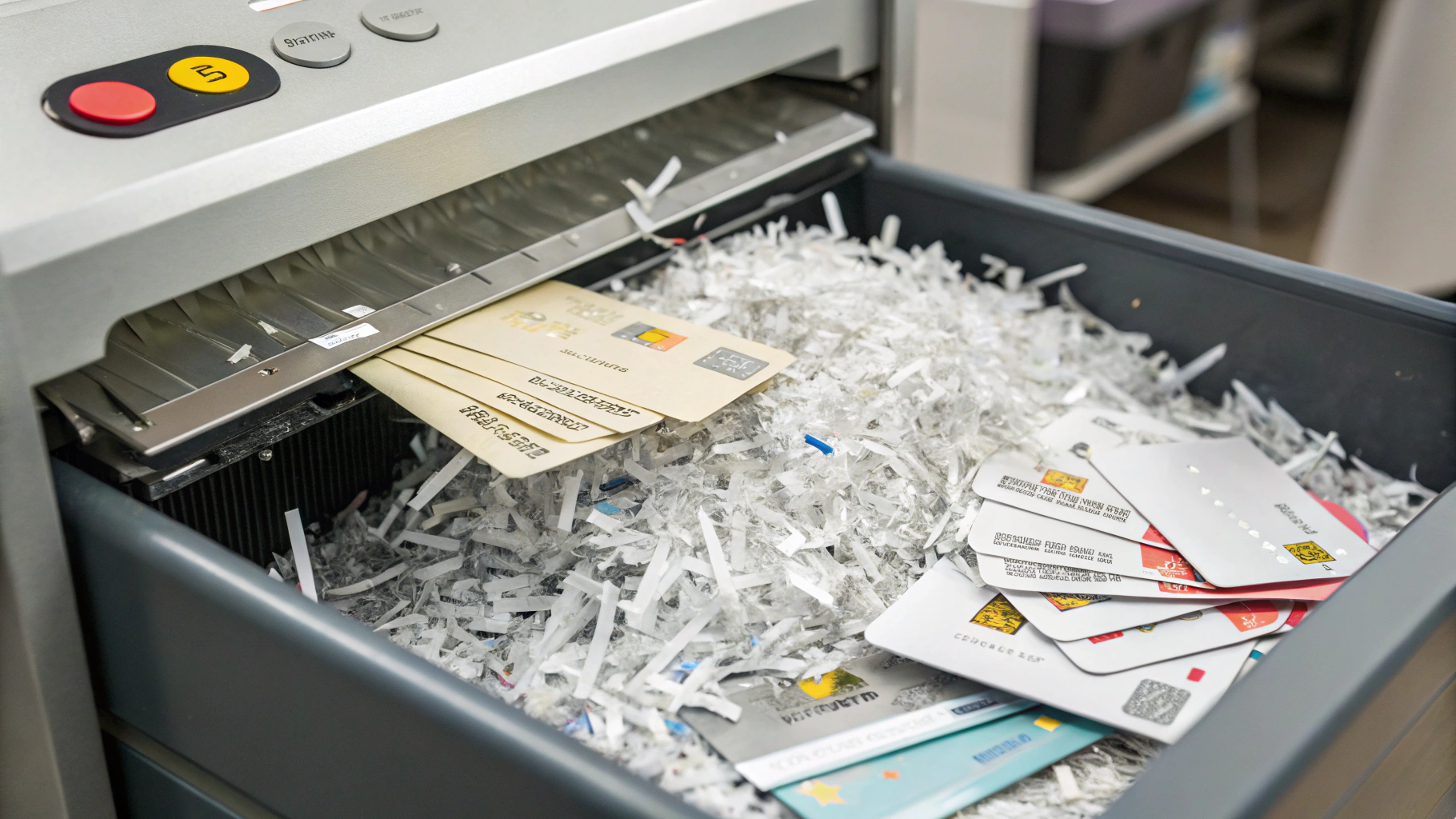
There is no single “shred it” answer. Match the method to the card type:
- Cross-cut / high-security shredding — the baseline for PVC/ABS bodies and magstripe cards. Spec the cut size to your risk level; NSA-style particle cut is appropriate for classified-adjacent programs.
- Incineration — total physical destruction for large volumes; pairs well with energy recovery but needs an emissions-compliant processor.
- Degaussing — only neutralizes magnetic-stripe data. It does nothing for a contact chip or contactless secure element, so never treat it as sufficient on its own.
- Cryptographic erasure — for intelligent cards, revoke and erase the credential logically before (or instead of) physical destruction. This is the only method that proves the key material is unrecoverable.
For smart cards with secure elements, physical destruction alone does not prove the key material is unrecoverable — pair it with cryptographic erasure logged in your key-management system. The NIST SP 800-88 Revision 1 media-sanitization guidance is the reference most auditors cite: it distinguishes clear, purge, and destroy, and tells you when a method is “not applicable” to a given media type. Plan your method from that matrix, not from whatever shredder is in the supply closet. Tie the logical side to your smart-card key-management practice so revocation and destruction are one auditable event.
Certificates of Destruction: What Auditors Expect

“We shredded them” is not an answer an auditor will accept. A proper Certificate of Destruction (CoD) should record:
- Chain of custody — who handled the cards from collection to destruction, with sealed-bag or bonded-courier evidence.
- Method and standard — the exact destruction method and the standard it meets (for example NIST SP 800-88 “destroy”).
- Serial or batch mapping — each card or batch tied to the record, not a vague volume.
- Date, location, and witness — when and where, signed by the destruction operator.
An auditor will not accept “we shredded them” — you need a Certificate of Destruction that maps each serialized card to a verified method and timestamp. This is exactly why serialization and numbering pays off at end-of-life: the same identifier that tracked the card from factory to issuer now closes the loop at destruction. CoD evidence also underpins your ISO/IEC 27001 information-security controls and satisfies the accountability principle in most data-protection regimes. Before physical destruction, deprovision the credential in your card-management system so the backend cannot be replayed.
Recycling and WEEE: Disposing of the Body, Not the Risk
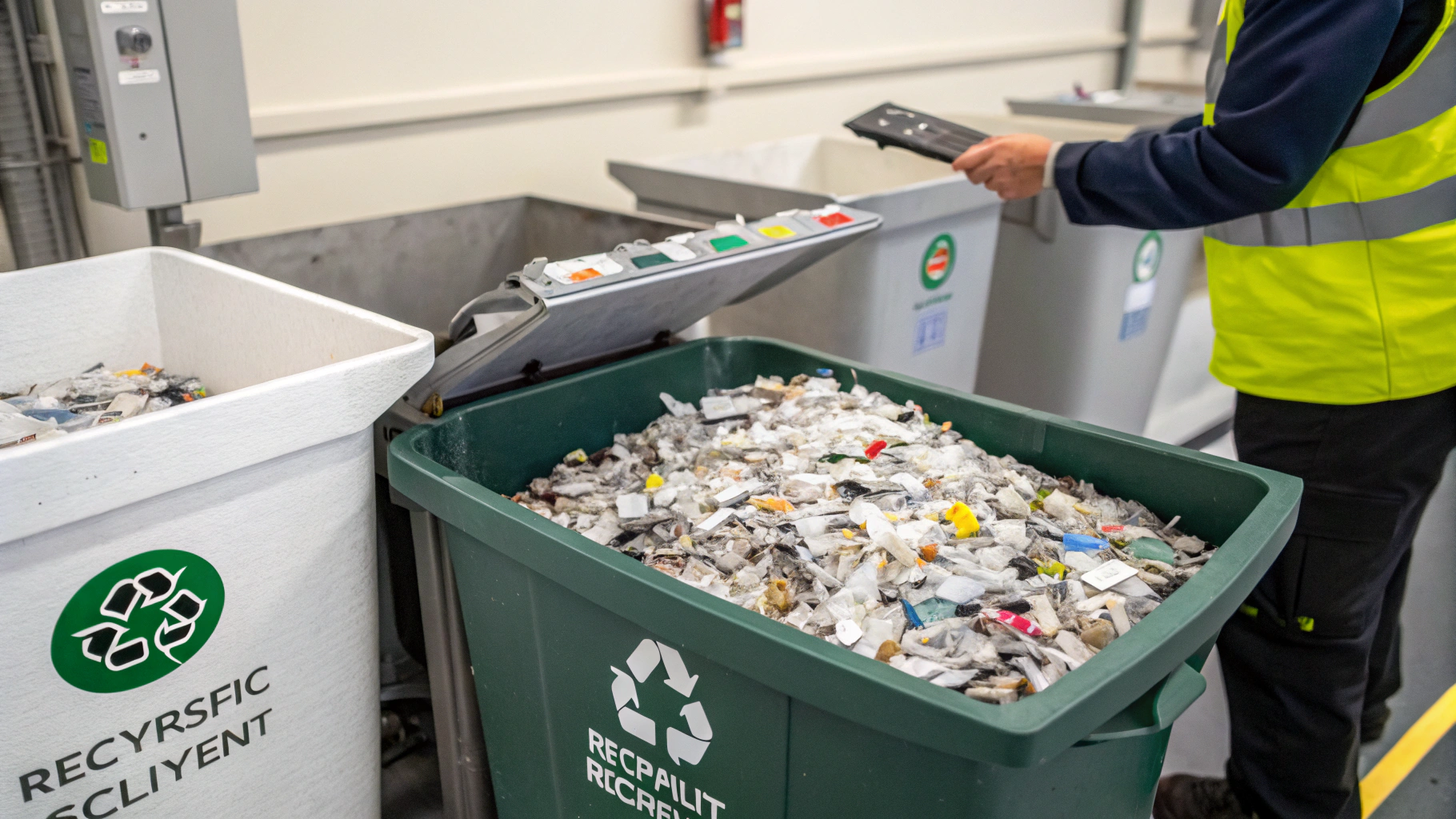
The card body is plastic and metal — and that makes it e-waste, not trash. Under the WEEE Directive, smart-card waste is classified as e-waste — the body must enter a compliant recycling stream, but only after the data-bearing components are sanitized. The right sequence is sanitize first, then recycle: never send an intact card to a recycler who is not also a vetted destruction partner, or you reintroduce the exact data risk you were trying to remove. Separate the chip/module from the PVC substrate where the processor supports it, and keep the recycling certificate alongside the CoD so environmental and security compliance are documented together.
Choosing a Secure Destruction Partner

If you outsource, the vendor is an extension of your compliance posture. Shortlist against this checklist:
- Certification — NAID AAA (for destruction) and/or ISO/IEC 27001 for the information-security management system.
- Destroy-at-source — on-site, mobile shredding/incineration so cards never leave your custody intact.
- Chain of custody — sealed transport, GPS-tracked custody, and a witnessed destruction step.
- Evidence — automated CoD with serial mapping, plus video or weight certificates for bulk jobs.
- Scope — one partner who handles both secure destruction and WEEE-compliant recycling, so you get one auditable trail.
Specify a vendor holding NAID AAA or ISO 27001 certification and insist on on-site, destroy-at-source destruction for high-assurance credentials. For PIV/PKI and payment-bearing cards, treat off-site transport of intact credentials as a last resort, not a default. Build the destruction clause into your card-procurement contract from the start so end-of-life is a line item, not an afterthought.
Build an End-of-Life Policy Before You Need One
Secure card destruction is not a one-off cleanup; it is a lifecycle stage that should be designed alongside issuance. The minimum viable policy: serialize cards at order, deprovision them in your card-management system the moment they are revoked, sanitize (logically and physically) against the NIST SP 800-88 matrix, recycle the body under WEEE, and keep a CoD that maps every identifier end to end. Do that, and a “retired” card becomes exactly what it should be — a credential that no longer exists, provably. If your current process cannot produce that evidence on demand, that is the gap to close first.