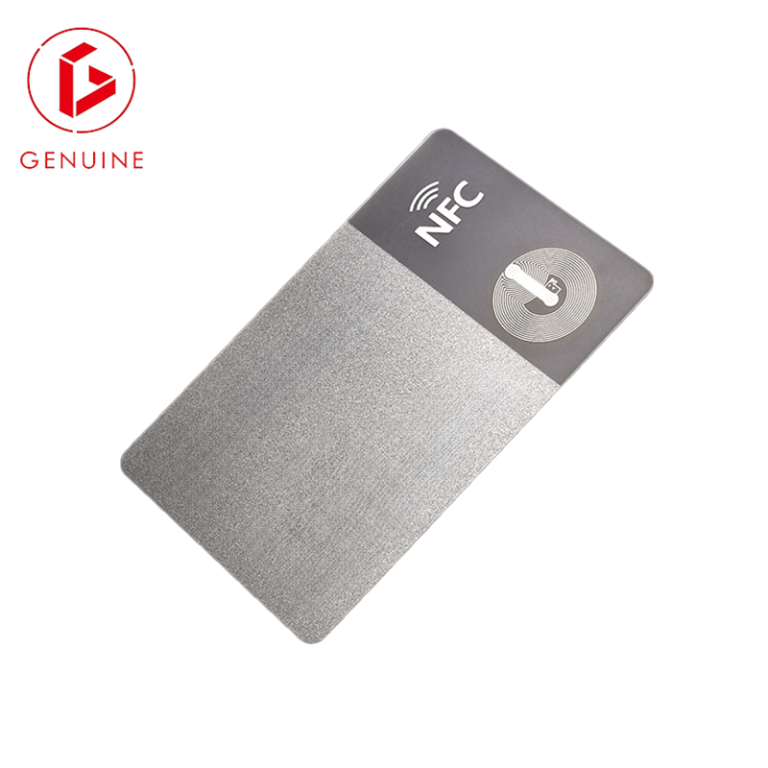
You asked your supplier to “encode the cards.” Three weeks later the boxes arrive — and half of them fail at the door reader. The problem was never the factory; it was one missing line in your purchase order. “Encode” can mean a magnetic stripe, a contact chip, a 13.56 MHz contactless inlay, or all three, and each follows a different standard with its own acceptance rules. This guide explains the three encoding standards B2B buyers actually specify — ISO 7811, ISO 7816, and ISO/IEC 14443 — in plain language, so you can write an RFQ a factory builds correctly the first time. If you already know what you need and want the procurement-ready version, start from our card encoding specification walkthrough.
Why “Just Encode the Cards” Is a Risky Instruction
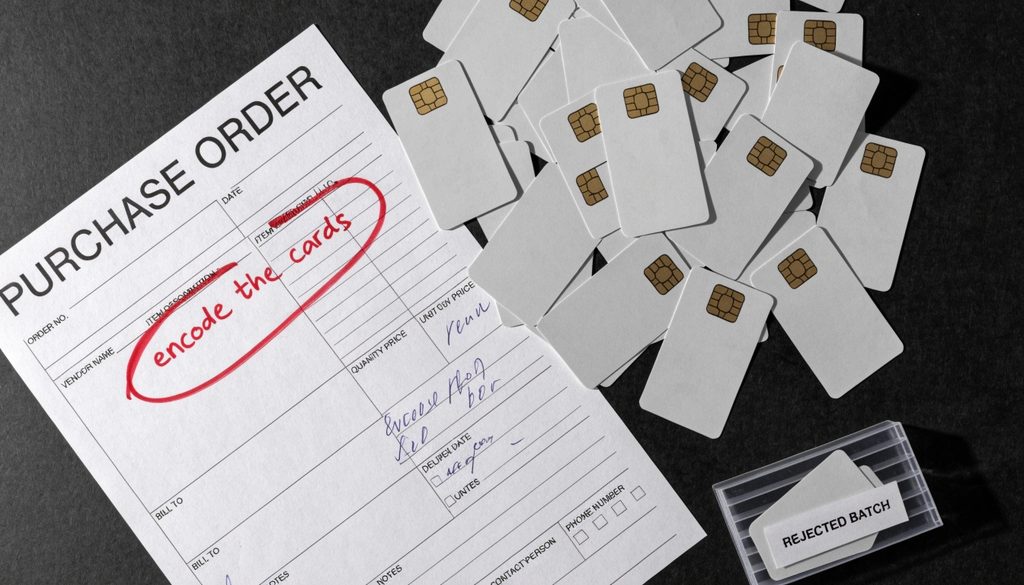
Encoding is not the same as printing. A card can carry several unrelated technologies side by side, and each one is governed by its own ISO standard, tested with its own equipment, and read by its own class of reader. When a purchase order simply says “encode,” the factory fills the gap with assumptions — and assumptions are where costly mismatches are born.
The failure modes are predictable:
- A contactless-only card shipped to a site whose readers expect a magnetic stripe.
- A LoCo stripe specified where HiCo was required, so the data erases near a speaker magnet.
- A contact chip delivered without the right ATR or applet, so the host system rejects it.
The most expensive encoding mistake is a vague purchase order: a single mismatched encoding specification can force a full re-issuance of every card in a program, plus the labor to recall and replace them. The fix costs nothing but a few precise lines in your RFQ.
ISO 7811 — Magnetic Stripe Encoding (and Why It Still Matters)
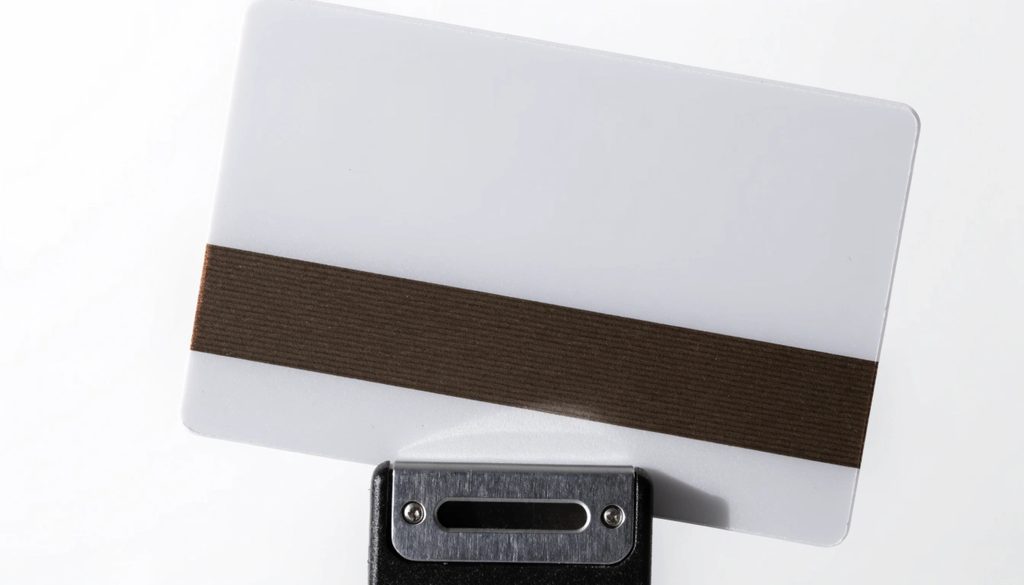
ISO 7811 defines the magnetic stripe on the back of a card: its physical properties, the three track positions, bit density, and the character encoding (typically ABA or MIL) used to record data. The spec that buyers most often get wrong is coercivity.
- HiCo (high-coercivity, ~2750 Oe) stripes resist accidental erasure and are the default for access control and payment-adjacent credentials; LoCo (~300 Oe) is cheaper but easily demagnetized by everyday magnets.
- Track 1 (often unused in access), Track 2 (the workhorse for banking and ID), and Track 3 (rarely used) each have defined densities and start/end sentinels.
Despite the rush to “smart,” the magnetic stripe is far from dead. Legacy readers — ATMs, older POS terminals, hotel locks, and many transit gates — still depend on it, and a card that drops the stripe can suddenly stop working at exactly the infrastructure you cannot replace. Specify the stripe deliberately, not by omission.
ISO 7816 — The Contact Chip: Reliable, High-Security Interface
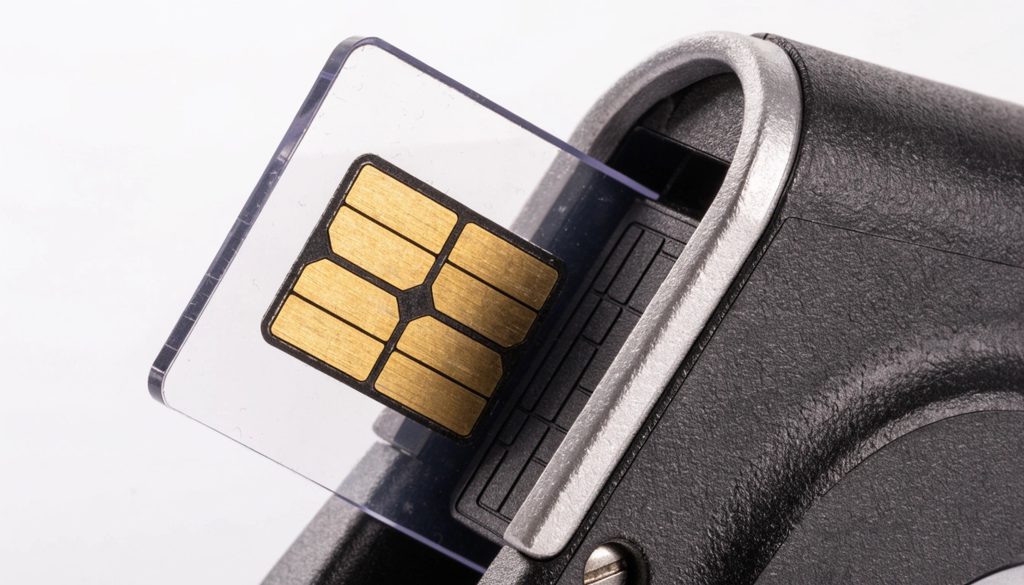
ISO 7816 governs the contact smart card: the eight-pad contact plate, the electrical interface, the Answer-To-Reset (ATR) handshake, transport protocols (T=0 / T=1), and the file structure (MF/DF/EF) addressed by APDU commands. Modern cards run a card operating system — Java Card or MULTOS — with applets managed through GlobalPlatform secure domains.
Contact chips remain the interface of choice wherever the highest assurance is required — government ID, banking, and PIV credentials — because the physical contact eliminates over-the-air skimming risk that contactless interfaces carry. In the U.S., the PIV standard (NIST FIPS 201-3) mandates a contact interface for federal identity cards, and payment schemes align their contact profiles through EMVCo.
When you buy contact-chip cards you are really specifying a mini-computer: the chip type, the operating system, the applets, the ATR your reader expects, and the secure element’s certification level. Our pieces on PIV and PKI smart cards and on dual-interface designs cover how these choices interact.
ISO/IEC 14443 — Contactless at 13.56 MHz
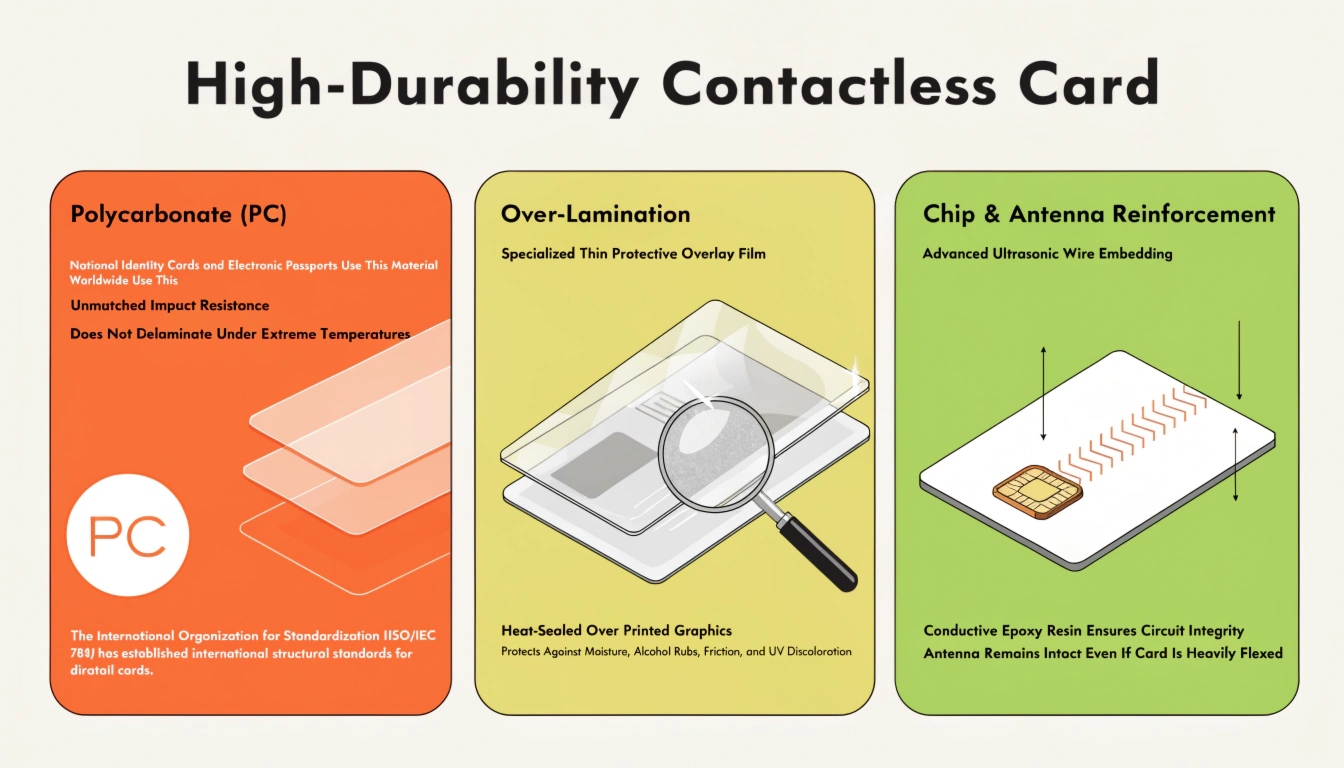
ISO/IEC 14443 defines proximity cards that talk at 13.56 MHz over a few centimeters (up to roughly 10 cm). It comes in two flavors buyers should know:
- Type A (used by MIFARE and most access systems) uses a simpler, asymmetric bit coding.
- Type B (common in banking and some government ID) uses a more robust, synchronous framing — calmer on a noisy RF environment.
ISO/IEC 14443 is the backbone of contactless employee badges, transit tickets, and payment cards; it enables sub-second tap transactions but trades some security assurance for convenience versus the contact interface. NFC (defined by the NFC Forum and built on 14443) is what lets a phone emulate or read these cards.
Two buyer traps sit here. First, do not confuse 14443 (proximity, <10 cm) with ISO/IEC 15693 (vicinity, up to ~1 m) — they are different standards for different read ranges. Second, chip choice matters: a MIFARE vs NTAG vs ICODE comparison and our frequency selection guide help you match the chip and band to the job.
Putting Them Together — Dual-Interface and Multi-Technology Cards
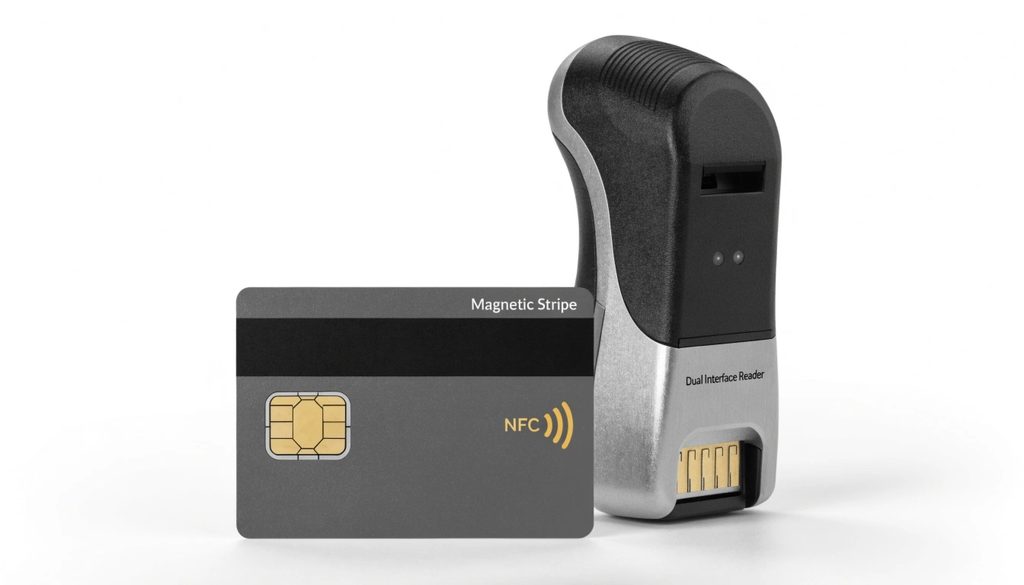
A single card can carry a magnetic stripe, a contact chip, and a 13.56 MHz contactless inlay — sometimes all sharing one secure element. A dual-interface card wires one chip to both the contact pads and the contactless antenna, so the same credential works in a contact reader and a tap reader.
Dual-interface cards let you migrate from contact to contactless without reissuing the credential — you pay once and keep both reader ecosystems working. The trade-offs are real: extra antenna layers add thickness and cost, and not every supplier can laminate a reliable multi-technology inlay. That is exactly why our dual-interface smart card guide walks through the build and qualification questions to ask a factory.
How to Write Encoding Into Your RFQ (Checklist)

Turn the vague line into a precise specification. For each interface your program needs, state:
- Interface(s): magnetic stripe / contact chip / contactless / dual-interface.
- Magnetic stripe: HiCo or LoCo, which tracks carry data, and the exact data format (ABA, MIL, or custom).
- Contact chip: chip family and OS, ATR or protocol (T=0/T=1), applet and file structure, voltage class.
- Contactless: 13.56 MHz, Type A or B, chip family (e.g., MIFARE DESFire, NTAG), memory size, and security level (plain, AES, or SAM-assisted).
- Acceptance: sample encoding verification and a reader-compatibility test on your own hardware before full production.
A reusable template lives in our smart card RFQ specification template, and the artwork side is covered in our card artwork specifications guide. The cheapest place to fix an encoding error is on the RFQ, not in a returned shipment. When the spec is tight, request samples and a quote — most reputable factories will personalize a small proof batch against your exact encoding before committing to volume.
Frequently Asked Questions
Can one card carry all three encoding types at once?
Yes. Multi-technology cards combine a magnetic stripe, a contact chip, and a contactless inlay — often through a dual-interface secure element — so a single credential works across legacy and modern readers.
Is the magnetic stripe obsolete?
No. Legacy infrastructure such as ATMs, older POS, hotel locks, and many transit gates still read stripes, so dropping it can break compatibility you cannot quickly replace.
Which is more secure, contact or contactless?
Contact chips generally offer the highest assurance because the physical contact removes over-the-air skimming; contactless adds convenience with managed risk and should be paired with strong chip-side security.
Do I need to specify the chip’s ATR?
Only for interoperable government or PIV programs where readers expect a specific ATR. For closed systems, the supplier can default it — but it should still be written into the RFQ to avoid ambiguity.
Encoding is the difference between a card that works on day one and a shipment you return. Pin down the interfaces your program actually needs, write them into the RFQ using the checklist above, and let a factory prove it on a sample before you scale. Need a second opinion on your specification? Reach our team or start from the RFQ template.