Every procurement officer now gets the same brief: make the card program greener. Then the questions arrive — what does “eco-friendly card” actually mean, will a recycled card still survive five years in a wallet, and how do you stop a supplier from dressing up ordinary PVC with a green label? A sustainable smart card is not one product but a set of material choices, each of which changes durability, printability, and sometimes reader behaviour in different ways. This guide compares rPVC, PLA, and recycled cores for ESG and tender compliance, and gives you the contract language that separates a real sustainability claim from greenwashing.
What “Sustainable” Actually Means for a Smart Card
Start by separating three different levers, because they are not the same thing and a supplier may quietly conflate them:
- Recycled content — part of the polymer comes from recovered material (post-industrial scrap or post-consumer streams).
- Bio-based content — part of the polymer comes from renewable feedstock (e.g. corn-starch PLA) rather than fossil PVC.
- End-of-life / circularity — the card is designed to be recovered, taken back, or more easily recycled after use.
A card can score on one lever and fail another. The only non-negotiable is that the finished card still meets ISO/IEC 7810 for ID-1 dimensions and 0.76 mm nominal thickness — your readers, printers, and slotting do not care about the marketing story, only about the physical card.
rPVC: Recycled Content Without Reinventing the Card
Recycled PVC (rPVC) is the lowest-risk entry point because it keeps the same polymer the industry has used for decades. The card body, the lamination, and the dielectric behaviour stay close to virgin PVC, which means your existing personalisation equipment and contactless reader energy budget are largely unaffected.
The real work is consistency. Recycled feedstock varies more than virgin resin, so you must specify a controlled grade and require the supplier to hold it batch-to-batch. Where the substrate choice meets government or high-assurance programs, the material trade-off is covered in our comparison of polycarbonate, PVC, and PETG for government ID.
PLA and Other Bio-Based Cores: The Real Constraints
PLA (polylactic acid, typically corn-starch derived) is the headline bio-plastic, and it is where most “green card” claims begin. The honest constraints are two:
Bio-based is not the same as compostable. Many PLA grades need industrial composting at specific temperature and humidity to break down, conditions a normal waste stream does not provide — so the card can still end up in landfill despite the “bio” label. Heat tolerance is lower, which matters because personalisation and lamination put the whole card surface under heat and pressure, and a rigid module or antenna inside the stack makes that worse.
The choice between dye-sublimation, re-transfer, and laser engraving behaves differently around bio cores, which is why the personalisation method matters even more on a sustainable card — see card personalisation methods compared.
Recycled PETG and Recovered-Core Programs
Recycled PETG (rPETG), often sourced from bottle streams, offers a step up in mechanical stability over rPVC while carrying meaningful recycled content. The more interesting model for large tenders is a recovered-core program: the manufacturer takes back decommissioned cards, recovers the core material, and feeds it back into new production under a documented chain of custody.
This only pays off at scale. A take-back loop needs volume, a collection logistics plan, and a supplier willing to certify the recovered fraction. For a 200-card pilot it is over-engineering; for a multi-year national program it can be the strongest claim you have.
What Each Substrate Changes: Durability, Printability, Reader Performance

This is the section demos skip. Each material changes three things:
- Durability. Some recycled blends and bio cores embrittle or delaminate faster under flex and heat. Do not accept “durable” as a word — require ISO/IEC 10373 dynamic bending and torsion results for the eco card specifically, not the supplier’s standard card, as we explain in writing card durability testing into your contract.
- Printability. Laser engraving and re-transfer behave differently on bio and recycled cores; approve a personalised physical sample before volume.
- Reader performance. Contactless energy harvesting depends on thickness and dielectric constant staying in spec. If the eco card holds ISO/IEC 7810 dimensions, read performance is normally unaffected — but verify on your own oldest readers, not the supplier’s bench.
Lifecycle: Will It Still Read in Five Years?
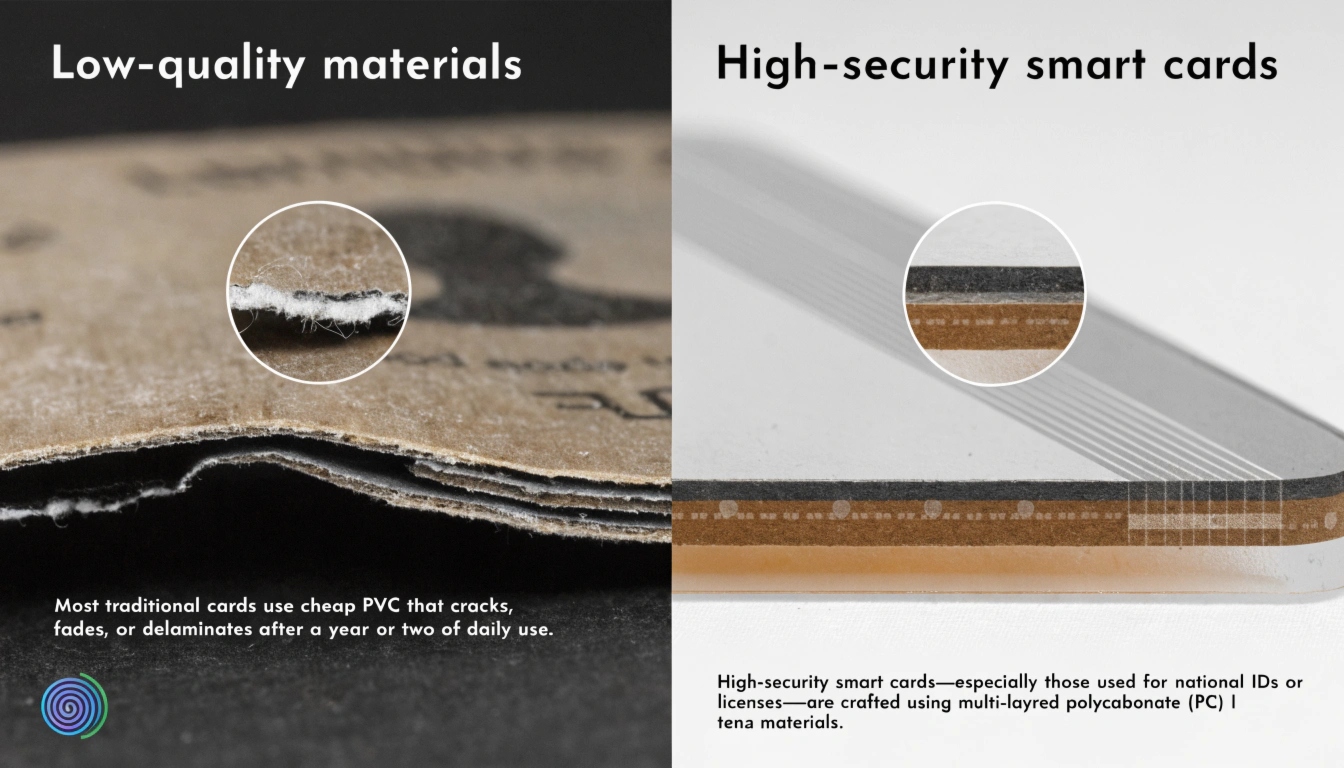
A sustainability win that fails at year three is not a win. Require accelerated aging and a stated service-life target for the specific eco formulation, and tie replacement cost into the total cost of ownership. For programs with a defined population and re-issue cycle, the lifecycle discipline is the same one described in building an ID card issuance program.
Tender Language to Demand
Vague “eco-friendly” language is unenforceable. Make the offer answer these points in writing:
- Stated recycled / bio-based percentage, with the basis of calculation (mass balance vs. physical content).
- A chain-of-custody or traceability certificate for the recovered fraction (for recycled plastics, schemes aligned with EN 15343-style traceability).
- ISO 14021-compliant environmental claims — self-declared claims must meet the standard’s rules, not just sound good.
- Third-party verification where available, and durability acceptance criteria that still apply to the eco card.
The EU’s Green Claims framework and card-security bodies such as GlobalPlatform are useful references when drafting what “evidence” means in your market; the European Commission’s environmental claims guidance explains why unverified claims are increasingly treated as greenwashing.
Greenwashing Red Flags

Watch for these during evaluation:
- “100% recyclable” with no collection infrastructure — recyclability is a property, not a fact about what happens to the card.
- Unspecified “eco” or “green” with no certificate — a colour and a leaf icon are not a claim.
- Bio-plastic presented as compostable when it needs industrial conditions the waste stream lacks.
- Recycled-content claims with no traceability — if a supplier cannot show a chain-of-custody certificate, treat the claim as unproven.
Substrate Quick-Reference
| Substrate | Recycled / bio content | Printability & heat | Reader compatibility | Best fit |
|---|---|---|---|---|
| rPVC | Recycled, variable grade | Close to virgin PVC | Unaffected if ISO 7810 held | Low-risk first step |
| PLA / bio-core | Bio-based | Lower heat tolerance, needs validation | Usually fine if thickness held | Marketing-led ESG, small runs |
| rPETG | Recycled, stable | Good mechanical stability | Unaffected if ISO 7810 held | Mid-to-large programs |
| Recovered-core loop | High, certified | Depends on core grade | Depends on core grade | Multi-year, high-volume tenders |
Frequently Asked Questions
Do sustainable smart cards work with our existing readers?
Almost always yes, provided the finished card holds ISO/IEC 7810 ID-1 dimensions and 0.76 mm nominal thickness. Contactless read depends on thickness and dielectric behaviour, not on whether the polymer is recycled. Still test on your oldest reader models, because that is where marginal cards fail first.
Is a PLA card compostable?
Usually not in practice. Many PLA grades require industrial composting conditions that ordinary waste streams do not provide, so the card can still end in landfill. If compostability is a real requirement, specify the exact certification and the disposal route, not just “bio-based.”
How do we verify a recycled-content claim?
Require a stated percentage with its calculation basis, a chain-of-custody or traceability certificate for the recovered fraction, and ISO 14021-compliant claim language. Independent verification turns a slogan into something you can defend in an audit.
Does going green hurt durability?
Only if you drop your durability acceptance criteria. The risk is not the material itself but failing to re-test the eco formulation to ISO/IEC 10373 for the specific card. Keep the same bending, torsion, and aging requirements and the trade-off is manageable.
Next Step: Specify Before You Buy
As a card manufacturer since 2005, we build card bodies, artwork, and personalisation around the substrate your ESG and tender targets require — and we will tell you plainly when a “green” option compromises durability or reader performance for your program. If you are scoping a sustainable card program, send us your requirements with your target recycled/bio content, expected volume, and reader models: we will recommend a substrate, prepare personalised physical samples on the actual eco core, and put durability acceptance criteria in writing so the claim is enforceable rather than decorative.