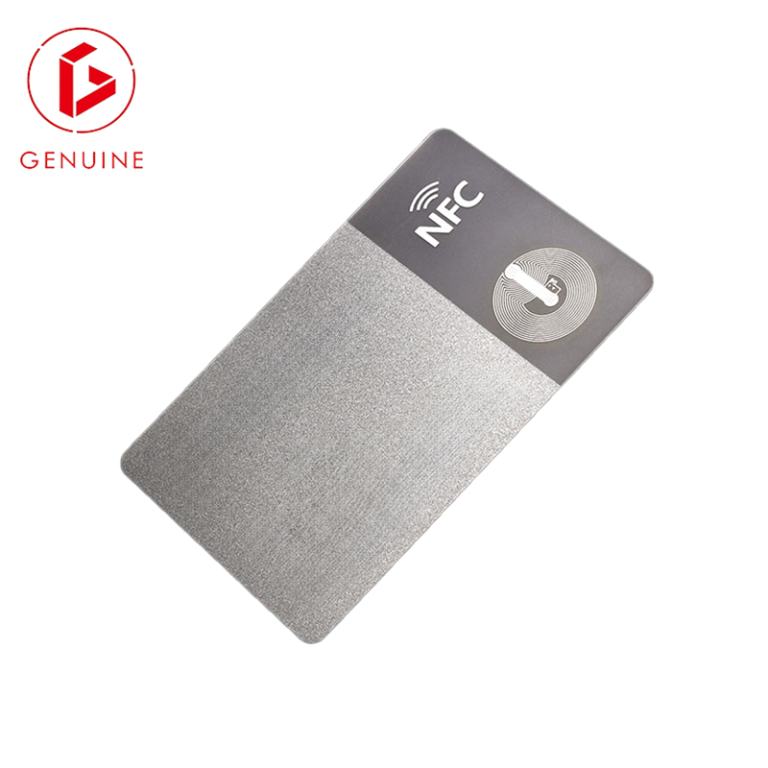
You have speced the card body, the chip and the print finish—and then someone asks: “Should this be RFID, NFC, or BLE?” On a smart or ID card, that single decision sets your read range, your reader budget, your phone compatibility, and how long the program survives its next technology refresh. Get it wrong and you re-issue every card in the field. This guide walks system integrators and procurement leads through the three wireless interfaces in plain terms, then maps each one to the jobs cards actually do: access, identity, payment, and attendance.
The interface isn’t a detail—it’s the backbone of your card program
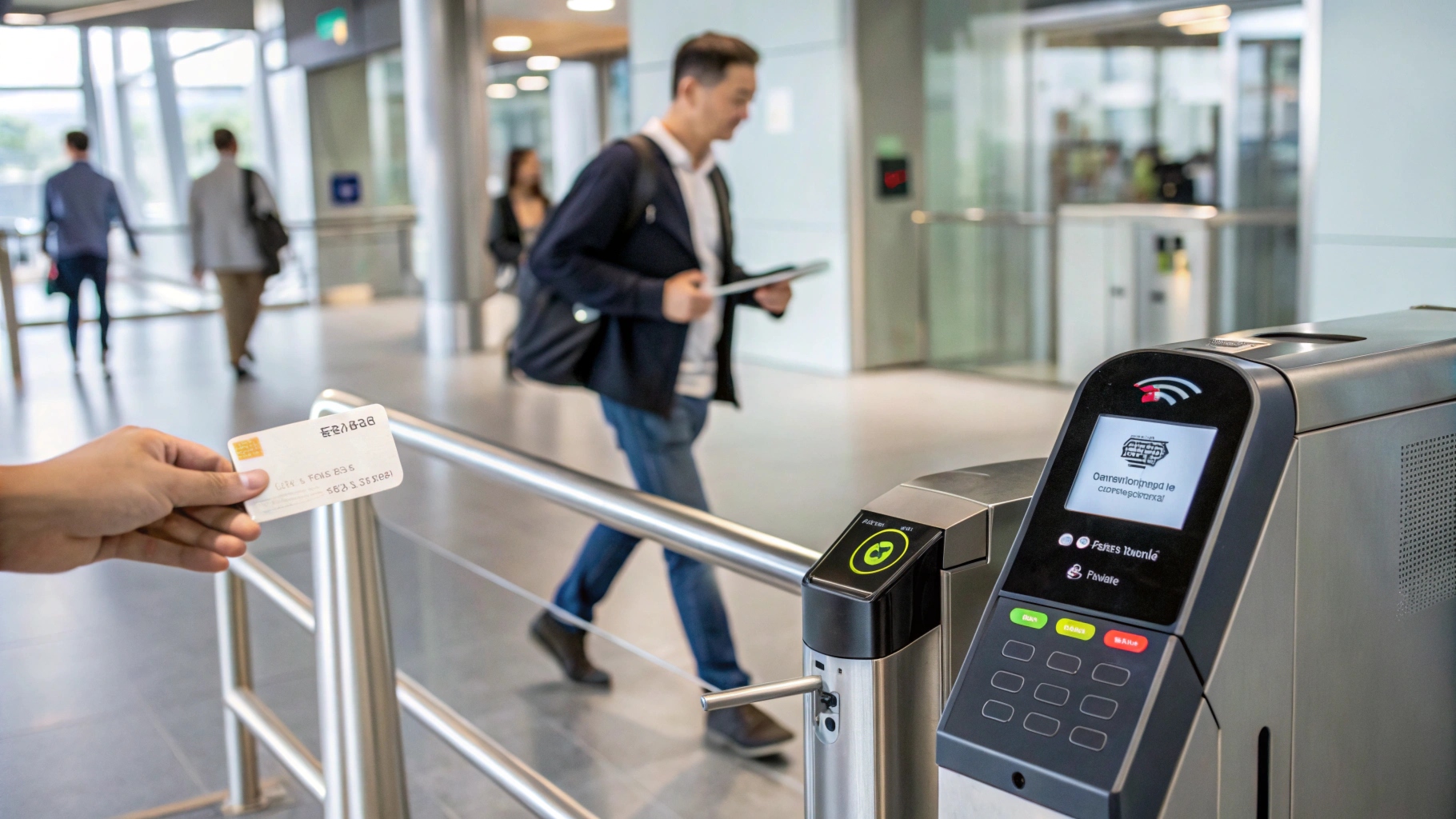
It is tempting to treat the wireless interface as a late-stage checkbox: pick a chip, drop it in the body, move on. In practice the radio is the part that defines the entire system around the card. The interface decides which readers you can use, how far away they work, whether a phone can read the card at all, and what security architecture you are locked into. Card dimensions are governed by a stable standard (ISO/IEC 7810:2019), but the wireless layer is where programs quietly commit to a vendor ecosystem for five to ten years.
The wireless interface—not the plastic—determines which readers, apps, and ecosystems your card can ever talk to. Change your mind after rollout and you are not swapping a component; you are re-printing, re-enrolling, and re-issuing every credential, plus the downtime that comes with it. That is why the interface deserves to be chosen first, from the use case, not last, from a price list.
- Reader infrastructure: HF readers, BLE gateways, or nothing but phones
- Read distance: a deliberate tap versus hands-free detection across a room
- Power and maintenance: battery-free versus a coin cell you must eventually replace
- Phone compatibility: readable by every smartphone, or only by dedicated hardware
- Security model: the silicon and protocol that actually protect the credential
RFID, NFC and BLE in plain terms—where each gets its power
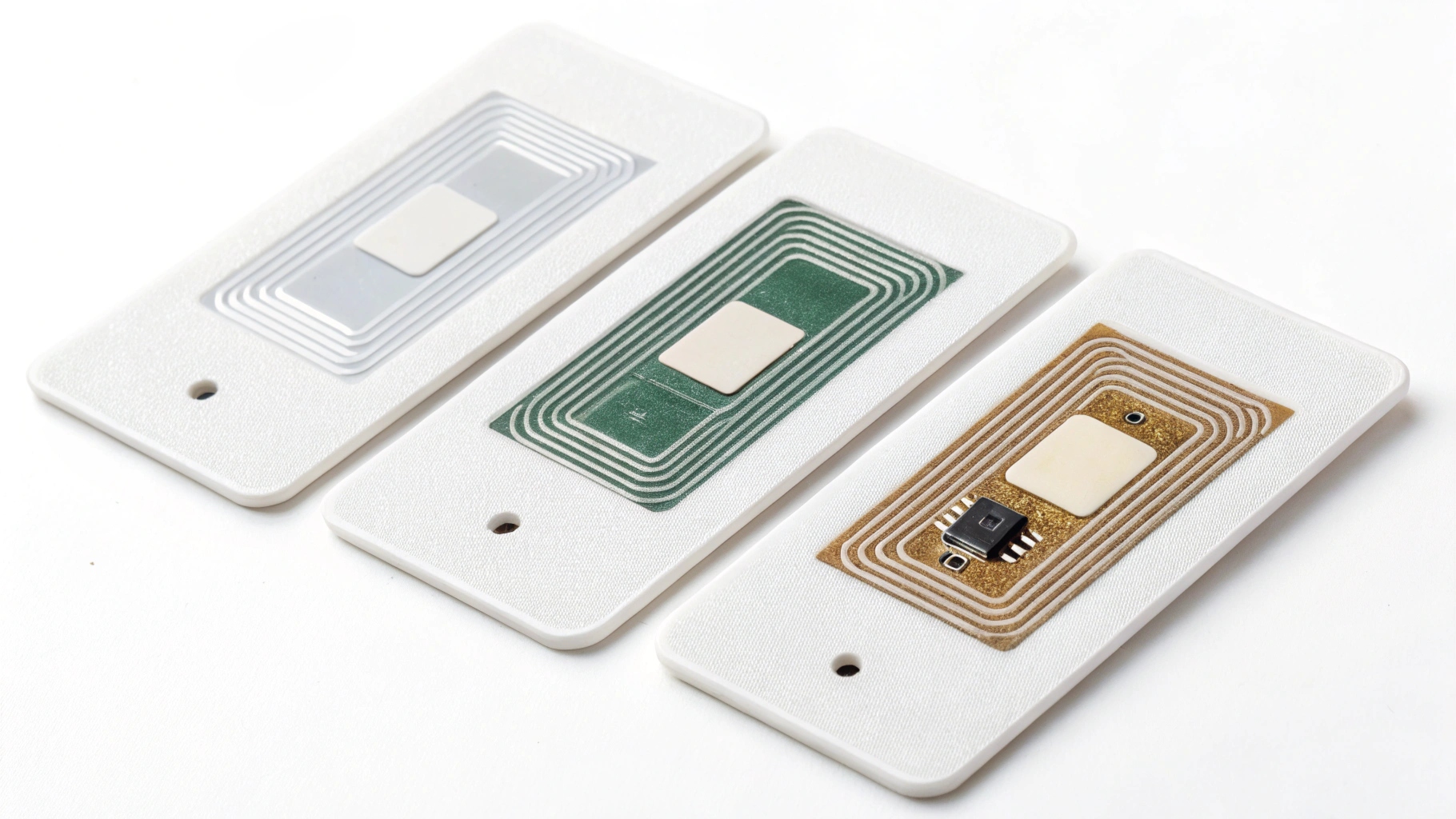
The three terms get used as if they are three rival radios. They are not quite that. Two of them share the same frequency, and the difference is mostly about standards and ecosystem.
HF RFID (13.56 MHz, ISO/IEC 14443) is the workhorse of access and ID cards. It is passive: the card has no battery and is powered by the reader’s electromagnetic field, which also limits range to roughly 0–10 cm. This is the technology inside MIFARE, DESFire, and SEOS credentials, and it is what most door readers already speak. The NFC Forum and the underlying ISO standards are the reason these cards interoperate across vendors.
NFC is not a separate radio. It is a standardized operating mode of that same 13.56 MHz HF band (ISO/IEC 18092), with a defined data format (NDEF) and a crucial property: every modern smartphone can read and write NFC without any extra hardware. So when a buyer asks for an “NFC card,” what they usually mean is an HF 14443 card that phones can understand. NFC adds phone interoperability and a predictable data layer; it does not add range.
BLE (Bluetooth Low Energy) is the odd one out. It is active: the card needs a coin-cell battery or harvested power, which pushes range out to roughly 10–30 m and enables two-way communication, higher data rates, and real-time location through a phone app or gateway. That capability comes with a bill—battery, extra thickness, a finite life, and a replacement logistics plan. The Bluetooth SIG maintains the specification behind it.
Read range and the real environment—metal, liquid, and crowd density
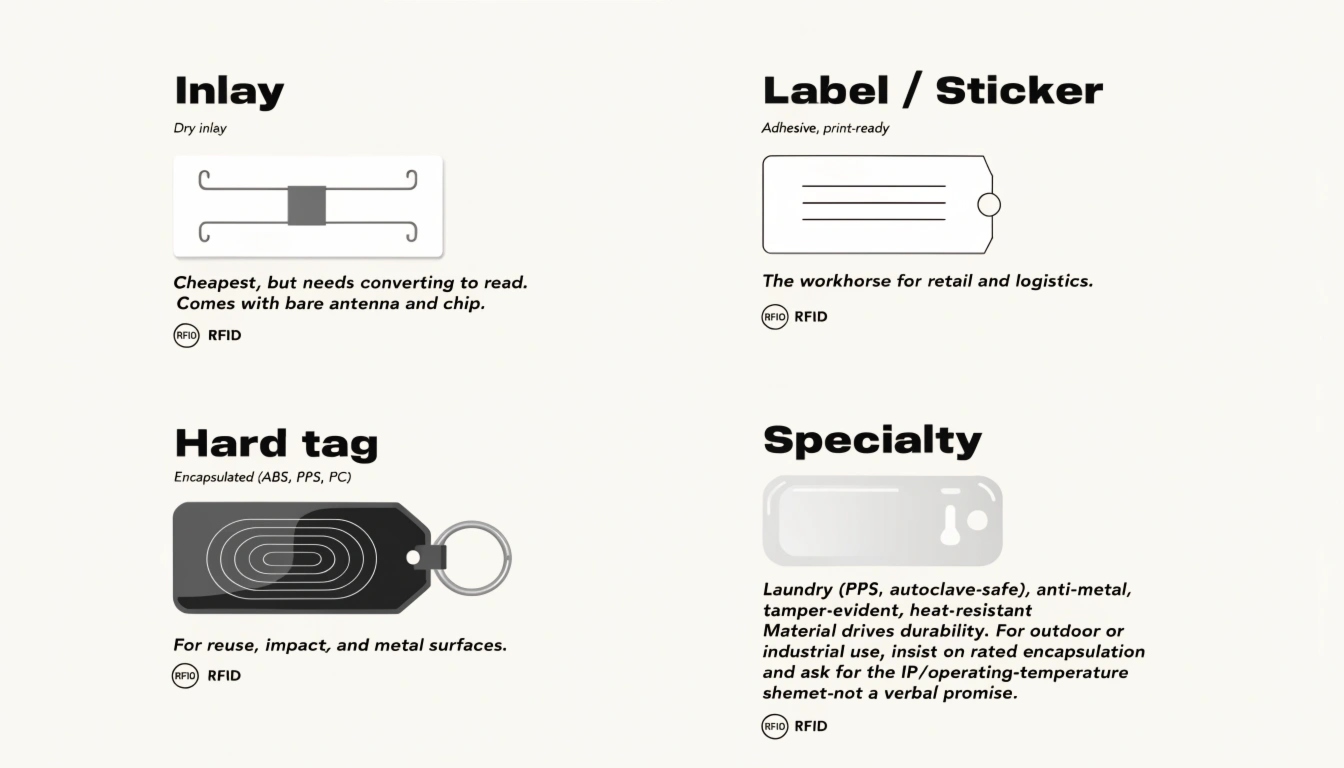
Spec sheets love to quote “up to” ranges. In the field, the environment writes the real number. Passive HF cards read best with a clean, deliberate tap; their short range is a security feature, not a defect, because it is hard to skim a credential from across a room. But that same field collapses near metal and water—a card next to a metal badge reel or inside a wet wallet reads worse than the datasheet promises.
BLE flips the problem. Its longer range is genuinely useful for hands-free attendance or mustering, but the signal is attenuated by the human body holding the card and by crowded spaces, so a card in a back pocket reads very differently from one on a lanyard. And for cards specifically, long-range UHF RFID—the technology built for tags and asset tracking—is rarely the right answer for a tap-and-go credential. We cover the frequency trade-offs in our LF vs HF vs UHF frequency guide.
For a card people tap, long range is usually a liability, not a feature—it invites relay attacks and accidental reads. Choose range because the use case demands it, not because a bigger number looks impressive on a slide.
The true cost of ownership—per-card silicon vs reader infrastructure
Unit price is the least interesting number here. The total cost of ownership is what bites.
- Passive HF inlay: from a few cents for a basic 1k MIFARE up to a few dollars for a secure DESFire element. No battery, no maintenance, essentially unlimited service life.
- BLE module: typically several dollars plus a battery and extra assembly, adding roughly 2–4 mm of thickness. The battery dies in one to three years, so the card must be replaced or serviced on a schedule you now own.
- Readers: HF readers run from tens to a few hundred dollars and are already deployed in most buildings. BLE “long range” usually means phones (free for ad-hoc reads) or BLE gateways at tens to hundreds of dollars each, with real coverage-planning work behind them.
The expensive part of a BLE card is never the card—it is the gateway network and the battery logistics you did not budget for. Our 2026 RFID pricing guide breaks the line items down so a quote can be read, not just accepted.
Which interface fits which job: access, identity, payment, attendance
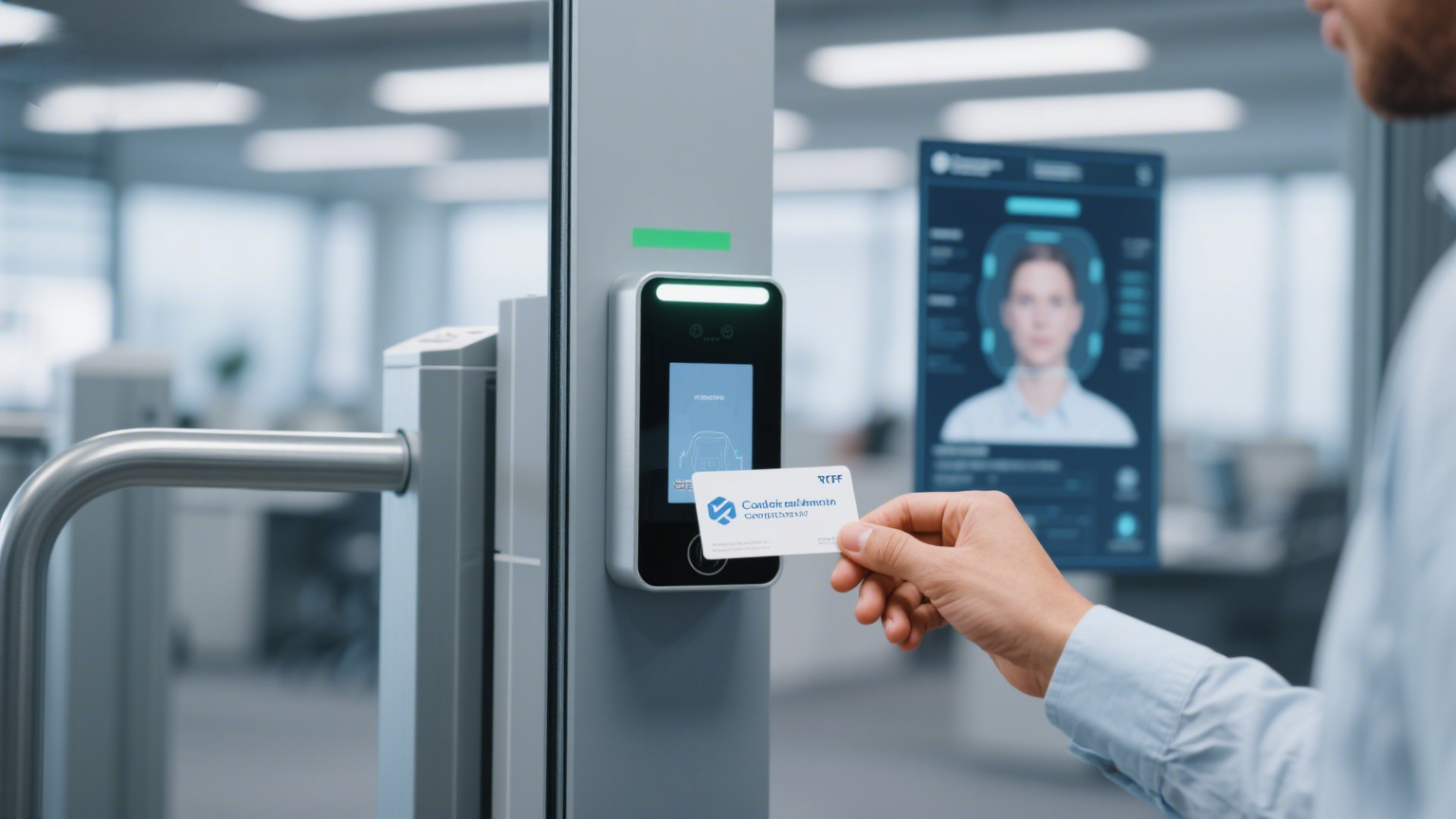
The fastest way to choose is to start from the job, not the technology. Match the interface to what the card is actually asked to do.
| Use case | Best interface | Why | Watch-out |
|---|---|---|---|
| Access control (door) | HF 14443 (MIFARE / DESFire / SEOS) | Proven, secure tap, huge installed reader base | Legacy 1k cloning risk—use secured silicon |
| Logical identity (PKI, SSO) | HF/NFC smart card with secure element | Standardized crypto, phone-readable certificates | Enrollment and lifecycle complexity |
| Payment / closed-loop campus | EMV Contactless (HF 14443) | Globally standardized and interoperable (EMVCo) | Certification cost and timeline |
| Attendance / mustering | HF tap (cheap) or BLE (hands-free) | Tap for gates; BLE for automatic, no-touch reads | BLE battery life and gateway coverage |
| Long-range people/asset tracking | BLE or UHF tag | Range is the requirement | Not a “tap card” user experience |
If your readers are already installed and your users already tap a card, an HF or NFC credential almost always wins on cost, security, and simplicity. Reader compatibility is the trap most programs fall into, so start your spec from the readers you have—our employee ID card buyer’s guide shows how to audit them before you buy.
Dual-interface and coexistence—combine without lock-in

You do not have to pick exactly one. Dual-interface cards—contact plus contactless 14443—are already standard in banking and national ID, and NFC-plus-BLE combinations are appearing for “tap now, track later” programs. Coexistence is legitimate when a real transitional need exists: a building migrating from one reader standard to another, or a campus that wants tap today and hands-free attendance tomorrow.
The trap is specifying the extra radio “because it is newer.” Adopt dual-tech only where a real transitional need exists—otherwise you pay for a radio you never use, plus the battery and thickness that come with it. When you do adopt it, set a sunset date for the legacy side up front, and always test phone compatibility (NFC) before rollout, because that is the property most buyers forget to verify until a stakeholder shows up with the wrong handset.
Frequently asked questions
Is NFC the same as RFID? Functionally, NFC is a standardized subset of HF RFID at 13.56 MHz. The practical difference is that NFC is readable by every smartphone and carries data in a standard NDEF format, while “RFID” covers a broader family of chips and readers, some of which phones cannot see.
Can a phone read my RFID card? Only if the card is NFC or ISO/IEC 14443-A. Many legacy LF 125 kHz cards and some proprietary formats are not phone-readable at all, which is often the hidden reason a “RFID” card fails a quick tap test.
Do BLE cards need batteries? Yes. An active radio requires power, and you should plan for a one-to-three year battery life with a defined replacement or card-swap process—this is the maintenance cost HF cards simply do not have.
Which interface is most secure? Security comes from the silicon and the protocol, not the frequency band. A hardened HF secure element with encryption beats a plain LF chip, and a BLE card adds attack surface if it is not properly hardened. Choose the band for the use case, then choose the security level within it.
How do I avoid re-issuing everything later? Lock the interface to the actual use case, demand samples encoded with your own data, and test read range and phone compatibility before the purchase order—not after the rollout.
Ready to lock the interface before you commit to a volume order? Our factory-direct vs reseller sourcing guide explains how to qualify a manufacturer, and our engineering team can encode and ship a pre-production sample matched to your readers so you can test the real thing. Reach out to request a sample set built around the interface this article points you to.