If you issue payment cards—staff cards with a stored-value function, co-branded debit, or a closed-loop campus/transit fare product—personalization is where good intent becomes a working card or a rejected one. EMV payment card personalization is a regulated, multi-layer process, and the gaps in your specification are exactly what show up as declined transactions and failed approvals.
What “personalization” actually covers for a payment card

Personalization is more than printing a name. For a payment card it spans three layers that must stay in sync:
- Visual—card body, brand artwork, embossing or indent printing, and any security print.
- Electronic—the EMV chip profile, application loads, and cryptographic keys.
- Magnetic—the legacy magstripe track data, still required by many acceptance points.
The most common B2B failure is a mismatch between these layers—a card that prints perfectly but carries a chip profile the acquirer will not accept, or a magstripe that does not match the chip. Your specification, not the factory’s goodwill, is what prevents that.
Print methods: embossing, indent, and retransfer quality

Payment cards still lean on embossing for the classic raised-number feel, but most modern issuance uses retransfer (reverse-transfer) printing for edge-to-edge, scratch-resistant artwork, with indent printing or thermal for secondary data. Specify the print method against your brand and durability needs—embossing is costly and slows the line, while retransfer maximizes longevity for daily-tap cards. If you issue co-branded cards, agree the artwork zones and the personalization reserve (the area kept clear for the chip, stripe, and number) up front.
Dual-interface is now the default expectation

A 2026 payment card should almost always be dual-interface: a contact chip (ISO/IEC 7816) plus a contactless one (ISO/IEC 14443) in a single module. Contactless tap is what customers expect at terminals and transit gates; contact remains essential for some bank counters and high-value authorizations. Buyers should state the interface explicitly and confirm the card body supports both without signal loss—see our guide to dual-interface smart cards for the manufacturing trade-offs.
EMVCo compliance is not optional

Every payment card must follow the EMVCo specifications for the chip application, and the personalization environment must meet PCI PIN Security requirements for any key handling. A card that is not EMVCo-approved will be declined at the terminal or blocked by the scheme. Put the approval reference and the PCI attestation in the contract, and ask for the personalization bureau’s certification rather than taking “we do EMV” at face value. Align the chip encoding with our card encoding specification guide.
QA and batch control: the difference between a pilot and a recall
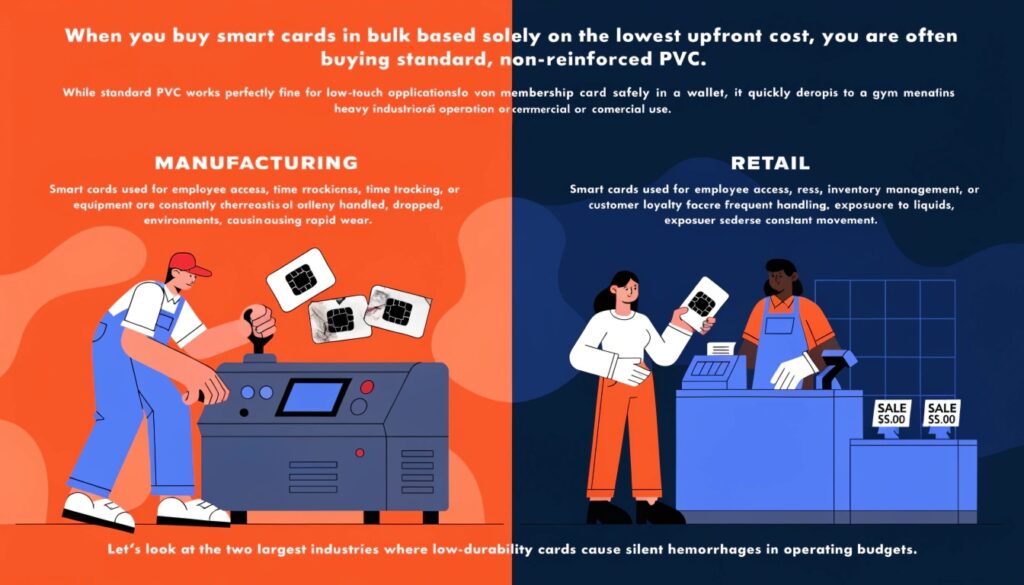
Issuing thousands of cards amplifies every defect. Specify batch-level QA: chip read-rate testing on a statistical sample, magstripe verify, visual inspection against a golden sample, and a serialization log that ties each card to its batch. Require a written acceptable failure rate and a reissue path for any batch that exceeds it. Our card durability testing guide shows how to write acceptance criteria into the contract so QA is enforceable, not promised.
The legacy magstripe: keep it until you are sure you don’t need it

Even fully contactless programs keep a magstripe, because some ATMs, legacy POS, and transit readers still depend on it. Decide deliberately, not by default: if you drop the stripe, confirm your entire acceptance environment is chip-and-contactless. If you keep it, specify track data formatting and coercivity. The chip selection behind this matters—our smart card chip selection guide covers matching the secure element to the application.
Your EMV personalization RFQ checklist

Before you release a purchase order, put these in the specification:
- Dual-interface module: ISO/IEC 7816 contact + ISO/IEC 14443 contactless.
- EMVCo approval reference and PCI PIN Security attestation for the bureau.
- Print method (emboss / indent / retransfer) and personalization reserve zones.
- Magstripe decision: keep (with track format/coercivity) or explicitly drop.
- Batch QA: read-rate sample size, golden-sample inspection, failure-rate clause.
- Key custody and secure transfer evidence for any cryptographic loading.
Request the bureau’s EMVCo and PCI certificates with the quote—a payment card built outside that chain is a liability the moment it touches a real terminal. EMVCo and PCI Security Standards Council publish the current specifications your supplier must be audited against.