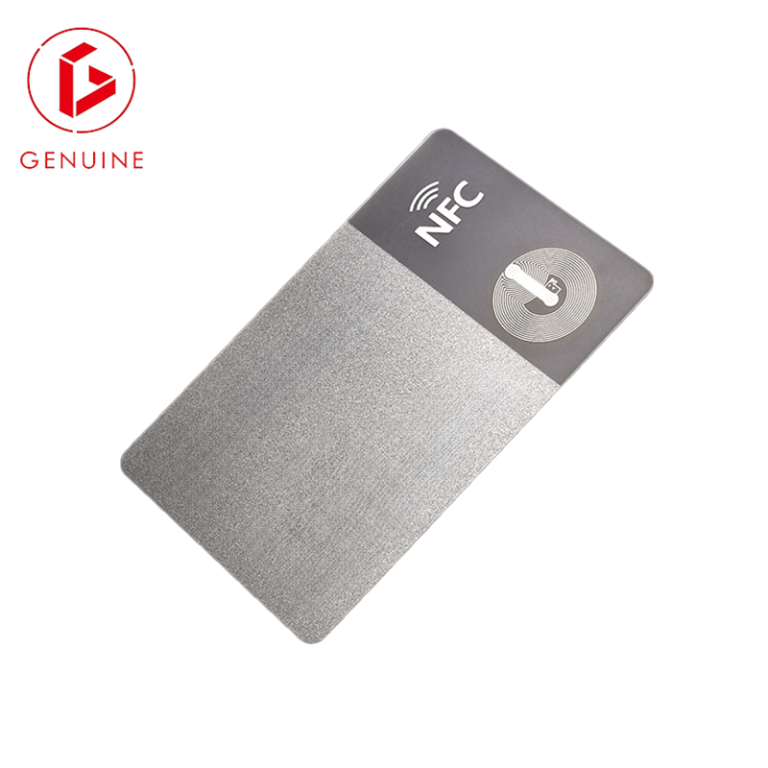
You have negotiated the unit price, the lead time, and the MOQ. But none of that protects you if the boxes that arrive three weeks later do not actually meet the specification you agreed on. A verbal “we’ll make it right” is not a control — a written acceptance test protocol attached to the purchase order is. This guide shows you how to build one: a short, contractual test plan covering sampling, electrical and contactless read checks, and durability against ISO/IEC 10373, with pass/fail rules that tell both sides exactly what happens when a lot falls short.
Why the Acceptance Test Protocol Belongs Inside the Purchase Order

A purchase order is a contract. If the PO only says “smart cards, 10,000 pcs, blue,” you have given the supplier wide latitude on everything that is not spelled out — and you have no documented basis to reject a non-conforming lot. The acceptance test protocol is the part of that contract that defines what “good” means and how it gets proven. Put it in the PO (or in the referenced specification) so that inspection results are binding, not negotiable after delivery.
For buyers issuing tenders or RFQs, this is the natural companion to your specification sheet — the smart card RFQ template tells the supplier what to build, and the acceptance protocol tells them how you will verify it. Done well, it shifts risk back to where it belongs and prevents the most expensive failure mode in card procurement: discovering a defect after cards are already in employees’ wallets.
Define “Acceptable” Before You Order
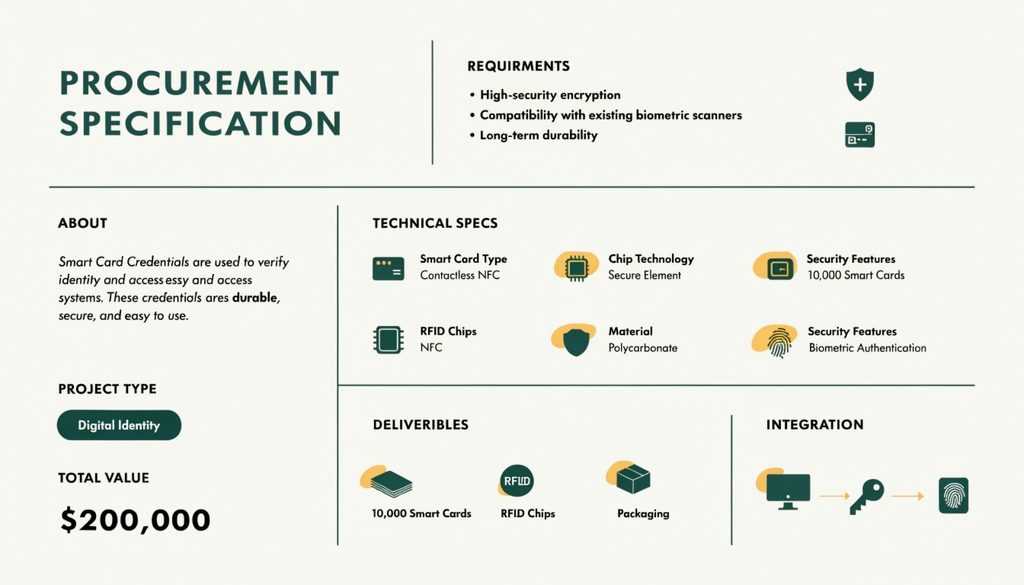
Acceptance criteria must be measurable, not adjectives. “High quality” is not testable; “print legibility ≥ 95% on the personalization line, verified by sample inspection” is. Before the order is placed, convert every line of your specification into a checkable limit:
- Dimensional limits per ISO/IEC 7810 (ID-1: 85.60 × 53.98 mm, nominal thickness 0.76 mm).
- Encoding parameters for contact (ISO/IEC 7816) or contactless (ISO/IEC 14443) — format, facility code, key, UID range.
- Personalization accuracy: name, number, barcode/QR, photo match to the supplied data file.
The trap most buyers fall into is writing the protocol after a problem appears. By then the supplier can reasonably argue the requirement was never agreed. Lock the criteria into the PO before production starts, and reference the exact specification revision. If you are still finalizing what to specify, start from a card samples evaluation checklist so the limits reflect what a real sample can actually achieve.
Sampling Plan: How Many Cards to Test (AQL per ISO 2859-1)

You rarely test every card in a 50,000-piece lot, and you do not have to. Acceptance sampling, indexed by Acceptance Quality Limit (AQL) under ISO 2859-1, lets you infer lot quality from a statistically sized random sample. The practical steps:
- Pick an AQL. For secure credentials, AQL 1.0 is a common commercial starting point; high-assurance government or payment programs often tighten to AQL 0.65 or 0.4.
- Find the sample size from your lot size and the standard’s inspection level (General Inspection Level II is typical).
- Read the acceptance (Ac) and rejection (Re) numbers — for a given lot, sampling 200 cards might allow zero or one defect before the lot is rejected.
- Use the switching rules: consistent good lots move to reduced inspection; a single bad lot triggers tightened inspection. This rewards reliable suppliers and pressures weak ones.
Sample the cards randomly across multiple sealed cartons, not from a single open box — that is where reviewing sample cards before a bulk order pays off.
Electrical and Contactless Read Tests (the Must-Pass Checks)
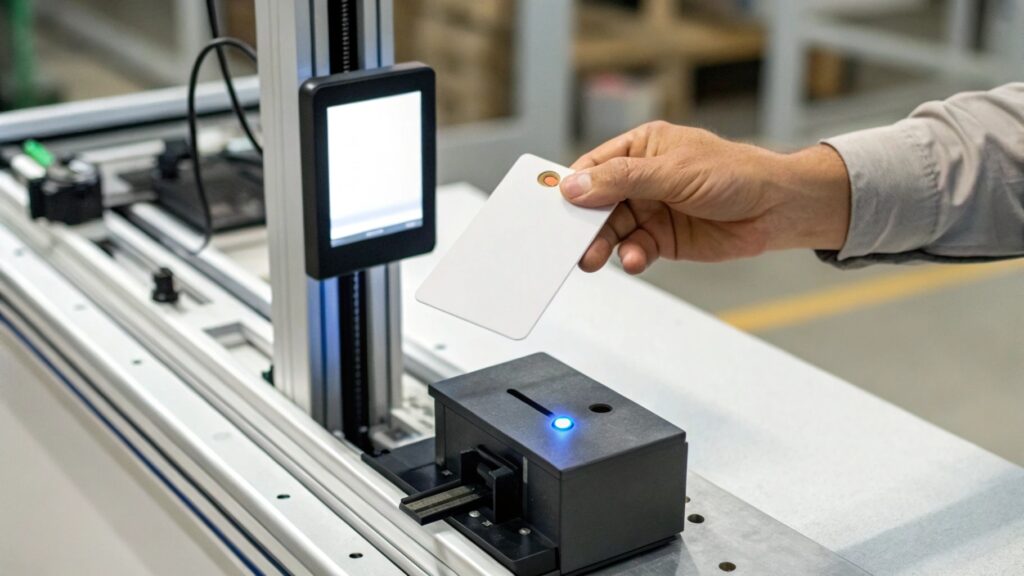
Function is non-negotiable: a card that cannot be read is scrap, regardless of how polished it looks. On the sampled cards, run the electrical and RF checks that match the technology you bought:
- Contact chips: verify read/write of the EEPROM, ATR (answer-to-reset) correctness, and protocol conformance to ISO/IEC 7816-3. A card that returns a bad ATR or fails a write cycle is a hard fail.
- Contactless / dual-interface: confirm the card wakes up at the specified read range, returns the correct UID, and passes the application-level read per ISO/IEC 14443. Test at both the near and far edge of the claimed range.
- Magnetic stripe or barcode/QR: verify track data or symbology reads on a calibrated reader.
Every sampled card must read and write correctly on the first pass for the lot to pass this section; intermittent reads are treated as failures, not “close enough.” Pair this with your encoding specification so the test uses the same keys and formats the field system expects.
Durability Tests Against ISO/IEC 10373
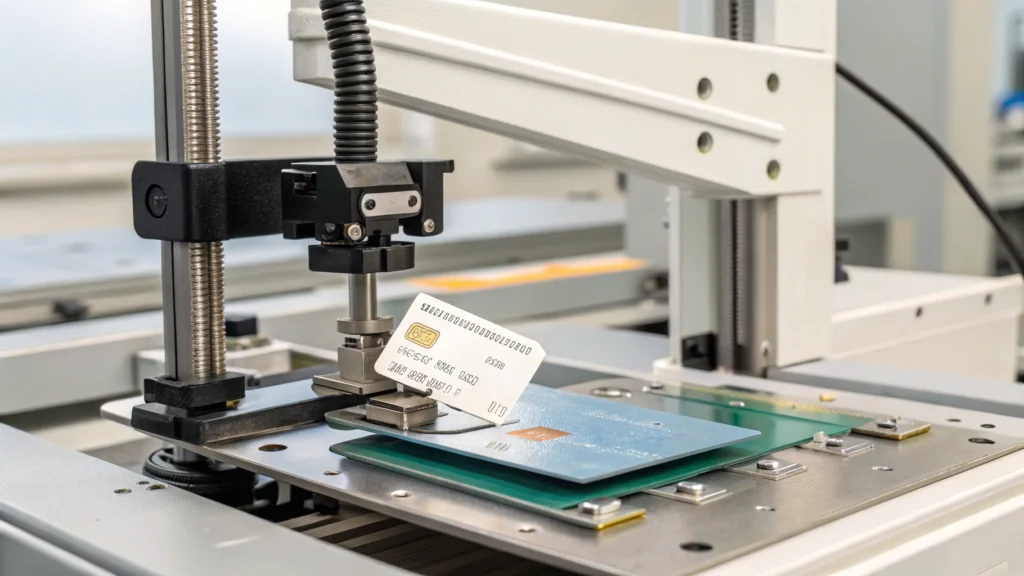
Cards live in pockets, wallets, and harsh environments for years. Durability testing proves they survive. Reference the ISO/IEC 10373 series, which defines the methods; the most relevant for buyers are:
- Bending and torsion (ISO/IEC 10373-1): the card must not crack or delaminate after the specified bend cycles. Bending stiffness itself is governed by ISO/IEC 7810.
- Temperature and humidity cycling, chemical resistance, and abrasion — simulated wear that mimics a multi-year field life in a few days.
- Proximity/contactless-specific tests (ISO/IEC 10373-6:2025, standard 83862): antenna coupling and RF performance under stress.
You do not need to run the full 200-page suite. Specify 3–5 durability methods that match your use case (e.g., a campus ID needs bending and abrasion; an outdoor access card needs temperature and chemical resistance) and set the pass threshold from the base standard. This is the single biggest lever for cutting field-failure complaints.
Physical and Visual Checks: Dimensions, Print, and Personalization
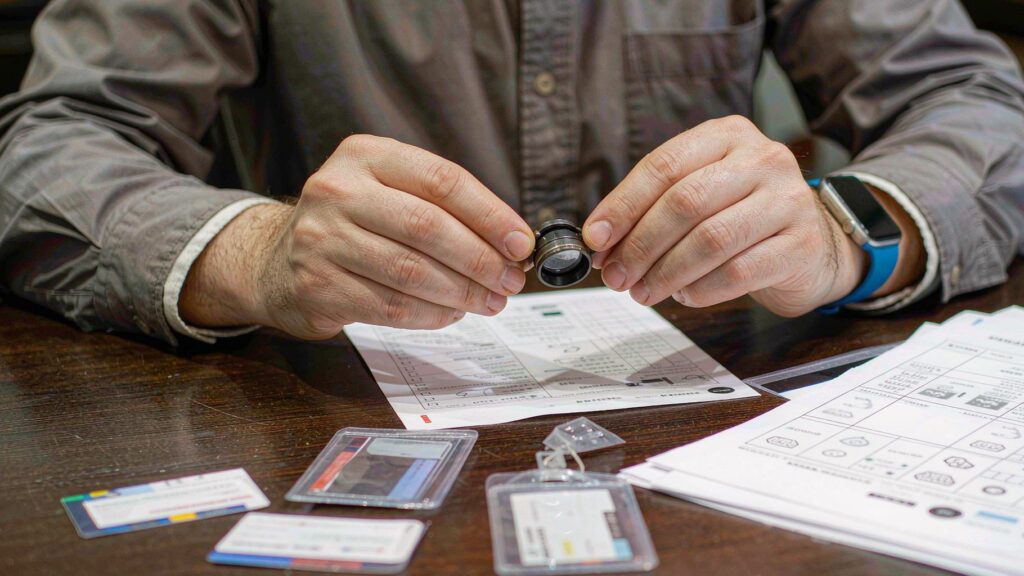
With a loupe or comparator, verify the things a buyer can see and measure:
- Dimensions and thickness to ISO/IEC 7810 ID-1 tolerances; check for warpage, blocked corners, or edge burrs.
- Print quality: color match to the approved drawdown, no misregistration, no voids in security printing.
- Personalization accuracy: every printed/encoded field matches the supplied data file — name, ID number, barcode/QR value, and (if applicable) photo. A single mismatched number is a security incident, not a cosmetic flaw.
Using a card sample testing checklist here keeps the inspection consistent across batches and inspectors. Note that not every minor blemish is a reject — agree a three-tier severity system (critical / major / minor) with the supplier up front so inspections do not stall on subjective calls.
Pass/Fail Criteria and What Happens When a Lot Fails

The protocol is only useful if it says what happens next. For each test group, state the acceptance number (Ac) and rejection number (Re), and the escalation path:
- Within Ac: lot accepted, shipment released.
- At or beyond Re: lot rejected; supplier re-inspects, reworks, or replaces at their cost.
- Borderline: define a permitted re-test (single, with tightened sampling) so neither side games the result.
The clause buyers forget most often is cost allocation: who pays for return freight, rework, and the buyer’s own re-inspection time when a lot fails. Put it in writing — a rejected 100,000-card lot with ambiguous liability can sit in dispute for months. Comparing a genuine card against a defective or cloned sample, as in incoming inspection, is exactly how anomalies get caught before they reach users.
Documenting the Result: The Acceptance Report

An inspection with no record is an inspection you cannot defend. The acceptance report should capture, per lot:
- PO and specification revision referenced.
- Sample size, AQL level, and sampling method.
- Test results per group (electrical, durability, dimensional, visual) with measured values, not just “pass.”
- Serial numbers or carton IDs of sampled units for traceability.
- Sign-off by the inspector and a copy to the supplier.
Keep these on file for the credential lifecycle — they are your evidence if a dispute or a sample verification question arises later. A clean, signed report also feeds continuous improvement: recurring minor defects point to a process drift the supplier should fix before the next order.
Frequently Asked Questions
What AQL level is typical for smart cards? AQL 1.0 is a common commercial baseline; government, payment, and high-assurance programs usually tighten to 0.65 or 0.4. The right number depends on the consequence of a failure in your environment.
Should the buyer or a third party run the tests? Either works. Buyers often inspect at goods-in; independent labs add credibility for tenders and regulated programs. The protocol should name who tests and which standard methods they use.
Can I reference ISO 10373 directly in the contract? Yes — citing the specific ISO/IEC 10373 part(s) and the pass thresholds makes the requirement unambiguous and internationally defensible.
Does an acceptance protocol replace the factory’s own QC? No. It is your independent verification at the point of receipt. The factory’s in-line QC reduces defects; your acceptance test confirms the delivered lot meets the contract.
A protocol this detailed is reusable across every card order you place. We have packaged the structure above into a fill-in template — request the acceptance-test template or talk to our team about specifying test plans for your next program.