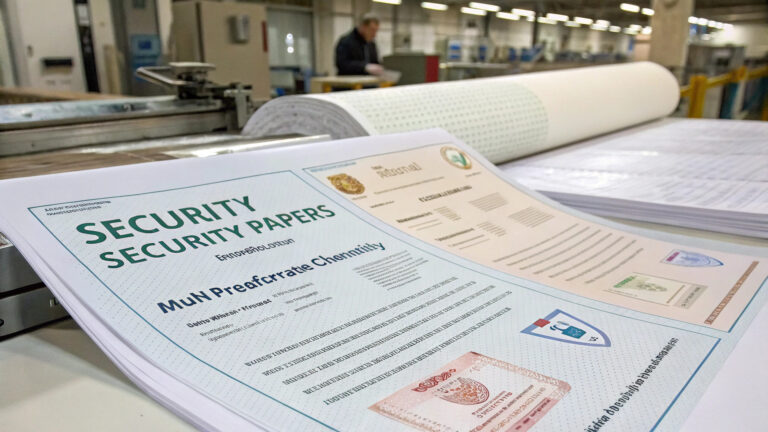
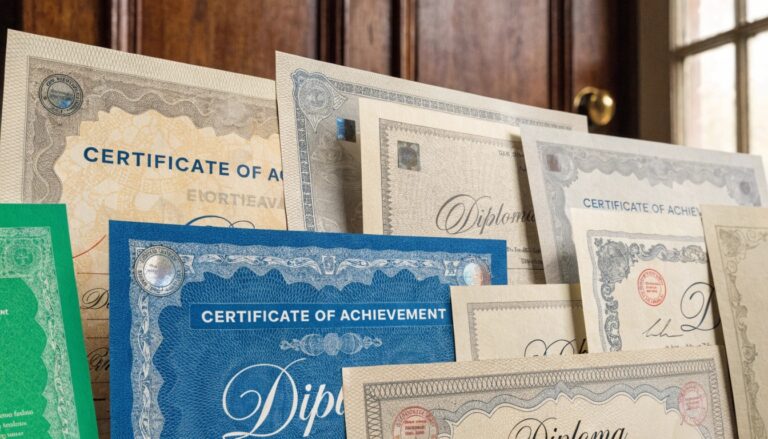
Most certificate and diploma tenders arrive with the same three words on the materials line: “security paper required.” No grammage. No fibre content. No watermark type. No forensic layer. No serialisation rule. Those three words are the most expensive omission in the entire RFQ, because they guarantee that every bid you receive will be priced against a different product — and that you will spend the next three weeks comparing quotes that cannot be compared.
This guide is the specification framework our engineers use when a ministry of education, a professional licensing board, or a certification body asks us to help them write the paper clause before it goes out to tender. Work through it feature by feature and you will end up with a document that produces like-for-like bids, protects you against the fraud you actually face, and does not make you pay banknote money for a training certificate.
Why “Just Send Us Security Paper” Is the Costliest Line in Your RFQ
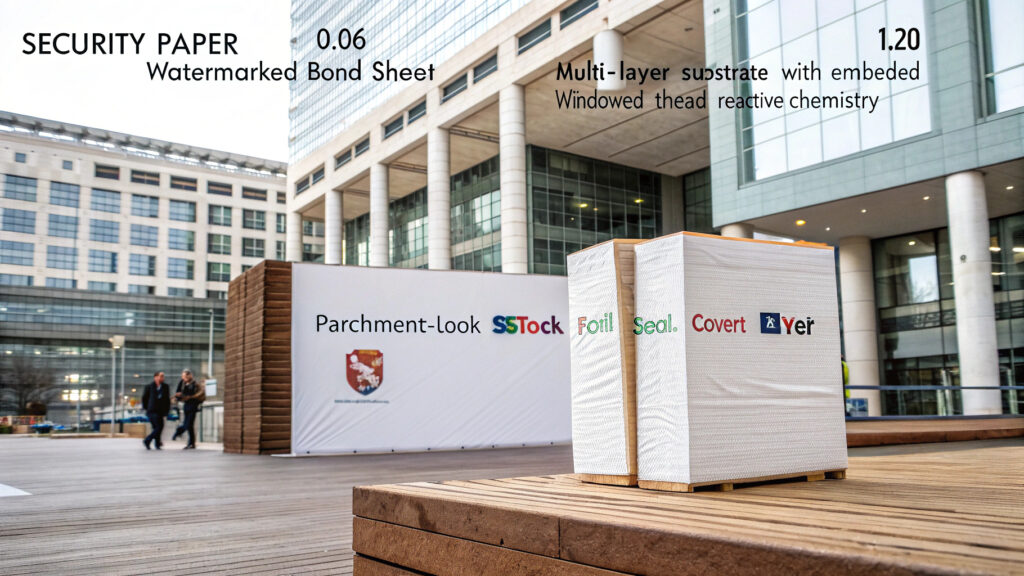
“Security paper” is not a product. It is a category that spans a €0.06 watermarked bond sheet and a €1.20 multi-layer substrate with an embedded windowed thread and reactive chemistry. When you leave the category undefined, three predictable failures follow.
- Incomparable bids. Supplier A quotes 90 gsm woodfree with a simulated watermark. Supplier B quotes 120 gsm mould-made cotton with a true multi-tone watermark and UV fibres. The price gap looks like a 60% saving. It is actually a different security tier, and procurement has no basis on which to defend either choice.
- Over-specification. We regularly see internal training certificates specified with banknote-grade features. Nobody forges a two-day workshop certificate with an offset press. That budget belongs on the credentials that actually get faked.
- Under-specification. Far more damaging. A degree certificate printed on decorative “parchment-look” stock with a foil seal has no covert layer at all. When a fraudulent copy surfaces, your registrar has no forensic method to prove which document is genuine — and an unprovable credential is functionally the same as a forged one.
The fix is not a longer feature list. It is a specification that ties each feature to a defined threat and a defined verifier.
Step 1: Build a Threat Model Before You Build a Feature List
Before any technical clause, answer three questions in writing. They take an afternoon and they determine 80% of your spec.
- Who forges this document, and with what equipment? A candidate with an inkjet and a laminator is a different adversary from an agency selling 500 fake nursing diplomas a year with access to a commercial press.
- Who verifies it, and under what conditions? An HR officer holding the sheet to a window has three seconds and no equipment. A border officer has a UV torch. A court expert has a laboratory. Each of these needs a different feature layer, and a feature nobody can check is decoration.
- What is the payoff for a successful forgery? A fake pharmacy licence carries public-safety consequences and litigation exposure; a fake attendance certificate carries reputational annoyance. Security budget should scale with consequence, not with print volume.
ISO 12931 — Performance criteria for authentication solutions used to combat counterfeiting of material goods — formalises exactly this logic: an authentication solution must be specified against a documented threat analysis, and must define who performs verification at which of the three levels (overt, covert, forensic). Citing it in your RFQ is also a useful signal to bidders that you know what you are buying.

Step 2: Specify the Substrate — Grammage, Fibre, and Permanence
The substrate is the only layer you cannot upgrade later. Specify it in four dimensions.
- Grammage. For certificates and diplomas, 100–160 gsm is the working range, with 120 gsm the most common compromise between perceived gravitas and compatibility with office laser printers. Below 90 gsm the document feels disposable; above 170 gsm many duplex laser paths will jam or scuff.
- Fibre composition. State it as a percentage, not a marketing term. Common security blends are 100% cotton, 75% cotton / 25% linen, or 25% cotton / 75% linen. Cotton-rag substrates fold and age far better than woodfree alternatives and produce a distinctly different acoustic and tactile response — a cheap but genuinely useful first-line authentication cue.
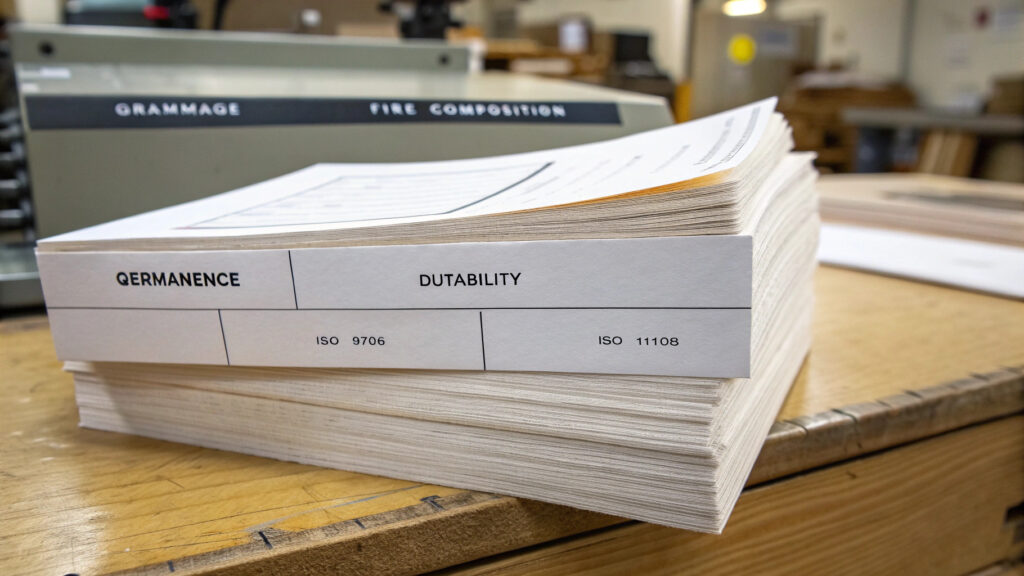
- Permanence and durability. This is the clause almost everyone forgets. A diploma is expected to be legible and intact in 60 years. Require compliance with ISO 9706 (permanence of paper for documents) and, for archival-grade credentials, ISO 11108 (archival paper). Both mandate an alkaline reserve and controlled acidity so the sheet does not yellow and embrittle.
- Optical brightening agents (OBA). Decide deliberately. If you plan to use UV-visible security features, the base sheet must be UV-dull — an OBA-loaded paper fluoresces uniformly under 365 nm and destroys the contrast your UV fibres and inks depend on. Write “UV-dull, no optical brighteners” into the spec or you will receive a bright white sheet that defeats your own covert layer.
If you are still narrowing the substrate family, our guide to choosing certificate paper walks through the trade-offs between cotton, linen blends and coated stocks in more depth.
Step 3: Specify Overt Features Anyone Can Verify in Three Seconds
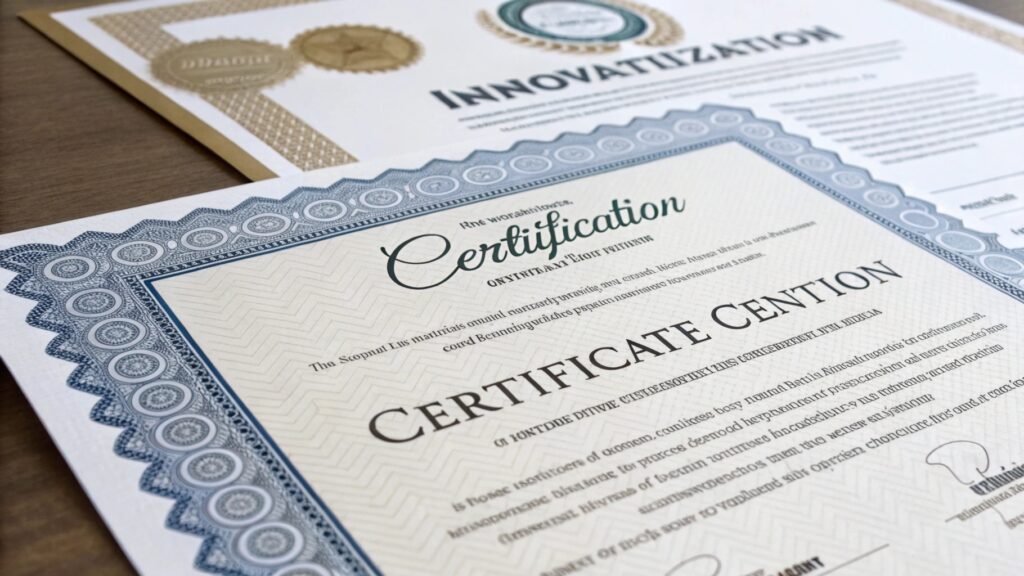
Level-one features exist for the untrained verifier: the HR manager, the admissions clerk, the border desk. They must be checkable without tools, and they must be described precisely enough that a supplier cannot substitute a cheaper lookalike.
- Watermark — and say which kind. A true mould-made watermark is formed in the wet web and shows continuous tonal gradation in transmitted light. A simulated or chemical watermark is applied to a finished sheet and is trivially reproducible. These differ by an order of magnitude in both cost and protection, so write “true multi-tone mould-made watermark, customer artwork, registered position” rather than “watermarked paper”. Our complete guide to watermark paper covers how the two are produced and how to tell them apart on receipt.
- Security thread — embedded or windowed. A fully embedded thread is visible only in transmitted light; a windowed thread surfaces at intervals so it can be felt as well as seen. Specify width, pitch, and whether it carries microtext or a fluorescent response — “security thread” alone leaves the supplier free to quote the cheapest variant.
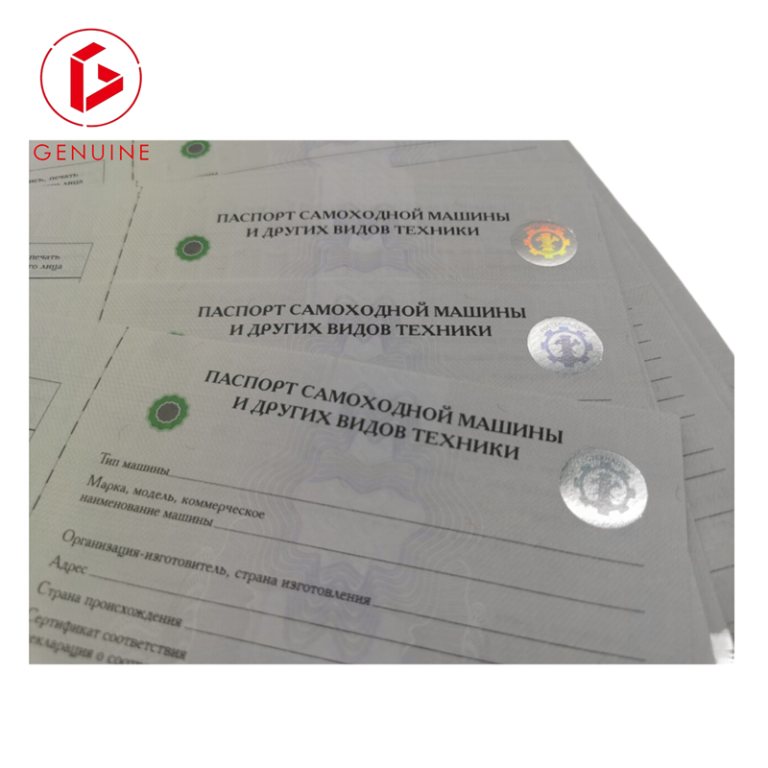
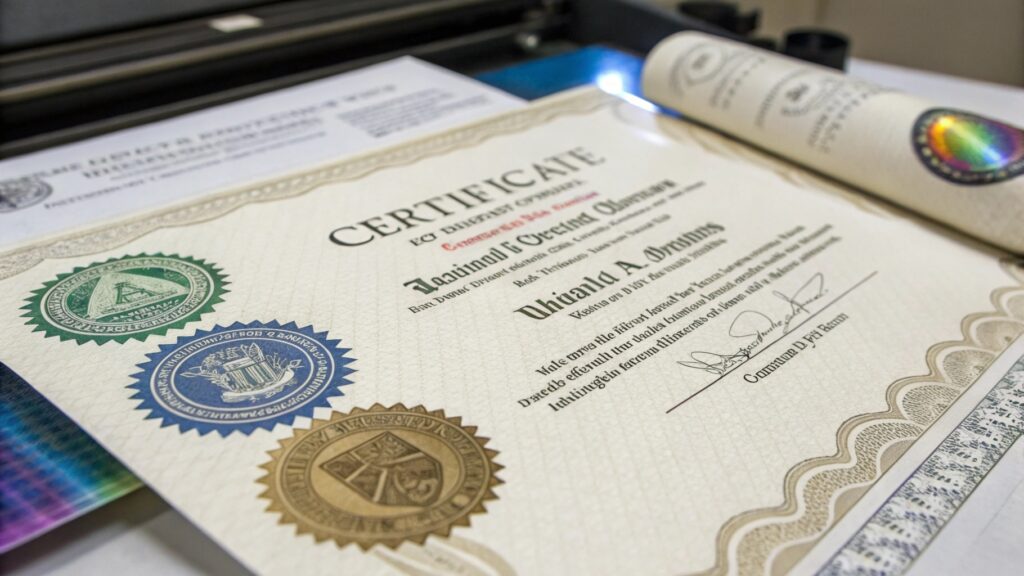
- Foil or holographic element. Effective, and useful precisely because it cannot be reproduced by any copier or printer. But specify origination: a custom-originated hologram is a security feature; a stock “generic” hologram bought by the roll is a decoration that anyone can buy too.
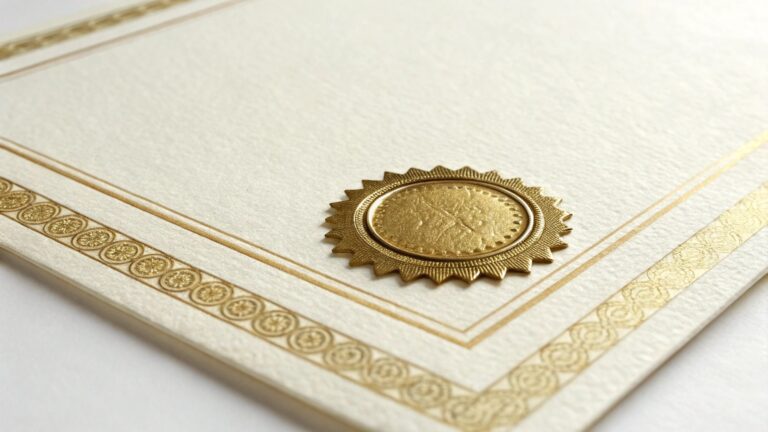
- Intaglio or embossed seal. A tactile relief the recipient can feel. Low cost, high recognition, hard to fake convincingly with desktop equipment.
One operational note that costs nothing and doubles the value of this layer: publish a short public verification page describing exactly which overt features your certificates carry, with photographs. Overt features protect nobody if the people receiving your documents have never been told what to look for.
Step 4: Specify Covert and Forensic Features for the Day You Are in Court
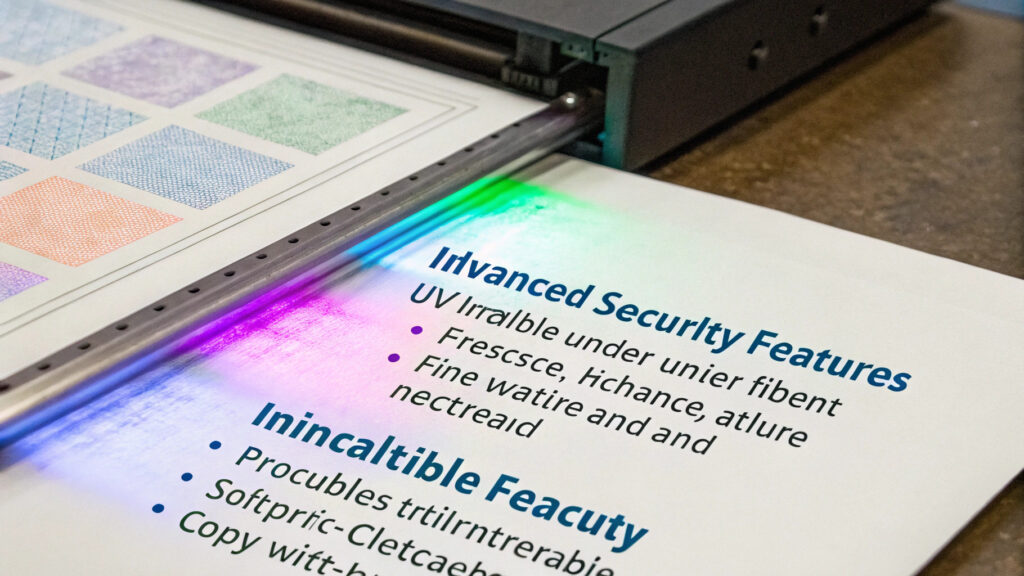
Level-two features need simple equipment; level-three features need a laboratory. Their purpose is not everyday checking — it is proving, to an evidentiary standard, which of two similar documents your institution actually issued.
- Invisible UV fibres. Randomly distributed fibres, invisible in daylight, fluorescing under 365 nm UV. Specify colour mix and density (fibres per dm²). They are inexpensive and, because distribution is random, essentially impossible to copy sheet-for-sheet. How UV fibre paper works explains the difference between planchettes and true embedded fibres.
- Chemical reactive sensitising. Paper treated so that common bleaches, solvents and ink eradicators produce an irreversible stain. This is the feature that defends against alteration of a genuine document — changing a grade, a date, or a name — which in our experience is more frequent than wholesale forgery.
- Microtext and anti-copy pantograph. Text below 0.5 pt that degrades to a grey line when scanned or photocopied, and latent “VOID”/”COPY” patterns that appear only in reproduction.
- Forensic taggant. A machine-detectable marker in the pulp or ink, verifiable only by the manufacturer or a nominated laboratory. If your credentials carry legal weight, include at least one. A feature that the forger cannot know exists is the only feature that survives a determined, well-resourced attack.
Rule of thumb we give clients: your specification should contain at least one feature from each of the three ISO 12931 levels. Three cheap features spread across the levels outperform one expensive feature concentrated in a single level.
Step 5: Specify Serialisation and Blank-Stock Accountability
Here is the uncomfortable finding from most credential-fraud investigations: the majority of fraudulent certificates in circulation are printed on genuine blank stock that walked out of an office — not on clever forgeries. Your paper spec is worthless without a stock-control clause.
- Pre-numbering at the mill. Require every blank to carry a unique serial applied during production, ideally in both a human-readable form and a machine-readable form. Use a non-sequential number with a check digit so that a stolen blank’s neighbours cannot be guessed.
- Delivery reconciliation. Contract the supplier to deliver a serial manifest per carton, and require your receiving team to reconcile against it. Any gap is a security incident on day one, not a mystery in year three.
- Spoilage destruction certificates. Misprints must be logged by serial and destroyed under witness, with a signed record. Unreconciled spoilage is the classic leak.
- Bind the serial to a registry. Print a QR code or Data Matrix that resolves to an authoritative lookup on your own domain, returning holder name, award, and issue date. This turns a physical document into a verifiable one and gives remote verifiers — foreign employers, other universities — a route that does not require them to hold the paper.
Physical security features and digital verification are complements, not alternatives: the substrate proves the artefact is genuine, the registry proves the content is genuine. Specify both.
Step 6: Assemble It — A Copy-Ready Specification Block
Paste this structure into your tender and fill in the brackets. Ask every bidder to respond line by line, and to price a mandatory column and an optional column separately so you can see what each feature actually costs.
- 1. Substrate: [120] gsm ±5%, [75% cotton / 25% linen], UV-dull (no optical brighteners), compliant with ISO 9706 [and ISO 11108 where archival].
- 2. Format & grain: [A4 / 8.5×11 in], long-grain, [±0.5 mm] trim tolerance, [4] sides guillotined.
- 3. Overt features: true mould-made multi-tone watermark to supplied artwork, registered position ±[3] mm; [embedded / windowed] security thread, [1.2] mm, [with microtext]; [custom-originated] foil element.
- 4. Covert features: invisible UV fibres, [two] colours, [minimum density]; chemical reactive sensitising against bleach/solvent/ink eradicator; anti-copy pantograph revealing “[VOID]”.
- 5. Forensic layer: [taggant / marker] verifiable by supplier laboratory; supplier to provide written verification protocol and turnaround commitment.
- 6. Serialisation: unique non-sequential serial with check digit, human-readable plus [QR / Data Matrix]; serial manifest per carton; spoilage destruction certificate.
- 7. Print compatibility: guaranteed compatible with [xerographic laser at 200 °C fuser / offset / inkjet]; supplier to confirm no feature degradation after fusing.
- 8. Quality & audit: supplier operates a certified security printing management system (e.g. ISO 14298 / Intergraf-audited); ISO 9001; batch COA per delivery.
- 9. Samples: [5] production-condition samples with all specified features before mass production; written approval gate.
- 10. Commercial: MOQ, unit price at [3] volume breaks, lead time for first order and repeats, packaging (sealed, tamper-evident, [500] sheets/ream), Incoterm.
For the commercial half of the exercise — volume breaks, freight, duty, and how to compare landed cost rather than sheet price — see our security paper procurement guide.
Five Specification Mistakes That Trigger a Re-Quote
- Naming a brand instead of a function. “Equivalent to [brand] Security Bond” tells a mill nothing measurable and invites substitution disputes. Specify the property, not the label.
- Ignoring print-process compatibility. A laser fuser runs at roughly 180–200 °C. Some thermochromic and pressure-sensitive features are destroyed by a single pass through a laser printer, and heavily sized security stocks can cause toner adhesion failure. Always state your printing method in the RFQ.
- No pre-production sample gate. Approving a swatch from a sales folder is not the same as approving a sheet made on your job, with your watermark, in your position tolerance. Write the approval gate into the contract.
- Omitting permanence. Certificates outlive the people who ordered them. Without an ISO 9706 clause you may be buying acidic stock that yellows within a decade.
- Specifying features nobody was taught to check. A verification instruction sheet distributed to registrars, HR partners and embassies costs almost nothing and is what converts your spend into actual deterrence.
Before You Sign: Questions That Separate Mills from Middlemen
A specification is only as good as the party executing it. Four questions reliably reveal who you are actually dealing with.
- “Is the watermark made on your own cylinder mould machine, and can we audit the site?” A trader cannot answer this. A mill can name the machine and offer the visit.
- “What is your documented procedure for controlling and destroying numbered spoilage?” A serious security printer produces the SOP immediately; if the answer is vague, so is your chain of custody.
- “Who performs forensic verification if we need evidence in a legal dispute, and what is the turnaround?” Ask for it as a written commitment, not a reassurance.
- “Can you produce a full-feature sample on our artwork before we commit to the order?” The willingness to invest in a real pre-production sample is the single best predictor of how the mass run will go.
GENUINE has manufactured security paper, certificates and identity documents for government agencies, universities and certification bodies since 2005, and we review draft specifications for tender teams at no charge — including a written note on where a spec is over-engineered and where it leaves a gap. Send us your current paper clause and the threat you are defending against, and we will return a marked-up specification plus a full-feature sample on your artwork.
Contact our specification team to request a sample pack and a spec review for your certificate or diploma programme.