You have shortlisted a tag, agreed a target price, and then the quote lands: a minimum order quantity three times larger than your rollout, and a lead time that misses your deployment window. If that scene feels familiar, this RFID MOQ guide for 2026 is written for you. Below you will find the MOQ tiers factories genuinely work to, the reasons lead times stretch from days to months, and the negotiation levers that actually move — so you can plan orders, protect margins, and commit to delivery dates with confidence.
RFID MOQ Tiers in 2026: What Factories Actually Require
Minimum order quantities are not arbitrary. They exist because RFID production is a converting process: chips arrive on wafers, antennas are made in reels, and every changeover of material, die-cut tooling, or encoding format costs machine time whether you order 500 pieces or 50,000. The single biggest driver of your MOQ is whether you buy a stock construction or a custom one — everything else (chip, size, face material) matters less than that one decision.
As a working reference, these are the tiers most manufacturers — including our own factory lines — quote in 2026:
- Stock wet inlays and blank labels: 1,000–5,000 pcs, often sold in full reels (2,000–10,000 units per reel).
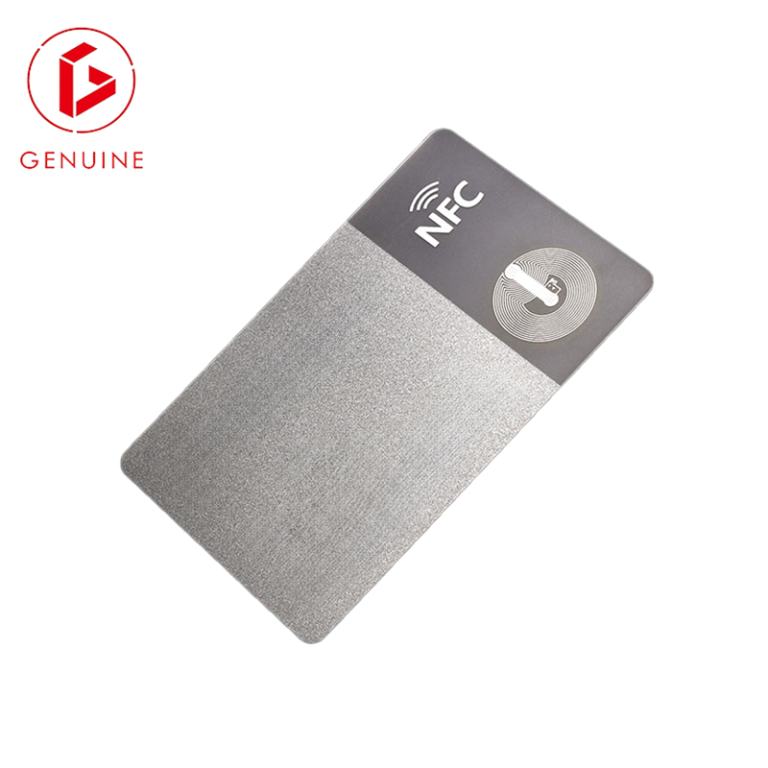
- Stock RFID cards (white PVC, common chips): 500–1,000 pcs, since card lines run smaller batches efficiently.
- Custom-printed labels or cards on stock inlays: 3,000–10,000 pcs, driven by printing plate setup and material minimums.
- Fully custom inlays (new antenna design or die-cut size): 10,000–50,000 pcs, because antenna tooling and reel-to-reel setup must be amortized.
- Specialty hard tags (on-metal, high-temperature, embeddable): 500–2,000 pcs for stock housings; molded custom housings typically start at 10,000+ pcs due to injection tooling.
Treat these numbers as planning anchors, not walls. A factory quoting 10,000 pcs for a custom label will often accept 5,000 if you accept a stock antenna and standard adhesive — which is exactly the kind of trade we unpack later in this guide. For a broader look at construction and chip choices before you commit, see our RFID tag buyer’s guide.
What Really Drives RFID Lead Times (and Where the Weeks Go)
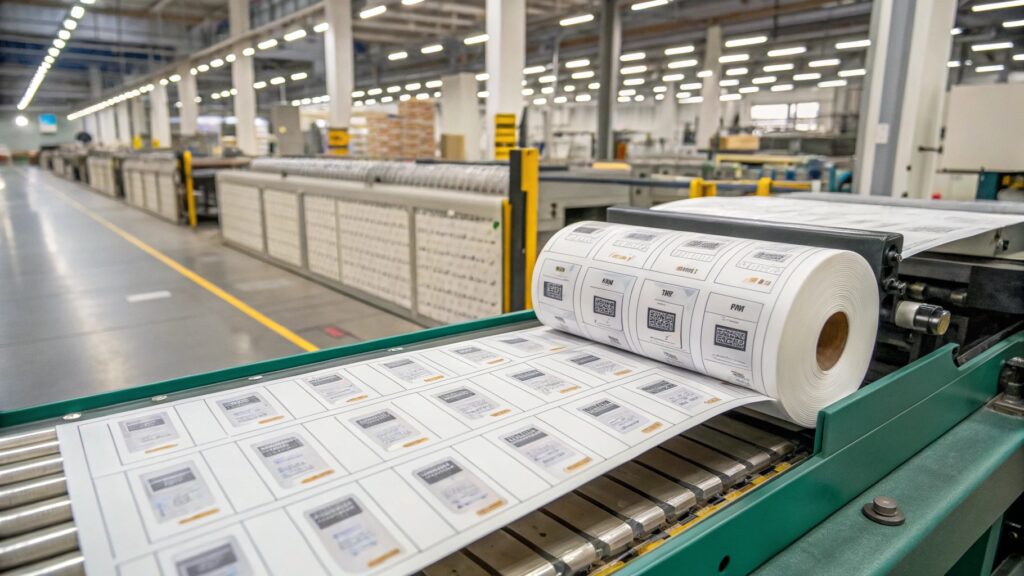
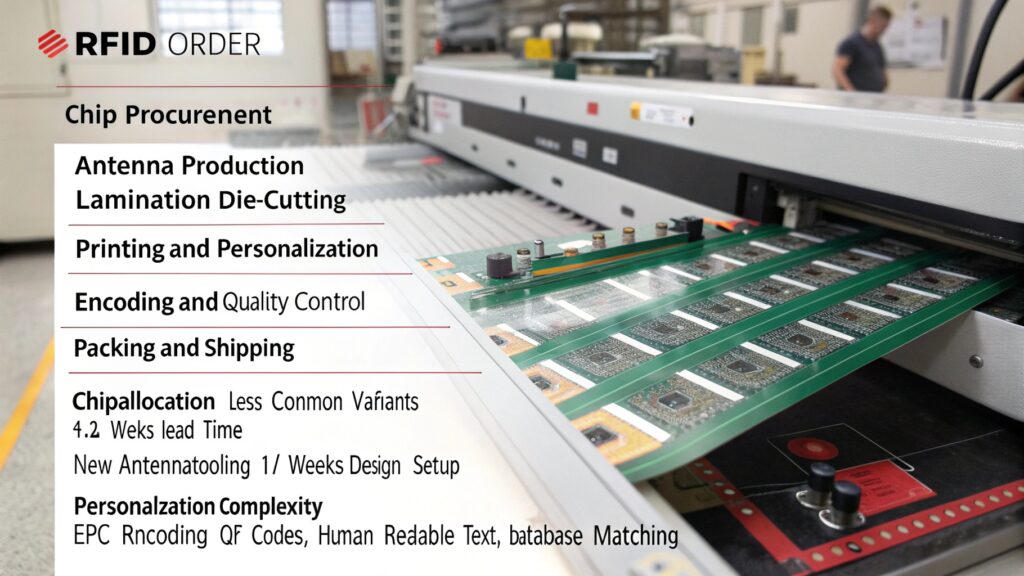
When a supplier says “4–6 weeks,” that window is the sum of several sequential stages, and knowing them tells you which orders can genuinely be expedited. A typical custom RFID order moves through: chip procurement → antenna production or inlay conversion → lamination/die-cutting → printing and personalization → encoding and QC → packing and shipping. Any one of these can dominate the schedule.
- Chip allocation is the number-one wildcard. Mainstream UHF chips compliant with ISO/IEC 18000-63 and HF chips under ISO/IEC 14443 are usually ex-stock, but less common variants (large user memory, cryptographic authentication, extreme-temperature grades) can add 4–12 weeks of wafer lead time on their own.
- New antenna tooling adds 1–2 weeks for design, etching or aluminum stamping setup, and first-article approval.
- Personalization scales with data complexity. Simple sequential EPC encoding adds a day; unique QR + human-readable + database-matched encoding with 100% verification can add a week on large volumes. If your project uses GS1 numbering, aligning your data plan with the GS1 EPC Tag Data Standard before ordering prevents costly re-encoding.
- Shipping is a decision, not a constant: air freight adds 3–7 days door-to-door; sea freight adds 25–40 days but cuts logistics cost dramatically on pallet-scale volumes.
Realistic 2026 planning windows: stock inlays/labels ship in 3–7 working days; printed and encoded orders on stock inlays run 10–15 working days; fully custom constructions run 4–8 weeks from artwork and data approval. Our smart card manufacturing project timeline breaks down the equivalent stages for card-format programs.
Stock vs Custom: How Specification Choices Move MOQ and Lead Time
Most buyers assume MOQ and lead time are fixed properties of a supplier. In reality, they are properties of your specification — and small spec changes often unlock much smaller minimums and faster delivery. Before you negotiate anything, walk through these decision points:
- Antenna: stock die vs custom design. Accepting a proven stock antenna in a standard size (e.g., 73 × 17 mm UHF, 25 mm round HF) can cut MOQ from 10,000+ to as low as 3,000 and remove 1–2 weeks of tooling.
- Chip: exact part vs functional equivalent. If your reader infrastructure only needs a 96-bit EPC and standard sensitivity, allowing an equivalent chip from a second source protects you from single-part allocation delays.
- Face material and adhesive: catalog vs special. Standard coated paper or white PET with general-purpose acrylic adhesive is always in stock; specialty liners, removable adhesives, or certified facestocks are purchase-to-order with their own material MOQs.
- Printing: digital vs plate-based. Digital printing supports short runs at modest cost per piece; flexo/offset needs plates and setup, which is where the 3,000–10,000 pc print MOQs come from.
A practical rule: pilot on stock, scale on custom. Run your proof-of-concept and first deployment phase on stock constructions at low MOQ, validate read performance in the field, then move to a cost-optimized custom construction once volumes justify tooling. Factories welcome this path — and buyers who follow it avoid the classic mistake of tooling up for a spec that field testing later changes. If you are still weighing frequency bands, our LF vs HF vs UHF frequency selection guide should come before any MOQ discussion.

Seven Negotiation Levers That Actually Work in 2026
Factories negotiate every day, and experienced sales engineers can tell within minutes whether a buyer understands the cost structure. These levers work because they reduce the factory’s real cost or risk — not because they squeeze margin:
- 1. Blanket orders with scheduled releases. Commit to annual volume, take delivery quarterly. You get volume pricing and the factory gets planning certainty; most suppliers will hold price for 6–12 months against a signed blanket PO.
- 2. Combine SKUs on shared tooling. Two label sizes sharing one antenna and one die can be ganged into a single run — often halving the effective MOQ per SKU.
- 3. Amortize tooling instead of paying MOQ. If you need a custom antenna but only 5,000 units now, offer to pay the tooling fee (typically US$300–1,500) explicitly rather than absorbing it through a 20,000-pc minimum.
- 4. Accept ±10% quantity tolerance. Converting scrap is real; allowing over/under-run delivery lets factories quote tighter prices and smaller minimums.
- 5. Trade lead time for price — explicitly. Ask for two quotes: standard schedule and economy schedule (produced in the factory’s low-load window). Savings of 5–10% are common if you can wait.
- 6. Second-source the chip, single-source the converting. Approving equivalent chips at PO stage prevents allocation-driven delays without fragmenting your quality accountability.
- 7. Negotiate Incoterms, not just unit price. Moving from EXW to FOB or CIF changes who controls freight cost and risk transfer; the definitions in ICC Incoterms 2020 are the reference both sides should quote from.
Just as important is knowing what cannot move: no legitimate factory will waive wafer-level chip minimums, skip antenna first-article approval, or guarantee lead times on unapproved artwork and encoding data. A supplier who promises all three is quoting to win the PO, not to deliver it — a red flag we discuss in our guide to factory-direct RFID sourcing.

How to Read a Proforma Invoice: Clauses to Check Before You Sign
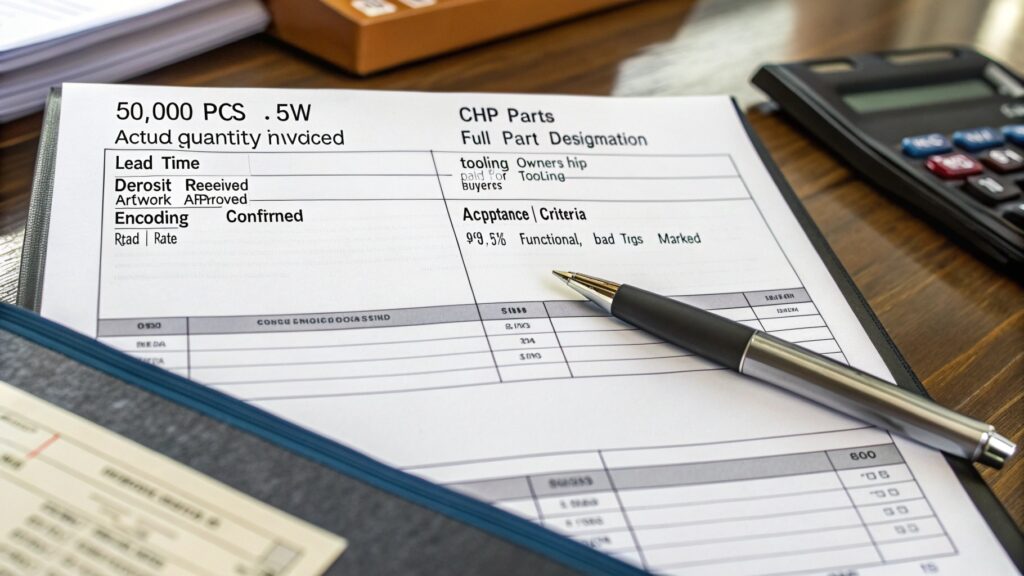
The proforma invoice (PI) is where verbal agreements either become enforceable or quietly disappear. Before transferring a deposit, verify each of these line items against what was discussed:
- Quantity and tolerance: the PI should state the exact quantity and the over/under-run tolerance (e.g., “50,000 pcs ±5%, actual quantity invoiced”). Missing tolerance language is the most common source of invoice disputes.
- Chip part number and origin: insist on the full part designation (not just “UHF chip”) so substitutions require your written approval.
- Lead time anchor: confirm whether the countdown starts at deposit received, artwork approved, or encoding data confirmed — on custom orders these can differ by two weeks.
- Tooling ownership: if you paid for antenna or die tooling, the PI should state that the tooling (or exclusivity of its use) belongs to you.
- QC and acceptance criteria: look for a stated read-rate or functional yield commitment (e.g., “≥99.5% functional, dead tags marked and replaced”) and the inspection standard used.
- Incoterm and named place: “FOB Shenzhen” and “EXW factory” can differ by hundreds of dollars per pallet and by who files export documents.
For a deeper dive into the numbers behind each line item — chip cost, converting, personalization, and where quotes get inflated — pair this checklist with our procurement cost-reduction guide for wholesale card buying.
FAQ: RFID MOQ and Lead Times in 2026
Can I order RFID samples below MOQ? Yes. Reputable manufacturers supply free or low-cost samples of stock constructions (typically 5–50 pcs) and paid pre-production samples of custom designs. Sample policy is a good supplier-quality signal in itself.
Why is the MOQ for custom inlays so much higher than for custom cards? Because inlay production is reel-to-reel: antenna tooling, web setup, and material minimums are amortized across a continuous run. Card lamination works in sheets, so small batches are economically viable.
Do RAIN/UHF and NFC/HF products have different lead-time risk? Structurally similar, but the UHF ecosystem tracked by the RAIN Alliance is more exposed to chip allocation cycles because volumes are dominated by a small number of chip families. Approving a second-source chip matters more on UHF projects.
Is it worth paying air freight on a first order? Usually yes for pilots: the 3–5 week sea-freight saving rarely outweighs the project cost of a delayed field trial. Switch to sea freight once you move to scheduled blanket-order releases.
What deposit terms are normal? 30% deposit / 70% before shipment (T/T) remains the 2026 norm for custom orders; established accounts on blanket orders can usually negotiate net terms on releases.

Get a Factory Quote With MOQ and Lead Time in Writing
As a security printing and RFID factory operating since 2005, GENUINE quotes MOQ, tolerance, chip part number, lead-time anchor, and Incoterm on every proforma — so what you negotiate is what you sign. Send us your target construction, annual volume, and deployment schedule, and we will return a two-option quote (standard and economy schedule) with samples of the nearest stock construction. Start with our RFID tag product range or go straight to a quote request — pilot quantities welcome.