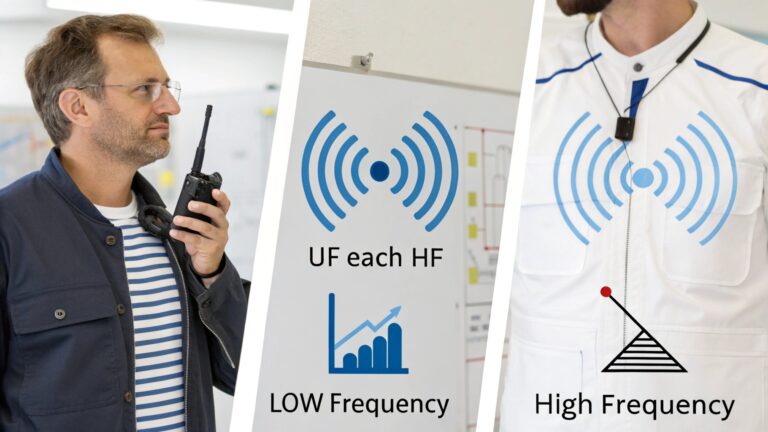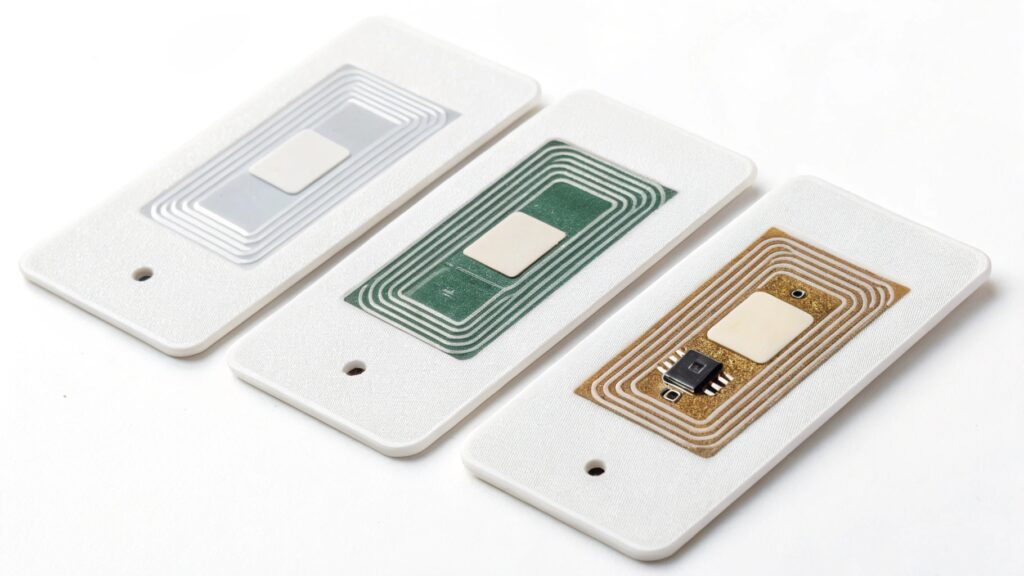
Specifying an RFID project is rarely about the chip alone—but the chip family you lock in early decides almost everything downstream: read range, memory, security, whether a consumer phone can read it, and what your per-unit cost looks like at volume. Four families dominate the B2B market—NXP’s MIFARE, NTAG, and ICODE, plus Impinj’s UCODE. This guide compares them on the dimensions buyers actually care about, so you can shortlist before you talk to a supplier.
Why the RFID Chip You Choose Actually Matters
The chip is the smallest, cheapest component in an RFID system and the one most likely to cause an expensive redo. Pick wrong and you may find the tag can’t hold the data your workflow needs, can’t be read by the readers you already own, or fails certification for a payment or government program. The chip family is decided by frequency band and use case, not by price alone—which is why a spec sheet should start with the application, not the unit cost. If you are still shaping the overall tag specification, our RFID tag buyers guide walks through the full decision tree.
MIFARE: The Established Standard for Access Control & Payment
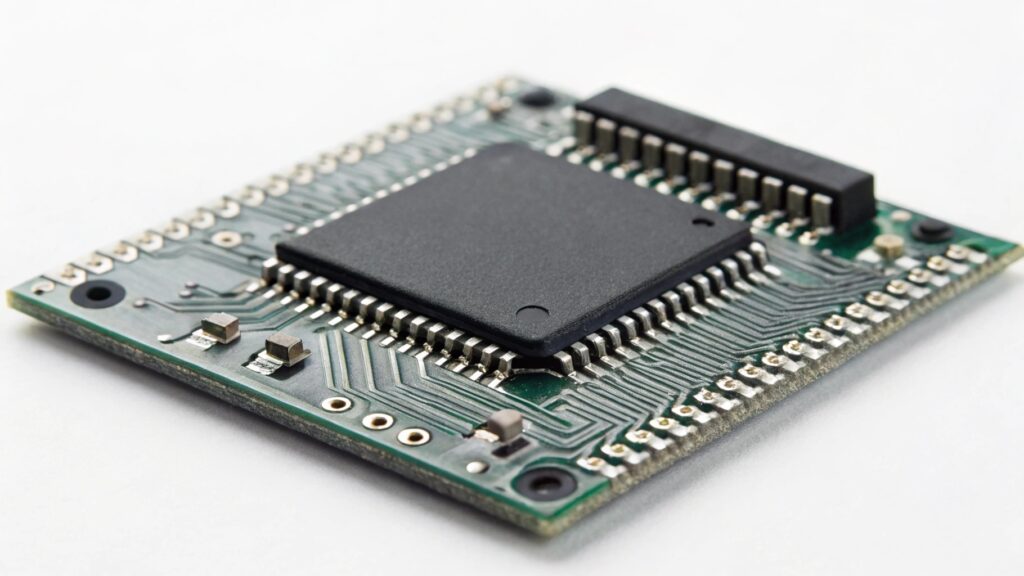
MIFARE is NXP’s HF (13.56 MHz) family built for secure, tap-to-read scenarios: employee badges, transit cards, campus IDs, and contactless payment. Variants range from MIFARE Classic (legacy, now discouraged for new secure programs) to MIFARE DESFire EV3 with AES-128 and mutual authentication. For any program that stores value or identity, choose a DESFire-class chip—Classic’s crypto is broken and should not ship in a new B2B deployment. MIFARE’s ecosystem is mature: readers, encoders, and card bodies are easy to source worldwide.
NTAG (NXP): The Go-To for NFC Tags & Consumer Engagement
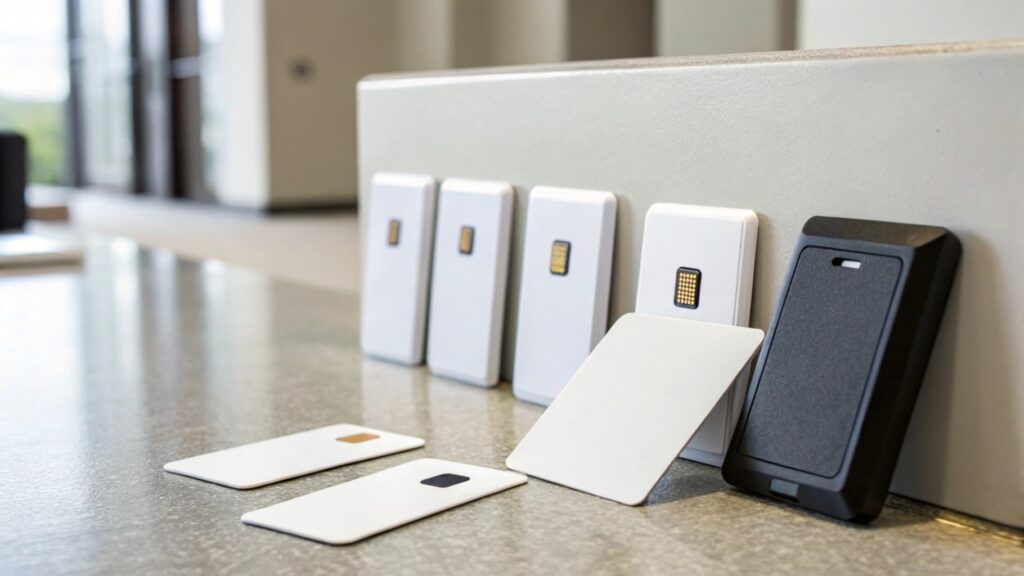
NTAG is also HF 13.56 MHz, but tuned for NFC—the mode a consumer smartphone reads natively. That makes it the default for marketing tags, product authentication, and QR-style “tap for more” experiences on packaging and certificates. NTAG 21x parts carry a few hundred bytes to a couple of kilobytes, enough for a URL or a signed record, and include anti-tearing and a unique 7-byte UID. If the reader is a phone in a customer’s hand, NTAG is almost always the right call. See our RFID tag procurement guide for supplier vetting and testing steps.
ICODE (NXP): The HF Smart Label & Retail Inventory Leader
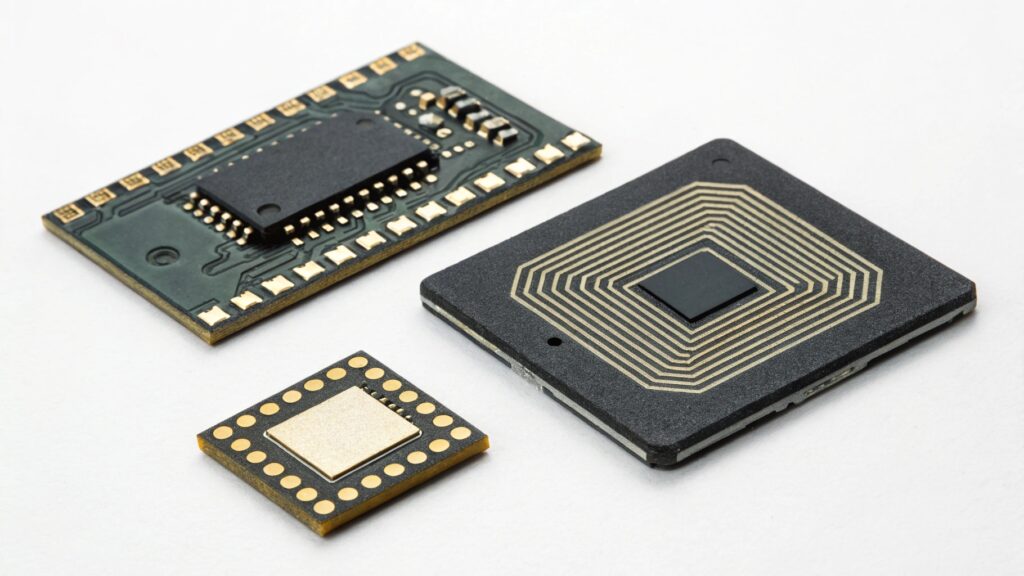
ICODE sits in the HF band and targets item-level retail and library workflows where many tags are read together quickly. ICODE SLIX and the ILT (long-range, tap) variants support anti-collision reads of dense populations and are common in apparel source tagging and book tracking. Memory and read reliability suit item-level serialization better than NTAG’s phone-first design. For HF item-level inventory at scale, ICODE beats NTAG on multi-tag throughput. It pairs well with the frequency planning in our LF vs HF vs UHF guide.
UCODE (Impinj): The Dominant Force in UHF Retail & Supply Chain
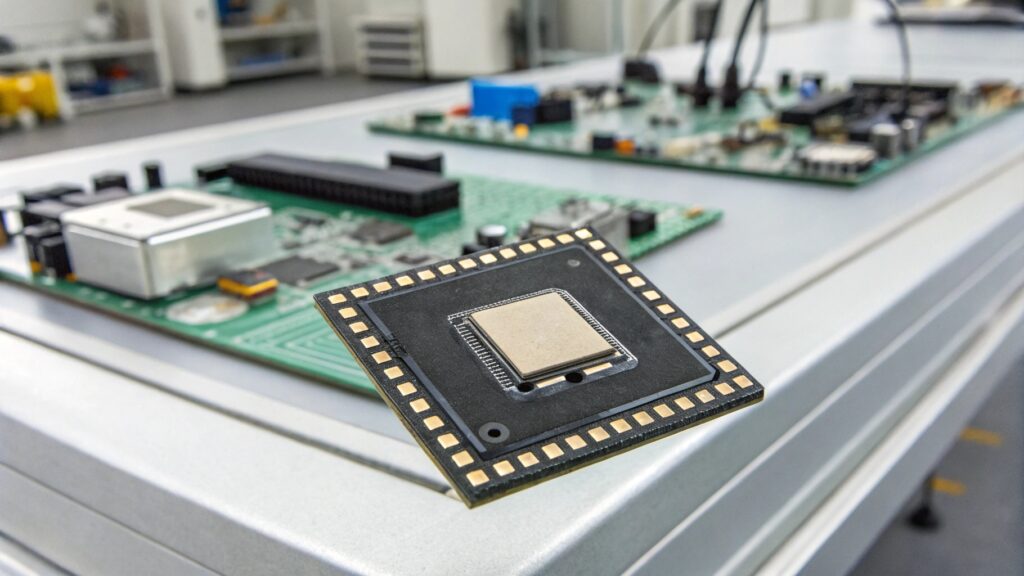
UCODE is Impinj’s UHF (860–960 MHz) family and the volume leader for RAIN RFID supply-chain and retail applications. UCODE 8/9 deliver long read ranges, fast inventory of thousands of items, and large memory for serialized EPCs. UCODE is the answer when the reader is a fixed or handheld UHF portal, not a phone. Because UHF range varies by region (see GS1’s RFID standards), confirm the band your market uses before committing. Our RFID pricing guide breaks down how chip choice moves per-unit cost at volume.
Side-by-Side Comparison: Memory, Range, Security & Cost
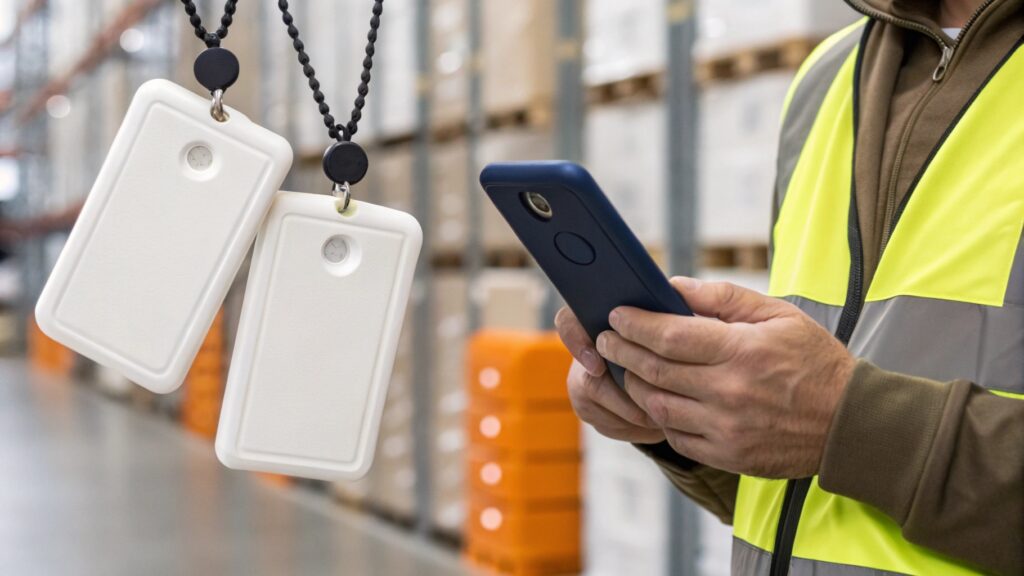
| Family | Frequency | Typical range | Memory | Best for | Security |
|---|---|---|---|---|---|
| MIFARE | HF 13.56 MHz | ~2–10 cm (tap) | 1–8 KB | Access, payment, ID | Strong (DESFire) |
| NTAG | HF 13.56 MHz | ~2–4 cm (NFC) | 0.1–2 KB | Consumer NFC, auth | Moderate |
| ICODE | HF 13.56 MHz | ~0.1–1.5 m | 0.5–2 KB | HF item-level inventory | Moderate–strong |
| UCODE | UHF 860–960 MHz | ~1–12 m | 0.3 KB+ | UHF supply chain/retail | Std RAIN |
No single winner exists—only the best fit for your frequency band and reader. MIFARE and NTAG cover HF tap/NFC; ICODE adds HF multi-tag throughput; UCODE owns UHF distance and volume. Protocol details and regional bands are maintained by the RAIN RFID alliance.
How to Match the Right Chip to Your Application
Start from three questions: (1) Who reads it—a UHF portal, an HF terminal, or a phone? (2) How much data must it carry—a URL, a serial, or a credential? (3) What security level does the program require? Lock the frequency and reader first, then pick the family, then negotiate volume pricing. For payment or government ID, require a certified secure chip and a published compliance statement from your supplier.
Frequently Asked Questions
Can I switch chip families mid-project without redesigning everything?
Not cleanly. Frequency band, antenna, and reader firmware are tied to the family. Switching MIFARE to UCODE means a new inlay, new readers, and new encoding—effectively a relaunch. Choose the family at the spec stage; change it only with a full re-test.
Are there viable alternatives to NXP and Impinj?
Yes, but the ecosystem is thinner. STMicroelectronics, EM Microelectronic, and several Asian fabs offer HF/UHF parts, and many are pin- and protocol-compatible. For mainstream B2B programs, NXP and Impinj remain the safe default for reader availability and long-term supply.
How does chip choice affect my RFID card or tag manufacturing cost?
The chip is often 30–60% of a tag’s material cost. UCODE and NTAG are commodity-priced at volume; DESFire-class MIFARE carries a security premium. Higher memory and crypto also raise unit price, so size the chip to the data you actually store.
What about emerging technologies like Bluetooth LE or dual-frequency tags?
BLE tags add a battery and app dependency—wrong for disposable labels. Dual-frequency (HF+UHF) inlays exist for programs needing both phone tap and portal reads, but cost more and complicate encoding. Adopt them only when a single band genuinely can’t serve both use cases.
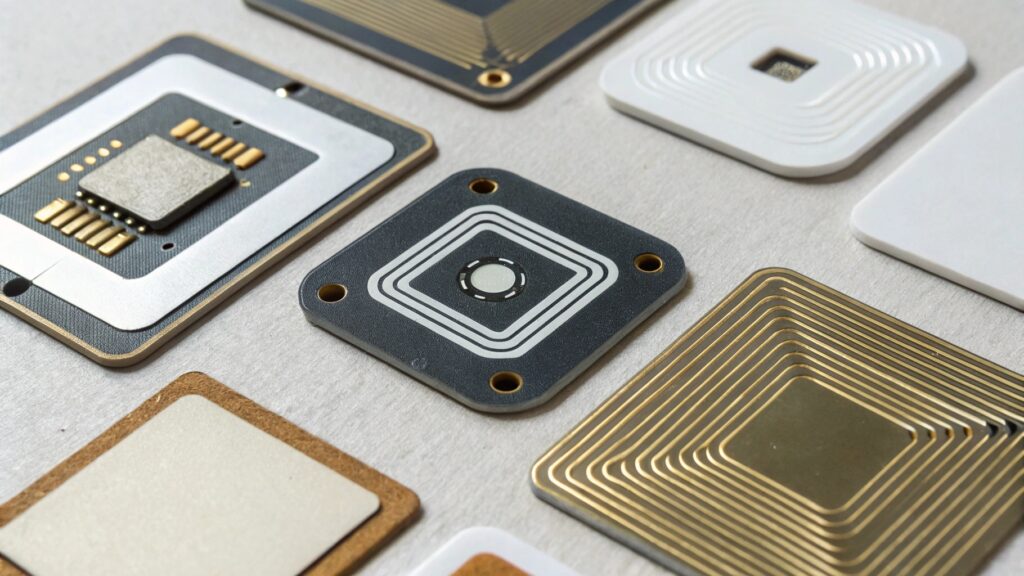
Still deciding between MIFARE, NTAG, ICODE, and UCODE? Send us your application, reader model, and volume, and we’ll spec the chip family and inlay that fit—then sample before you commit. Contact our RFID team for a tailored recommendation.