If you run procurement for a ministry, a university registrar’s office, or a certification body, you already know the stakes: one forged certificate, tampered ballot, or cloned staff ID can trigger a public scandal, legal exposure, and months of cleanup. The hard part isn’t wanting security — it’s knowing which printing features, materials, and suppliers actually hold up when someone with a scanner and time tries to copy your documents.
This guide walks you through how professional security printing protects institutions in practice — the technologies that matter, how to match a security level to each document, and a supplier checklist you can take straight into your next tender. No jargon dumps, just what a buyer needs to make a defensible decision.
What security printing actually protects you against

Security printing is the combination of specialised substrates, inks, and finishing techniques that make a document, label, or card hard to copy, alter, or fake. For an institution, that translates into three concrete jobs:
- Stop counterfeiting — someone producing a fake from scratch (a diploma mill certificate, a cloned access card).
- Stop tampering — someone altering a genuine document (changing a grade, a name, or an amount).
- Enable fast verification — your staff, or a border officer, confirming authenticity in seconds without lab equipment.
Good security printing layers overt features (visible checks anyone can do) with covert features (hidden checks only you and forensics can verify). The layering is the point: any single feature can eventually be imitated, but combining three or four makes forgery uneconomical. For a deeper look at the feature set, see our overview of modern anti-counterfeiting technologies.
The core anti-counterfeit technologies, explained for buyers

You don’t need to be a materials engineer, but you should recognise what each feature buys you and roughly what it costs.
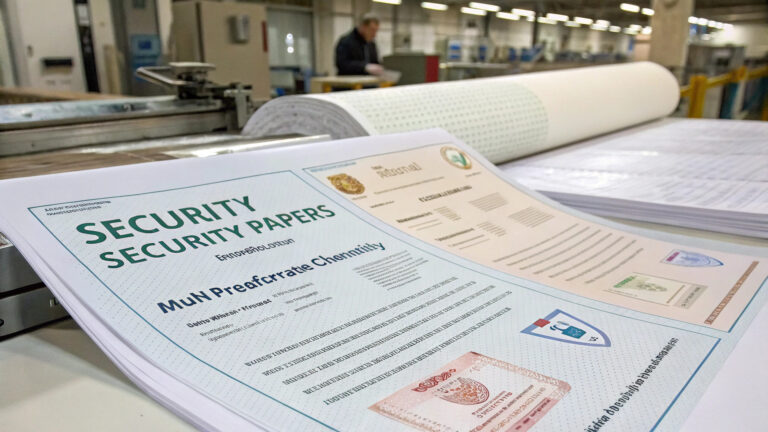
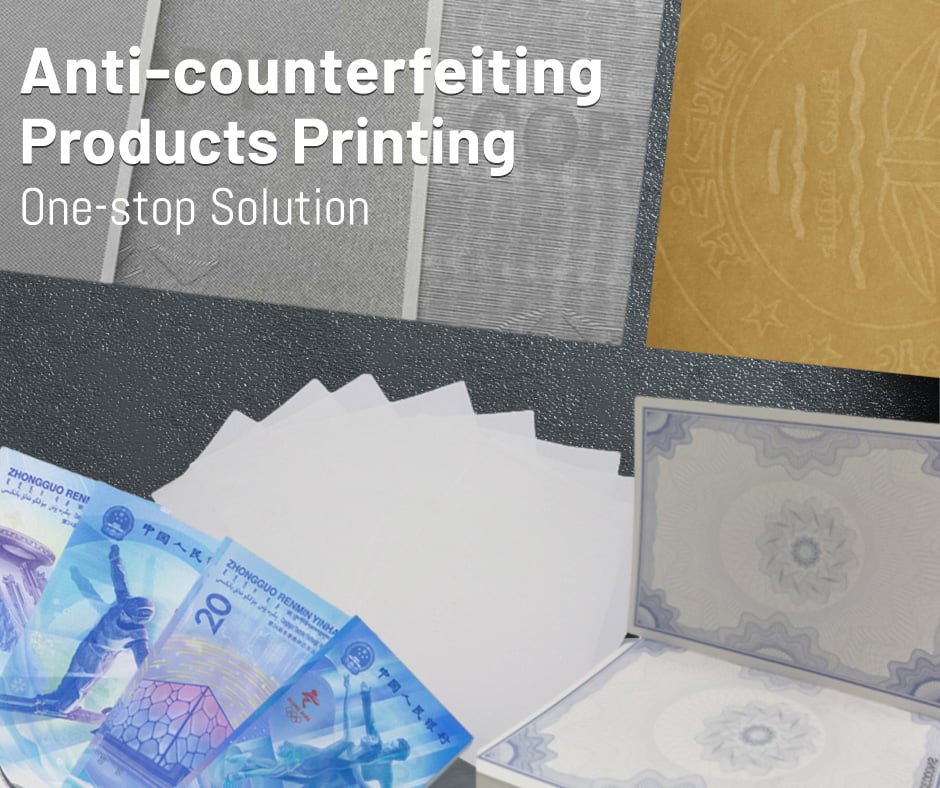
Watermarked security paper
A true watermark is formed in the paper itself and shows when backlit — it can’t be photocopied. Typical institutional stock runs 60–120 g/m² with a bespoke watermark for certificates, ballots, and licences. It’s the workhorse first layer for any paper document. See how custom watermarked paper is specified.
Security threads and UV-reactive fibres
A security thread is a thin strip embedded in the paper (sometimes with microtext or colour shift). UV fibres are invisible in daylight and glow under a UV lamp — a low-cost covert check that’s easy to train frontline staff on.
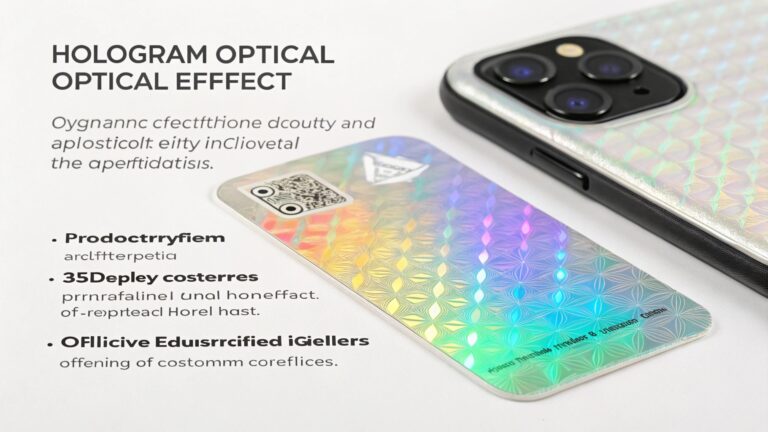
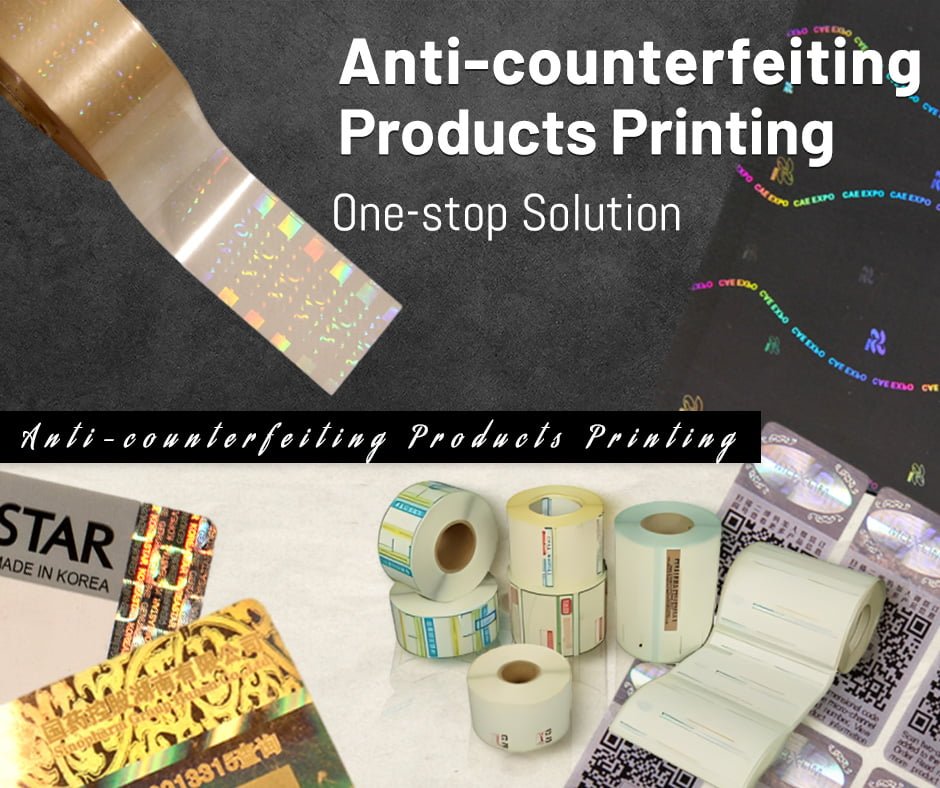
Holographic foils and labels
Holograms add dynamic visual effects, microtext, and serialisation that are extremely hard to reproduce with commercial printers. They’re ideal for seals, diplomas, and tamper-evident labels where a quick visual check happens in the field.
PC and NFC ID cards (chip cards)
Polycarbonate (PC) cards fused into a single durable body, with chips such as DESFire EV3 or national-grade secure elements, are the standard for staff, student, and citizen IDs. Add laser engraving, optically variable ink (OVI), and invisible UV printing for a multi-layer credential.
How to match a security level to each document

Over-specifying wastes budget; under-specifying invites fraud. A simple way to decide is to grade each document by the cost of a successful forgery, then layer features accordingly.
| Document type | Risk / forgery impact | Recommended layers |
|---|---|---|
| Internal certificates, training records | Low | Watermark paper + UV fibres |
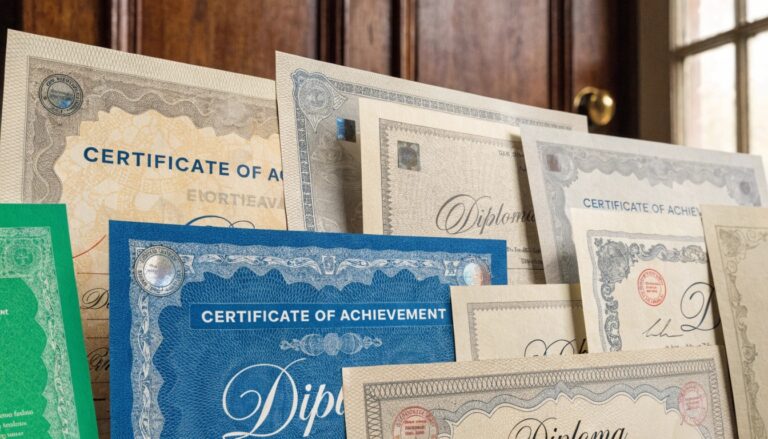
| Diplomas, licences, land / civil records | High | Watermark + security thread + hologram + serial number |
| Ballots, tax stamps | High | Watermark + thread + UV + numbered hologram seal |
| Staff / student / citizen ID | High | PC card + chip (DESFire/NFC) + laser engraving + OVI |
If you’re standing up a credential programme, our high-security ID card procurement guide breaks down chip choices, tolerances, and personalisation options in detail.
Why institutions buy from certified suppliers, not marketplaces

The feature list is only half the decision. For public tenders and regulated procurement, who you buy from is scrutinised as hard as what you buy. Certified suppliers give you what an open marketplace can’t:
- Traceable materials with batch records and compliance documentation
- Lab test reports and sample kits you can submit for tender evaluation
- Factory QA, NDAs, and secure handling of your artwork and data
- Customisable security elements matched to your exact risk profile
Genuine has supported national-level projects for 15+ years, delivering anti-counterfeit materials to government programmes across Latin America and Africa. To protect procurement privacy, we share redacted case studies and test reports on request — useful evidence to attach to a tender file.
Your supplier evaluation checklist

Bring this to your next vendor conversation. A supplier who can’t answer these quickly is a risk:
- Request sample kits and independent lab test reports — not just marketing images.
- Confirm the exact security features and tolerances (paper weight, thread type, chip model, hologram origination).
- Verify lead times and logistics for delivery into your country, including customs handling.
- Ask for tender-ready documentation, references, and redacted case studies.
- Check data security — how they store your artwork, personalisation data, and serial ranges.
Buying paper-based documents in volume? Our 2025 anti-counterfeit paper procurement guide covers cost optimisation and compliance for global buyers.
Frequently asked questions

How do I verify a security document without special equipment?
Start with overt checks anyone can do: hold paper to light for the watermark and thread, tilt holograms to see the effect shift, and inspect microtext with a phone camera zoom. Add one covert check — a cheap UV lamp reveals fibres and invisible print — and you’ve got a reliable two-tier field verification for staff.
What’s the difference between overt and covert security features?
Overt features (watermarks, holograms) are meant to be seen and checked by anyone. Covert features (UV fibres, invisible ink, microtext, chip data) are hidden and used for second-level or forensic verification. Institutions should combine both so a casual check is easy while deep authentication stays hard to fake.
Are PC/NFC ID cards worth it over standard PVC?
For high-value, long-life credentials — yes. Polycarbonate resists tampering and lasts far longer than PVC, and an embedded secure chip enables access control and digital verification. For short-term visitor badges, PVC is fine. Match the card to the credential’s lifespan and risk.
Can you provide documentation for a public tender?
Yes. We supply sample kits, lab test reports, compliance documents, and redacted references formatted for tender evaluation. Tell us the tender requirements and we’ll assemble the evidence pack.
Talk to a security printing specialist
Whether you’re specifying a single certificate or rolling out a national ID programme, the right combination of paper, holograms, and chip technology protects your institution’s credibility. Contact our team for samples, test reports, and tender-ready documentation tailored to your project.
SUZHOU GENUINE TECHNOLOGY CO., LTD.
Security paper | Hologram labels | NFC / PC ID cards
Email: may@genuine-printing.com
WhatsApp: +86 134 5197 7186