Every retailer chasing an omnichannel promise hits the same wall: online orders pile up, but inventory sits in silos, and the “ship-from-store” dream collapses into 2–4 day delays. Uniqlo solved it — and the answer was not more warehouses. It was a $0.03 RFID tag sewn into every garment. With 900+ stores in China alone and roughly a quarter of sales from e-commerce, Uniqlo turned its store network into a 3-hour fulfillment engine that competitors still struggle to copy. Here is the playbook — and what your operation can borrow.

How Uniqlo Turned 900+ Stores into a 3-Hour Fulfillment Network
Uniqlo’s model flips the traditional distribution-center-first supply chain. Instead of routing every online order to a central warehouse, the system treats each store as a node in a single, real-time inventory graph. When a shopper orders online, an algorithm locates the nearest store holding the exact size and colour, then triggers in-store pickup (ready in about 30 minutes) or same-day delivery through a logistics partner. According to the retailer’s published figures, about 90% of urban orders now arrive within three hours.
The payoff is operational, not just marketing. Uniqlo reports cutting restocking time by 70% and lifting inventory accuracy to 99.9% — the difference between a confident “yes, it ships today” and a costly oversell. Uniqlo is not alone — Zara followed a similar RFID inventory playbook.
The RFID Lifecycle: One Tag, From Factory to Pocket
The mechanism is deceptively simple. Each garment carries a thumbnail-sized RFID tag storing an encrypted SKU, size, and production record. Because RFID reads up to 200 items per second — roughly 50× faster than a barcode scan — a whole shipment, cart, or shelf can be counted in seconds rather than minutes.
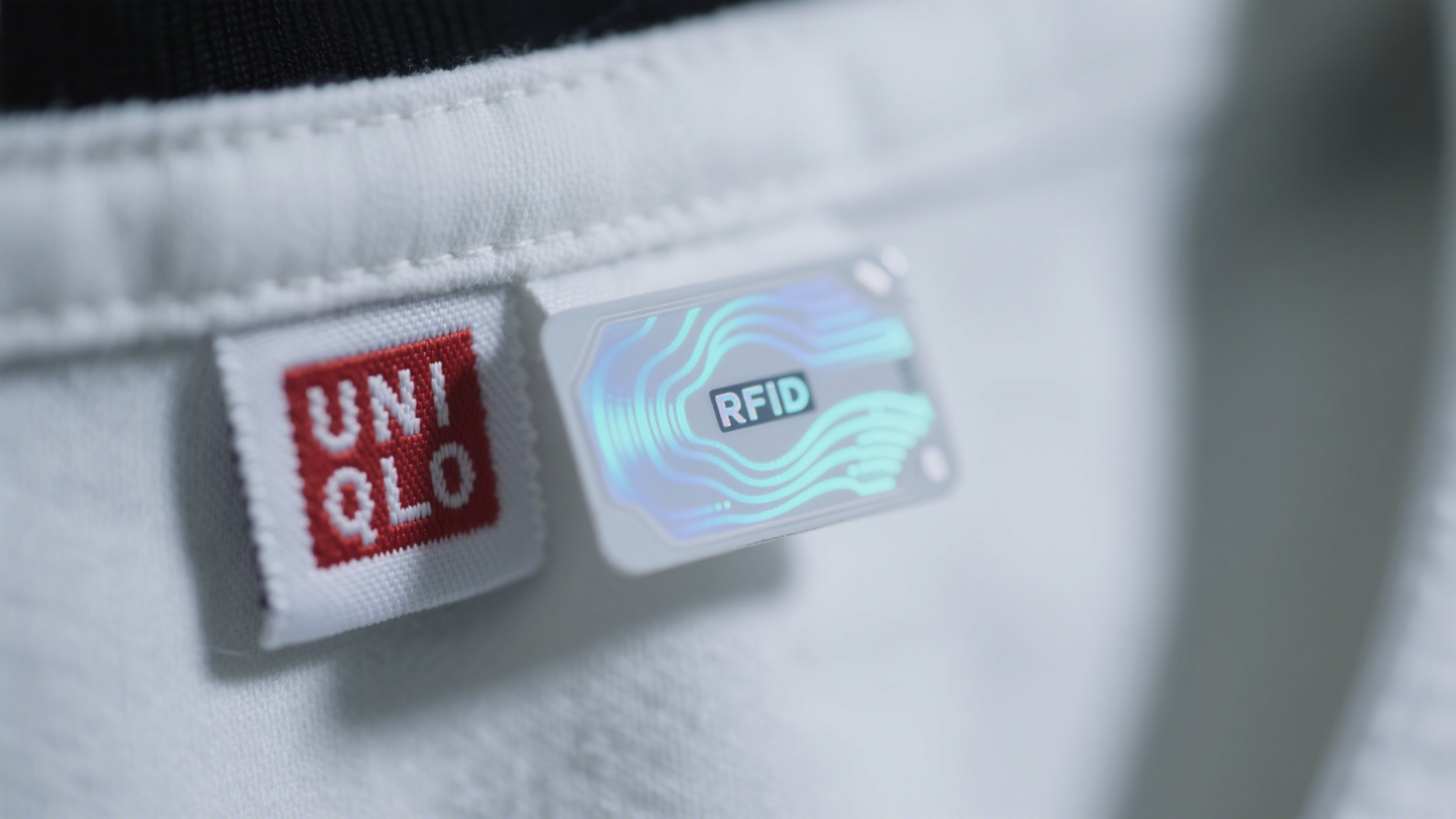
That speed is what makes real-time sync possible. A tagged item is visible to the system the moment it leaves the factory, arrives at a store, moves to the floor, or walks out the door — no manual scan, no blind spots. If you are scoping your own rollout, start with our RFID tag buyer’s guide for the substrate and chip choices that survive washing, shipping, and returns.
Real-Time Inventory and “Ship-from-Store” Micro-Fulfillment
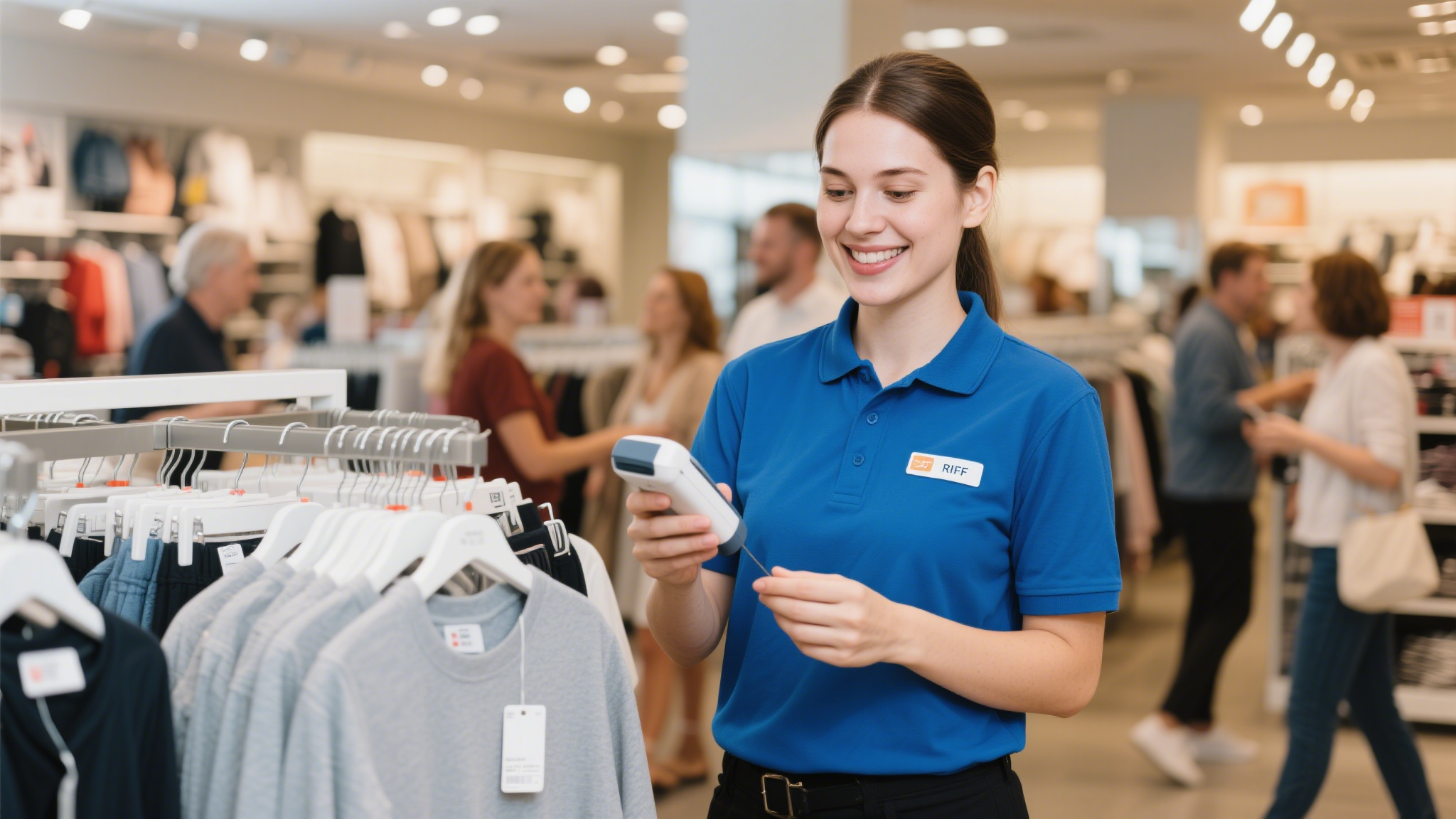
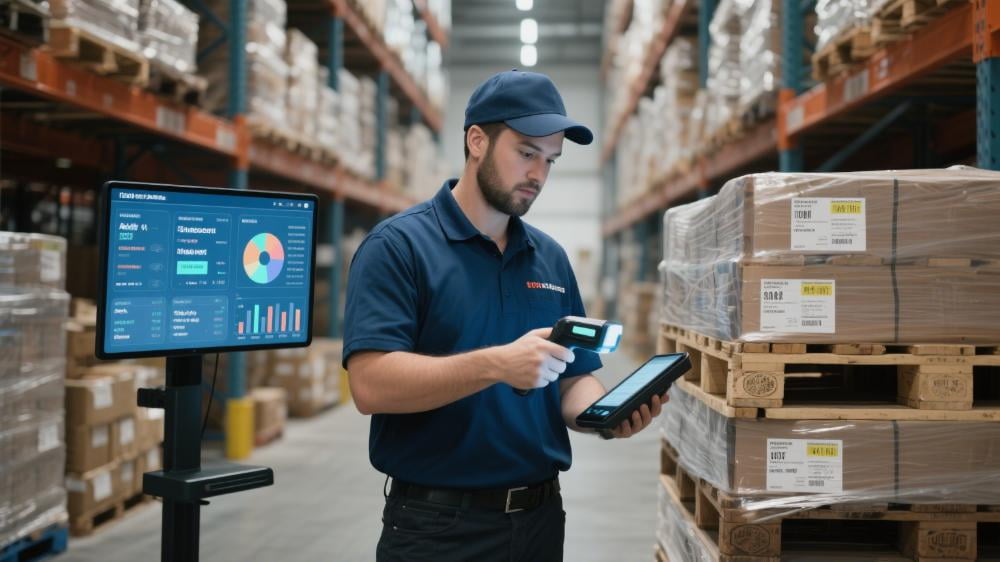
Inventory updates roughly every 30 minutes across the network, which is why “out of stock online” rarely means “out of stock in the building.” When a jacket sells on the website, nearby stores adjust their available stock automatically, and a staff member with a handheld scanner picks and packs it for collection or courier handoff.

This is the part most retailers underinvest in. The discipline of syncing every node to one source of truth is what costs effort — and what Uniqlo’s 99.9% accuracy buys back in a 30% cut to overstock carrying cost.
Three Innovations Working Behind the Scenes
Beyond the core tag-and-sync loop, three upgrades do the heavy lifting:
- Smart mirrors and instant checkout: RFID-enabled mirrors detect tried-on items and suggest matches; pad-style checkout drops transaction time from about five minutes to roughly 30 seconds.
- Anti-counterfeit shields: unique tag IDs block fake returns, which Uniqlo says cut return-fraud losses by about 80% in Japan — a direct margin-protection lever for any brand fighting counterfeit stock.
- Predictive restocking: RFID data feeds machine-learning models that, in 2024, predicted snow-jacket demand with about 95% accuracy, smoothing replenishment before spikes hit.

RFID vs Barcodes: The Five Metrics That Decide
None of this works on legacy barcodes at store scale — the comparison below is why most large apparel RFID programs moved off line-of-sight scanning.
| Metric | RFID | Barcodes |
|---|---|---|
| Speed | 200 items/sec | 1 item/sec |
| Accuracy | 99.9% | 85% |
| Durability | Waterproof | Easily damaged |
| Data Capacity | 1,000× more data | Limited |
| ROI (3-year) | $8 savings per tag | $0.1 per barcode |
For a standards grounding, GS1 and the RAIN RFID Alliance publish the tag-data and air-interface specifications most retail programs adopt, and the underlying air interface is standardized as ISO/IEC 18000.
What Your Retail Operation Can Copy from Uniqlo
You do not need Uniqlo’s scale to capture most of the value. Three moves transfer directly:
- Start with the highest-turn SKUs: tagging your top 20% of styles delivers the majority of inventory-accuracy and fulfillment gains for a fraction of the rollout cost.
- Treat stores as inventory, not just displays: the same sync that powers ship-from-store also slashes manual counts and shrinkage.
- Source tags as a system, not a commodity: chip family, frequency band, and print/encode method should be specified together. Our RFID procurement guide walks through the seven sourcing mistakes that quietly inflate total cost.
If you are still deciding on frequency, our LF/HF/UHF guide explains which band fits apparel, logistics, or asset tracking before you commit capital.
Frequently Asked Questions
How much does an RFID tag for retail apparel cost?
Uniqlo’s program is built on tags reported around $0.03 each at scale; for smaller runs the per-tag cost is higher but still cents, and the ROI rests on counting labor saved, fewer mis-ships, and lower overstock — not the tag price alone.
Can small and mid-size retailers replicate Uniqlo’s RFID model?
Yes, in phased form. Most of the payoff comes from tagging high-turn SKUs and syncing store stock to one system. You do not need 900 stores; a single DC plus a few locations already benefits from ship-from-store and automated counts.
Is RFID secure against counterfeiting and fake returns?
Unique, encrypted tag IDs make clones detectable and let retailers block fraudulent returns — Uniqlo cites roughly 80% lower return-fraud losses in Japan. RFID also pairs well with overt security printing for layered anti-counterfeit protection.
Which RFID frequency is best for clothing and retail?
UHF (Ultra-High Frequency) dominates apparel and supply-chain RFID because of long read ranges and fast batch scanning. HF suits access control and some item-level uses. Our LF/HF/UHF guide breaks down the trade-offs by use case.
Build Your RFID Fulfillment Case with a Trusted Partner
Uniqlo’s result — warehouse headcount cut by about 90% while delivery speed doubled — shows omnichannel success hinges on connectivity, not channel count. If you want to scope a pilot on your top SKUs, our team can spec tags, frequencies, and print/encode workflows to your operation. Talk to us about a reader-matched sample set, or start with the RFID tag buyer’s guide.