If you manage five hundred access cards, a missed expiry date is an annoyance. If you manage fifty thousand, it is a lockout event that walks straight through your lobby — and a renewal project that quietly triples its budget. This guide walks through the card renewal lifecycle the way B2B buyers actually experience it: expiry cadence, revocation, bulk reissue, and the questions that keep a credential program from stalling at scale.
Why Credential Lifecycle Management Matters at Scale
Credential problems rarely announce themselves. A badge that stopped working last Tuesday is an annoyance; a badge that still works after its owner left the company is a finding on your next security audit. At small volumes, both get fixed by a person walking to a drawer. At scale — hundreds of doors, multiple sites, contractors, visitors, and staff — the same two failures become systematic: avoidable lockouts that burn helpdesk hours, and unrevoked credentials that quietly expand your attack surface.

The fix is not more discipline. It is treating the card population as a pipeline with defined stages, owners, and dates — the same way you treat software licenses or insurance certificates. Buyers who do this consistently report two things: fewer emergency reissue orders, and renewal budgets that are planned instead of discovered.
The Four Stages of a Credential Lifecycle
Every access credential moves through the same four stages, whether anyone tracks them or not:
- Issuance — the card is personalized, encoded, and activated for a specific holder and access profile.
- Active — daily use at doors, printers, and logical access points; the longest stage and the one buyers plan for.
- Expiry — the printed or encoded validity date passes, and the credential should stop working on schedule.
- Revocation and reissue — the credential is disabled early (termination, loss, upgrade, compromise) and a replacement enters the pipeline.
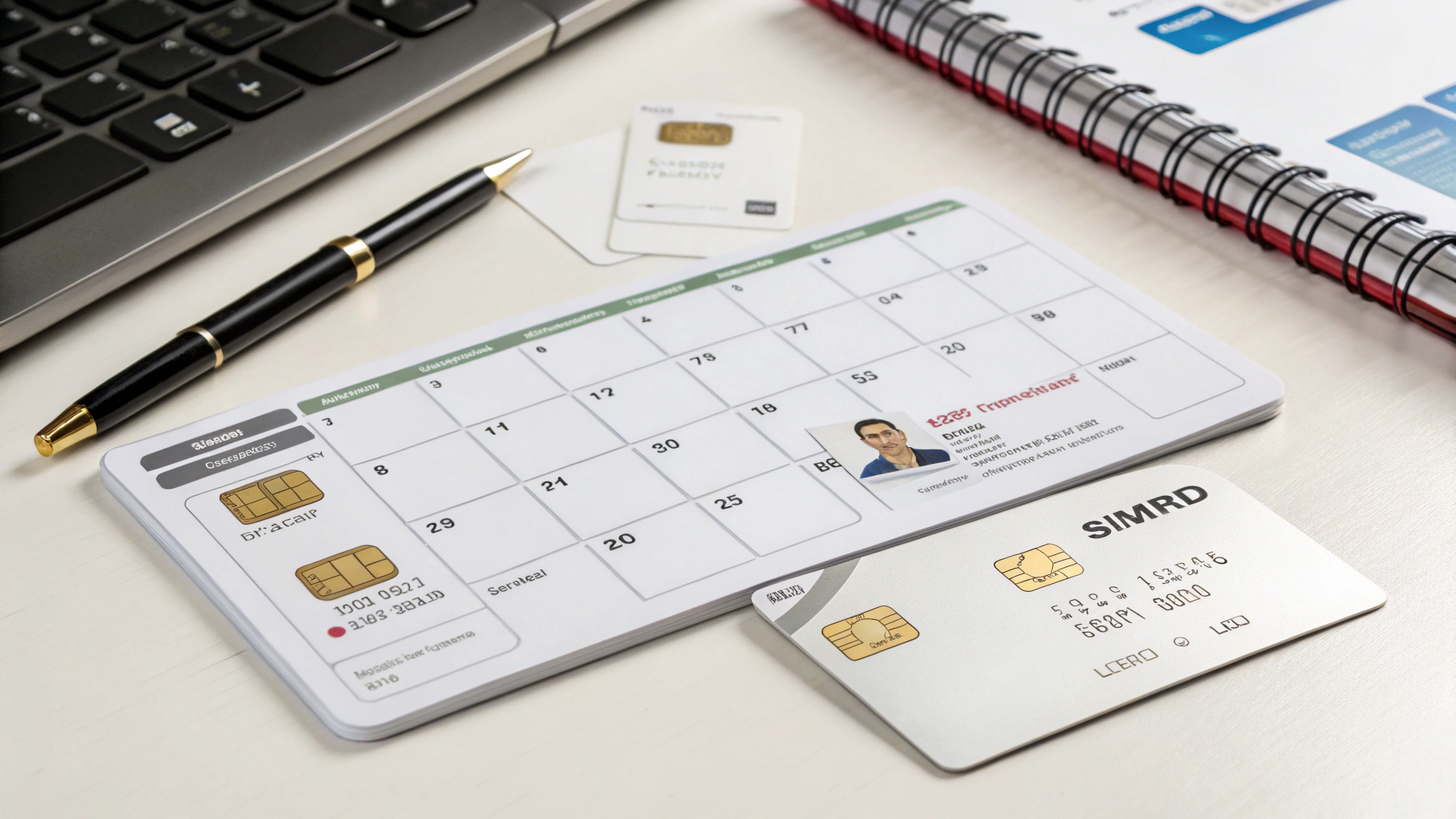
The stage most programs get wrong is the transition between them. Federal guidance on physical access control systems, notably NIST SP 800-116r1, treats lifecycle status as a first-class attribute of the credential rather than an afterthought — and that framing scales down to enterprise programs just as well. A credential that isn’t tracked through all four stages is either a security hole or a budget leak; in practice, it is usually both.
There is also a practical dependency buyers discover late: if your card management system cannot see expiry dates and HR status, the lifecycle is being tracked in a spreadsheet — which is where most lockouts are born. Our overview of card management systems and middleware covers what to look for before that gap bites.
Setting the Right Expiry Cadence by Credential Type
A single blanket expiry date is the most common design mistake in renewal programs. It feels tidy, and it guarantees that one week of the year becomes a reissue crisis. The cadence should follow the holder’s risk profile instead:
- Employees — 2 to 3 years for most enterprise ID and access cards, aligned with photo updates and role changes.
- Contractors — tied to the contract end date, not to a calendar year.
- Visitors — same-day expiry; the credential should not outlive the visit.
- High-assurance credentials — 5 to 10 years for government-grade ID, where the card body and chip are engineered for a decade of daily wear under the physical characteristics standardized in ISO/IEC 7810.
Align expiry with role risk, not administrative convenience. A visitor badge valid for a week and a national ID valid for ten years are both correct designs — for very different reasons. What matters is that the expiry is enforced by the system, not remembered by a person.
Revocation: Closing the Gap Before a Card Becomes a Liability
Revocation is where lifecycle management earns its budget. The scenario is always the same: an employee leaves, the exit checklist says “return badge,” and the badge — along with its encoded access rights — stays in a jacket pocket or on a data list nobody owns. A terminated employee’s credential must stop working the same day, and the only reliable way to achieve that is an automated link between your HR offboarding process and the access control system.

Two compliance angles make this more than an operational nicety. First, cards and their chip data are personal data; under the GDPR, access logs tied to an identifiable person carry obligations that do not end when the employment does. Second, when credentials are decommissioned, the data on them should be treated like any other stored media — NIST SP 800-88 guidance on media sanitization is the usual reference point for deciding what “clean” means before a card is reused, resold, or destroyed.
Bulk Reissue Without Lockouts
At some point every large program faces a bulk reissue: a technology migration (say, from low-frequency to smart card credentials), a rebrand, or simply a cohort that all started the same month and all expire the same week. Handled badly, it becomes a week where thousands of people queue at the security desk. Handled well, nobody notices. The mechanics that separate the two:
- Stagger expiry dates across cohorts — month of hire, department, or site all work as slicing keys.
- Overlap windows — issue the new credential while the old one still works; a 2–4 week overlap converts a lockout risk into a non-event.
- Phase by site or department, never by card number — you need a rollback path that maps to your org chart.
- Communicate early — a renewal nobody expected generates helpdesk tickets; a renewal with a two-week notice generates none.
Never let 100% of a credential population expire on the same date. If your current inventory does, the first renewal project should be about redistributing expiry dates — not just replacing cards. And receiving a renewal shipment is its own failure point; our receiving and acceptance checklist covers what to verify before a bulk order reaches your employees.
What Renewals Actually Cost at Volume
Buyers tend to price a renewal by the card. That is understandable — the card is the visible artifact — but it systematically underestimates the project. At volume, the card substrate is usually the minority of the total: personalization, encoding, serialization, packaging, and the internal labor of coordinating the rollout typically dominate. The card is often less than half of the true renewal cost; the pipeline around it is the rest. A simple way to sanity-check a quote is to ask which of these components it covers:
| Cost component | What it covers | Who usually misses it |
|---|---|---|
| Card body & chip | Substrate, chip, antenna, printing | Rarely missed |
| Personalization | Variable data: photo, name, employee number | Sometimes |
| Encoding & keys | Chip/RF encoding, key management, schema | Often |
| Serialization & data files | Numbering scheme, traceability records | Often |
| Logistics & packaging | Batch packing, shipping, customs | Sometimes |
| Internal labor | Enrollment, distribution, helpdesk | Almost always |
This is also where card serialization and numbering earns its keep: renewal projects with clean serialization trace every card from production file to employee, which is what makes a staggered reissue auditable at all.
Questions to Ask Your Card Supplier Before a Renewal Program
Most renewal projects fail at the specification stage, not the production stage. Before committing volume, put these questions to any supplier — the answers are more predictive of project success than the unit price:
- What is your MOQ and lead time at my volume, including personalization and encoding?
- Can cards ship pre-encoded to our access-control schema, tested against our readers?
- What serialization and data-file formats do you deliver for traceability?
- Will you provide sample cards from the actual production line before we commit?
- Which credential platforms (HID, MIFARE DESFire, OSDP readers) have you certified compatibility with?
- How do you handle personalization data: encryption in transit, retention, and destruction after the run?

The cheapest quote is rarely the lowest total cost once reissue loops, encoding failures, and compatibility rework are counted. Samples and a short pilot phase are the cheapest insurance available in this category — our guide on requesting card samples before an order explains how to run one without slowing the project down.
Renewal programs reward the buyers who treat credentials as a pipeline rather than a purchase order: expiry cadence matched to role risk, same-day revocation, staggered reissue, and a supplier who can prove compatibility before production. None of these are glamorous, and all of them are the difference between a renewal nobody notices and one that walks through your lobby. If you are preparing a renewal program, request samples or a quote and pressure-test the pipeline before you commit volume.