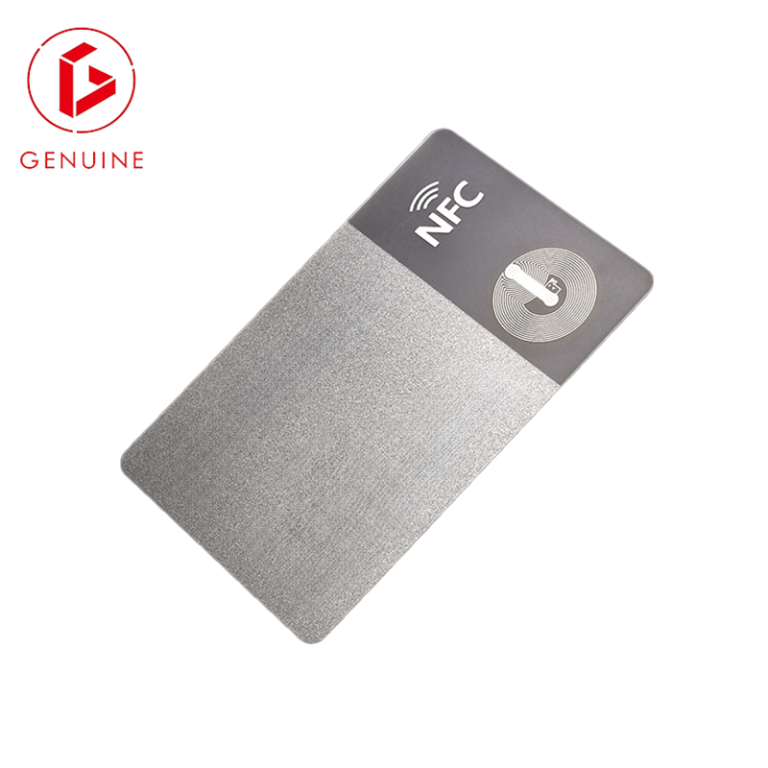
You have already specified the chip, the substrate, and the encoding. But the moment a carton of blank polycarbonate cards—or, worse, cards that already carry serial numbers and keys—sits in a warehouse or on a loading dock, it is a controlled asset you have not yet controlled. For a government ID, e-passport, or enterprise access program, secure card storage and chain of custody is not a logistics footnote; it is the part of the project where fraud actually happens. This guide walks through the handling discipline buyers should require before a single card leaves the supplier.

Why blank and pre-encoded cards are a controlled item, not office supplies
A blank secure card is not stationery. For a high-assurance program, the card body itself is a security substrate—polycarbonate layers, laser-engraved features, and (on pre-encoded stock) a chip that already holds a unique identifier or key. A pre-encoded card is, functionally, a live credential. Leaving it on a desk or in an unmonitored cupboard is the same risk as leaving a stack of issued badges unattended.
Standards already treat it this way. ISO 14298:2021, the management standard for security printing, requires controlled storage, restricted access, and documented destruction of rejects across the production and holding environment (ISO 14298:2021). For U.S. federal identity programs, NIST SP 800-79-2 sets the controls a Personal Identity Verification (PIV) Card Issuer must meet, and those controls extend to how cards are held before personalization and issuance (NIST SP 800-79-2). If your program is procured against FICAM or an equivalent framework, the custody expectation is already written into the contract—you just have to enforce it (FICAM, idmanagement.gov).
The issuer-accreditation angle maps directly to your sourcing decision—see our PIV and PKI smart cards buyer’s guide for how the controls should appear in a supplier’s paperwork.

Locked storage: who can touch what, and when
Segregate blank stock from pre-encoded stock, and keep both in access-controlled, logged storage. For government and enterprise high-assurance programs, apply dual custody—no single person moves or signs out a batch alone. Add environmental controls (temperature and humidity matter for PVC and polycarbonate) and a sign-out/sign-in log that names the custodian, not “the mailroom.”
Segregate blank from pre-encoded stock, and log every movement by name. A card that cannot be located at a given moment is a card you no longer control. If your supplier holds inventory for you, demand the same standard in their facility—this is exactly the kind of control our smart card certifications guide looks for in an audited manufacturer.
Serialization reconciliation: every physical card must match a record
Blanks carry batch and lot numbers; pre-encoded cards carry UIDs or serial numbers. After every movement—receipt, transfer, issue, return—reconcile the physical count against the serialization manifest. Define a discrepancy threshold that triggers immediate investigation rather than a footnote in next quarter’s report. Run a periodic wall-to-wall count so the books and the bins agree.
If the number of physical cards does not equal the number of recorded serials, you do not have custody—you have a gap. Building serialization into your order from the start is the cheapest way to make this reconciliation automatic; our card serialization and numbering guide shows the schema buyers should request.

The hand-off: transport, receiving, and the moment of transfer
Custody moves at the signature, not at dispatch. Ship blanks and pre-encoded stock in tamper-evident sealed bags or cartons, and require that the transfer be witnessed at both ends. On arrival, perform a receiving inspection before the batch is accepted into storage—count, verify seals, and confirm serial ranges against the manifest.
Custody transfers at the signature, not at dispatch. A sealed bag proves nothing until someone witnesses the opening. The same discipline applies at your dock as at the supplier’s: our card shipment inspection checklist lists exactly what to verify before you sign.

Destroying the rejects: blanks, spoiled prints, and returned cards
Misprints, spoiled encodes, and expired or returned cards are still controlled items—often the most dangerous ones, because they look legitimate. Destroy them to a standard: shredded, not tossed in recycling, and witnessed by two people who log the date, method, and count. Apply the same rule to obsolete blank inventory sitting in a supply closet; it is a live risk, not surplus.
A deactivated card in the access system ends its digital life; shredding it ends its physical life—finish both. Industry guidance on credential destruction stresses that assessors increasingly ask how credentials leave the population, and “we deactivated them” answers only half the question (Blue Violet Security; G5 Cybersecurity).

Logs and audit trails: the “who-touched-what” record
Every movement, transfer, and destruction should land in an append-only, named-custodian log with a retention period aligned to your program and audit cycle. When an assessor asks how a card left the population, the log is your only answer—and a missing log is itself a finding.
Assessors increasingly ask how credentials leave the population. Your destruction and transfer logs are the only answer. Keep them auditable and ready; the same governance mindset underpins the certifications we cover in our smart card certifications guide.

Contract clauses to require before you sign
Turn the discipline above into enforceable language. Put these in the RFQ and the contract:
- Dual-custody, access-controlled storage of all blanks and pre-encoded stock, at the supplier and in transit.
- Per-batch serialization reconciliation report (physical count vs. recorded serials) delivered with each shipment.
- Tamper-evident sealed delivery with a witnessed receiving inspection at your dock.
- Witnessed destruction certificate for every reject, spoiled print, and returned card—method, count, and two signatures.
- Auditable who-touched-what log with named custodians and a defined retention period.
- Right-to-audit / site-inspection clause so you can verify the above in person.
Put the destruction certificate and the serialization report in the contract, not in the supplier’s good will. The extra clause costs nothing at signature and prevents the expensive conversation later. Sourcing directly from a manufacturer rather than an intermediary also shortens the chain of parties who can touch your stock—our factory-direct vs reseller guide explains the risk trade-off.

Frequently asked questions
How long should chain-of-custody records be kept?
Align retention to the credential’s validity plus your audit cycle. Many government programs keep transfer and destruction logs for the life of the credential and several years beyond, because an investigation can open long after issuance.
Is ISO 14298 certification mandatory for my supplier?
It is the recognized management standard for security printing (ISO 14298:2021). For government and high-assurance programs it is increasingly a contractual requirement, not a nice-to-have; for lower-risk enterprise programs it is a strong signal that storage and destruction controls exist.
Can a supplier pre-encode cards and still keep keys safe?
Yes—if key custody follows a documented model with named custodians and dual control. The risk is a contractual gap, not the cryptography; specify the key-handling clauses alongside the storage clauses above.
What is the difference between deactivating a card in the PACS and destroying it?
Deactivation removes the card from the electronic access list; the physical card can still be cloned or reused in a legacy system. Destruction is what actually removes it from the population. Both are required.
You do not need to write the custody specification from scratch. Send us your reader model, volumes, and whether stock will be pre-encoded, and we will return a storage-and-destruction clause set you can drop into an RFQ—plus sample cards encoded with throwaway pilot keys so you can test the full lifecycle before committing. Request samples or a quote.