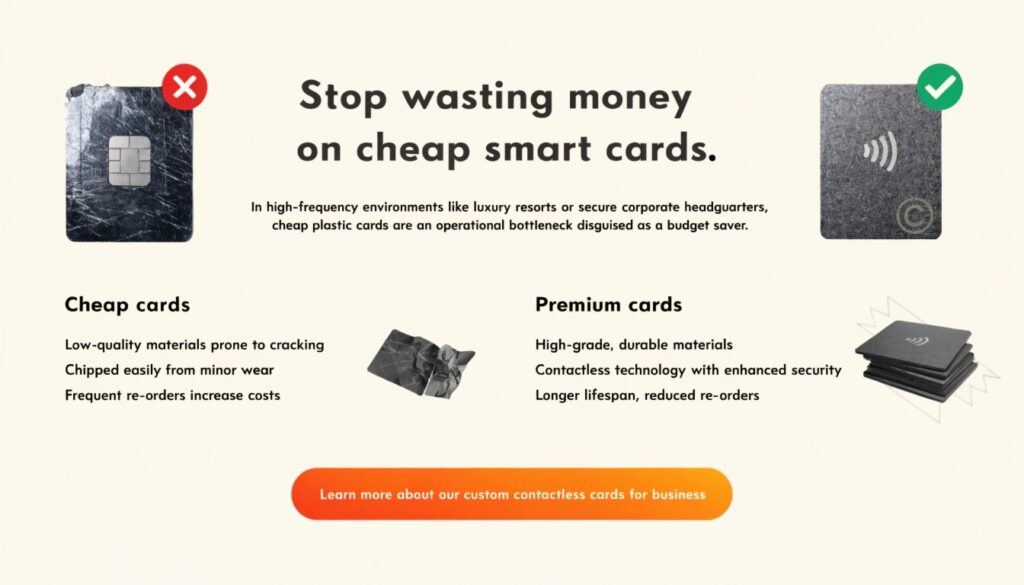
Are you tired of constantly re-ordering replacement smart cards because your current batch chips, cracks, or fails after just a few months of use? In high-frequency environments like luxury resorts or secure corporate headquarters, cheap plastic cards are an operational bottleneck disguised as a budget saver.
Investing in premium, high-durability custom contactless cards for business maximizes your long-term ROI by slashing re-ordering frequencies, reducing administrative overhead, and protecting your brand’s first point of physical contact with clients.
Let’s dive into why looking beyond the initial price tag is the smartest financial decision your procurement team can make this year.
High-Frequency Scenarios Where Cheap Cards Kill B2B Margins
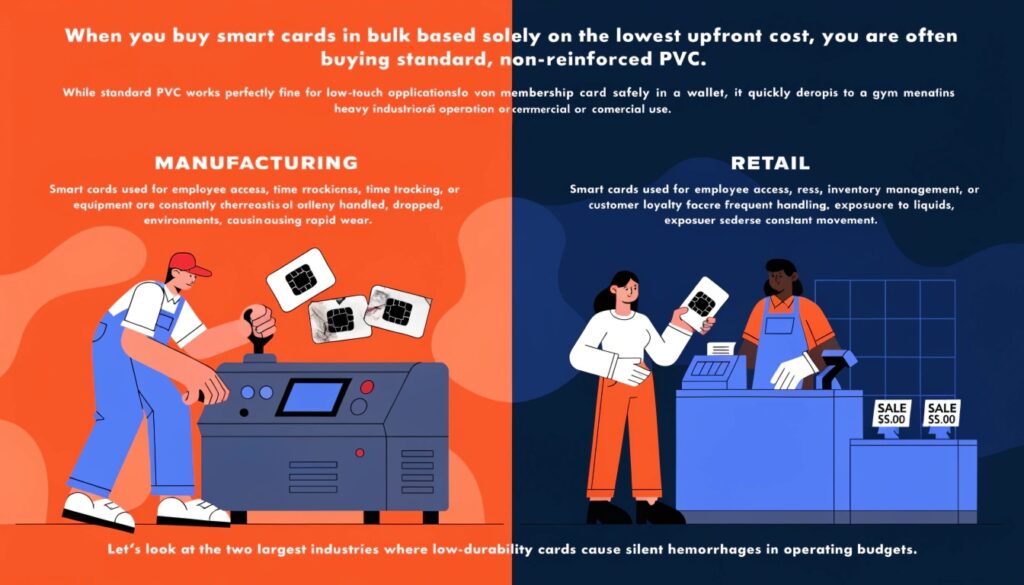
When you buy smart cards in bulk based solely on the lowest upfront cost, you are often buying standard, non-reinforced PVC. While standard PVC works perfectly fine for low-touch applications like a gym membership card stored safely in a wallet, it quickly degrades under heavy industrial or commercial use.
Let’s look at the two largest industries where low-durability cards cause silent hemorrhages in operating budgets.
1. Hospitality & Resorts: The Constant Tap-and-Swipe Cycle
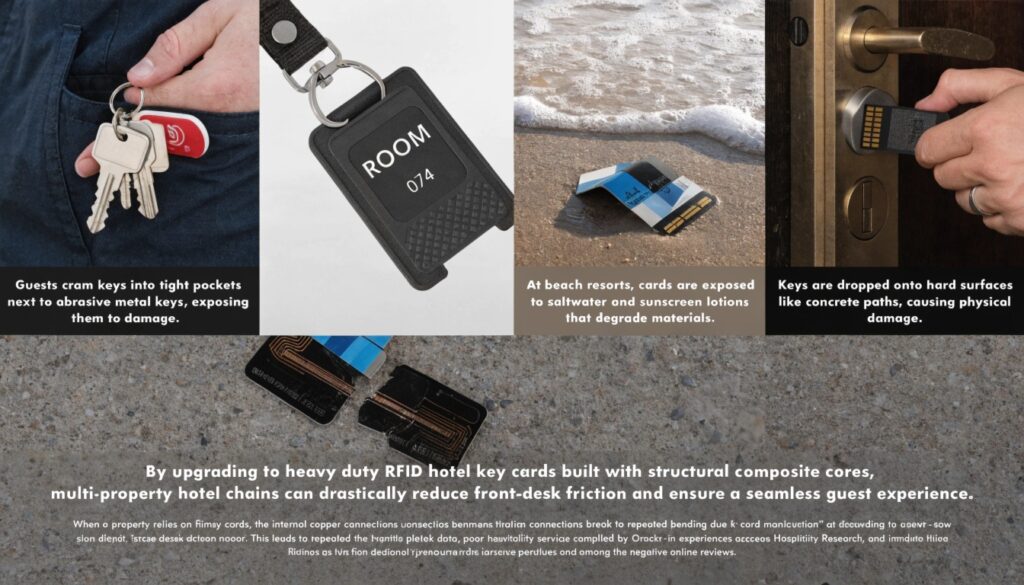
Hotel room keys go through a brutal lifecycle. Guests cram them into tight pockets next to abrasive metal keys, expose them to saltwater and sunscreen lotions at beach resorts, and drop them onto concrete paths.
When a property relies on flimsy cards, the internal copper antenna connections break due to repeated bending. This leads to the dreaded “card malfunction” at the guest room door. According to hospitality service data compiled by Oracle Hospitality Research, poor front-desk check-in experiences and immediate room access failures are among the leading triggers for negative online reviews.
By upgrading to heavy duty RFID hotel key cards built with structural composite cores, multi-property hotel chains can drastically reduce front-desk friction and ensure a seamless guest experience.
2. Corporate Access Control: Daily Wear in Enterprise Campuses
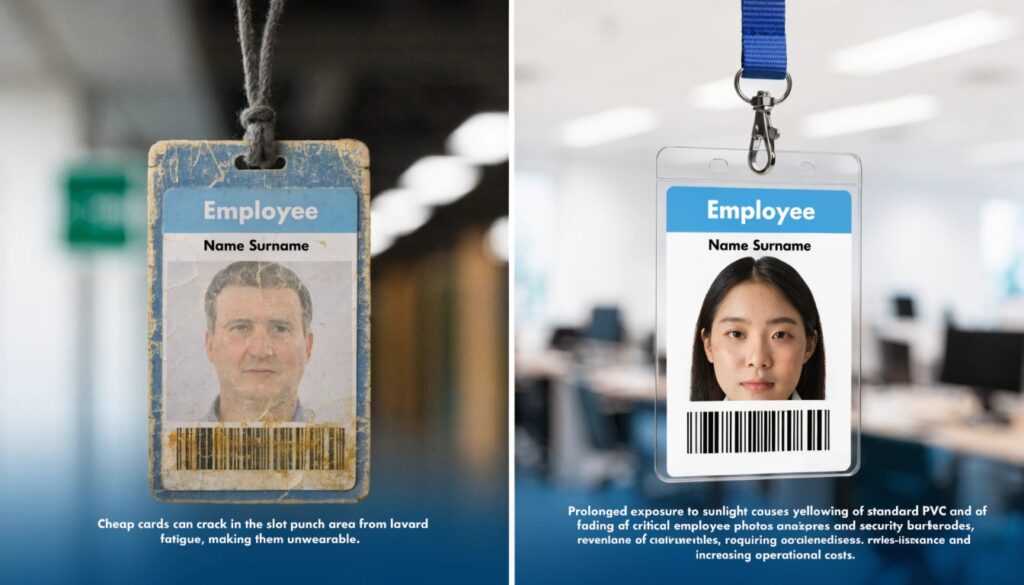
For large corporate offices, tech parks, and government facilities, an employee ID badge is a hard-working asset. Employees swipe or tap these cards multiple times a day to pass through turnstiles, unlock server rooms, buy lunch at the cafeteria, and sign into secure printing hubs.
Cheap cards quickly succumb to “lanyard fatigue”—the constant pulling and tugging cracks the slot punch area, rendering the badge unwearable. Furthermore, prolonged exposure to sunlight yellow-ages standard PVC and fades critical employee photos and security barcodes. When security teams have to spend hours re-verifying identities and re-issuing credentials, your operational costs soar.
The Technical DNA of a Truly Durable Contactless Card
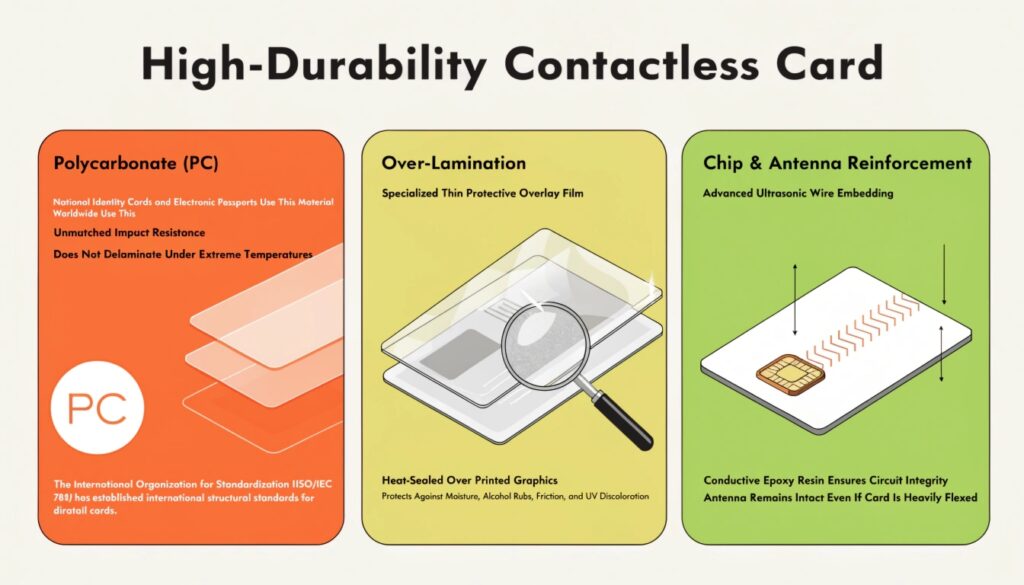
What makes a contactless card truly “high-durability”? As a premium manufacturer, we look at card construction through a lens of material science and rigorous stress testing. A long-lasting smart card relies on three critical engineering choices:
- Advanced Material Blends: Instead of 100% pure PVC, high-durability cards utilize advanced material composites like PETG (Polyethylene Terephthalate Glycol) or pure Polycarbonate (PC). Polycarbonate is the exact material used in national identity cards and electronic passports worldwide because it offers unmatched impact resistance and does not delaminate under extreme temperatures. You can learn more about international structural standards for identification cards via the International Organization for Standardization (ISO/IEC 7810).
- Over-Lamination Protective Layers: Premium cards feature a specialized, thin protective overlay film heat-sealed over the printed graphics. This ultra-clear barrier shields the underlying artwork and security features from moisture, alcohol rubs, friction, and UV discoloration.
- Reinforced Chip and Antenna Embedding: The weakest point of any RFID or NFC card is the bond between the microchip and the copper or aluminum antenna coil. High-durability manufacturing utilizes advanced ultrasonic wire embedding and conductive epoxy resins to ensure the circuit remains intact even if the card is heavily flexed.
Calculating the Total Cost of Ownership (TCO)
To truly understand bulk contactless cards ROI, we need to move past the initial unit price and calculate the Total Cost of Ownership (TCO) over a multi-year horizon.
Let’s look at a realistic cost comparison for an enterprise deploying 10,000 access cards over a three-year operational window:
| Expense Factor | Low-Cost Standard PVC Cards | High-Durability Composite Cards |
| Initial Purchase Cost (10,000 units) | $4,000 ($0.40 / card) | $8,500 ($0.85 / card) |
| Annual Failure & Replacement Rate | ~35% annually (10,500 replacement cards needed over 3 years) | <2% annually (600 replacement cards needed over 3 years) |
| Replacement Card Purchasing Cost | $4,200 | $510 |
| Administrative Labor & Security Re-issuing Costs | $15,750 ($1.50 labor cost per manual card activation) | $900 |
| Total 3-Year Operational Cost | $23,950 | $9,910 |
By investing more upfront in a premium product, the enterprise saves over $14,000 in hidden operational expenses over three years. High-durability cards pay for themselves by simply refusing to break.
Conclusion
When it comes to sourcing secure credentials and access solutions for your organization, cheap materials are an illusion of savings. By choosing high-durability custom contactless cards for business, you protect your infrastructure from downtime, eliminate repetitive shipping and administrative costs, and provide your clients or employees with a reliable premium product.
Are you looking to optimize your organization’s card procurement strategy? Partner with an experienced, globally recognized durable RFID card manufacturer to design smart cards tailored to your exact durability and security requirements.