Why do the world’s top aircraft assembly lines almost never stop because of a missing or mismatched part? Boeing’s answer is a network of more than 100,000 RFID-tagged components acting as an “aviation nervous system” — and the same playbook can cut tracking errors and downtime in your plant, whether you build aircraft or auto parts.
If you manage assembly operations, MRO, or high-value inventory, you already know the real cost of part-tracking failures: line stoppages, expensive rework, and audit findings you cannot close. Boeing deploys RFID (Radio Frequency Identification) for full lifecycle part tracking — each embedded tag stores production batch, installation location, and maintenance history, syncing to a central database in real time, cutting tracking errors by roughly 90% and lifting assembly efficiency by 25%. This guide breaks down how the system works, what it costs to replicate, and which pieces transfer directly to smaller operations.
When a Boeing 787 Needs 7,000 RFID Tags
Walk any 787 Dreamliner line and the scale becomes obvious: each aircraft carries roughly 7,000 RFID-tagged critical parts, from titanium bolts to composite skin panels. Every thumb-sized chip holds an “identity file” — who made the part, when, to which spec, and where it was installed. For a buyer, two numbers matter most:
- Instant location: manual checks that took 15 minutes per batch now happen in about 0.1 seconds as readers scan entire pallets — no line-of-sight, no unpacking.
- Error prevention: when an engine mount was staged at the wrong position, the system auto-alerted the crew and avoided an estimated $2M in rework.
The practice is not experimental. Boeing has required suppliers to fit RFID tags on maintenance-significant parts since the 787 program, and the approach is standardized industry-wide under SAE AS5678 (passive RFID tags intended for aircraft use) — a useful reference if your own customers demand airworthiness-grade tagging.

Three Tech Pillars Behind the 25% Efficiency Gain
1. Dynamic Inventory: From “Blind Search” to “X-Ray Vision”
Traditional monthly stocktakes are replaced by 115 fixed RFID readers covering 186,000 m² of factory floor, giving planners real-time visibility of every tagged item. The payoff shows up in surge capacity: Apache helicopter production can scale from 40 to 400 units per year in wartime scenarios because RFID-driven logistics removes the counting bottleneck. For your operation, the equivalent question is simple — how many labor hours does your team spend looking for parts that the system should already know about?
2. Pulse Lines and RFID Working Together
At the Renton 737 MAX line, the aircraft advances in fixed pulses, and every 4.5-meter pulse triggers next-stage material preparation automatically from RFID data. Because the system always knows which parts have arrived at which station, Boeing cut specialized tooling from 350 to 19 units — a roughly 50% tooling cost reduction. The takeaway for mid-size plants: RFID delivers the most value when it feeds your line-sequencing logic, not when it is used as a glorified barcode.
3. Quality Traceability: A “Black Box” for Every Part
Boeing’s 64KB high-memory tags, co-developed with Fujitsu, record up to 20 years of maintenance history on the part itself. When a 787 developed hydraulic issues, engineers isolated the affected global batch in five minutes instead of days. If your industry faces recalls or regulatory traceability requirements, this is the pillar that pays for the whole system — one contained recall can cover years of tag spend.
What This Costs — and What Smaller Operations Can Copy
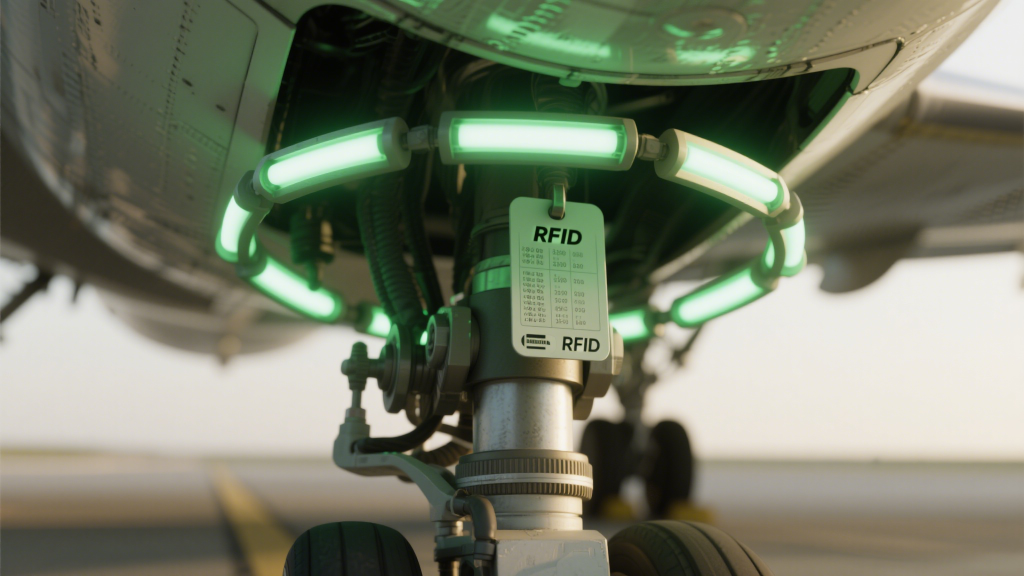
You do not need Boeing’s budget to capture most of the benefit. Tag prices have collapsed: volume pricing for passive UHF tags has fallen from several dollars to under $0.10–$0.80 per tag depending on form factor, driven largely by Chinese chip manufacturing. Specialized aerospace-grade tags (such as Xerafy units rated to survive 300°C composite curing ovens) cost more but are only needed for harsh-environment steps. A realistic entry path:
- Start with one pain loop — receiving-to-line or tool cribs — rather than tagging everything on day one.
- Budget for antennas, not just tags: metal-heavy environments need on-metal tags and tuned antennas; this is the most common hidden cost.
- Demand GS1/EPC compliance so your data stays interoperable with customers and 3PLs — see the GS1 EPC/RFID standards.
- Pilot with 500–1,000 tags and measure error-rate and search-time deltas before scaling.
Choosing the right tag construction for your surface, temperature, and read-range requirements is half the battle — our complete RFID tag procurement guide walks through the selection matrix, and if your parts mount on metal, review custom RFID solutions with factory-direct sourcing to keep per-unit costs down.
Beyond Aviation: Where the Same Playbook Works
The Boeing pattern — tag at source, read automatically, act on exceptions — transfers directly to other asset-intensive settings. Hospitals lose an estimated $2,000 per bed annually to misplaced equipment, a problem RFID asset tracking addresses the same way (see our analysis of RFID savings in medical asset management). In warehousing, RFID has taken inventory error rates from 1.5% down to 0.1% for logistics operators. Two caveats worth knowing before you commit:
- Metal interference is real: standard tags fail on metal surfaces; specify on-metal constructions with isolating substrates.
- Data integrity matters as much as reads: pairing RFID events with tamper-evident credentials or blockchain anchoring is emerging for high-liability supply chains.
Frequently Asked Questions
How much does an industrial RFID part-tracking system cost to pilot?
A single-zone pilot (one fixed reader portal, one handheld, 500–1,000 passive UHF tags) typically lands in the $5,000–$15,000 range including integration labor. Tags themselves are the cheapest element — expect $0.08–$0.80 per label tag at volume, and $2–$10 for rugged on-metal tags.
Do RFID tags survive harsh manufacturing environments?
Yes, if specified correctly. Aerospace-grade tags survive composite curing at 300°C, autoclaves, and paint lines. The failure mode is almost always wrong tag selection, not the technology — which is why your supplier should ask about temperature, chemicals, and mounting surface before quoting.
What read accuracy can we realistically expect?
Well-designed portals reach 99.5%+ read rates on non-metallic goods. Boeing-style results (90% error reduction) come from combining reads with exception alerts — the software rules matter as much as the hardware.
Is RFID worth it if we already use barcodes?
Keep barcodes for low-value SKUs. RFID earns its premium where you need bulk reads without line-of-sight, high part counts per assembly, or lifetime traceability on the part itself — exactly the three conditions Boeing’s 25% efficiency gain rests on.
Next Step: Scope a Pilot Before Your Next Stocktake
The gap between Boeing and everyone else is not budget — it is starting with one measurable loop and the right tag specification. If you can name the area where lost parts or manual counting hurts most, you already have your pilot scope. Tell us your mounting surface, temperature range, and monthly volume, and we will recommend a tag construction and send physical samples for testing — request your RFID tag samples here.