You are upgrading your building’s access control. Your integrator shrugs and says, “Wiegand is fine — everyone uses it.” That single sentence is why a surprising number of corporate badges, campus cards, and government facilities can still be cloned with a device the size of a key fob. This guide explains what Wiegand really is, why the security industry has been trying to retire it for years, and how the OSDP standard protects your cards, readers, and panels — plus exactly what to write in your next RFQ so you do not strand your estate on 1970s wiring.
What Wiegand Actually Is — and Why It Refuses to Die
Wiegand is not a product; it is an interface — a way for a card reader to send credential data to a controller. It was documented in the late 1970s and became the de-facto standard because it was simple, cheap, and worked with the electronics of the day. Decades later, it is still the default on countless readers because every controller on the planet understands it, and replacing working hardware is rarely anyone’s top priority.
In practice, “Wiegand” usually means a 26-bit format: a facility code plus a card number, sent as two data wires (Data 0 and Data 1). There is no standard connector, no error checking beyond the bit count, and — critically — no definition of how the data should be protected. That simplicity is exactly what makes it both durable and dangerous.
The Security Problem With Wiegand: It Can Be Cloned

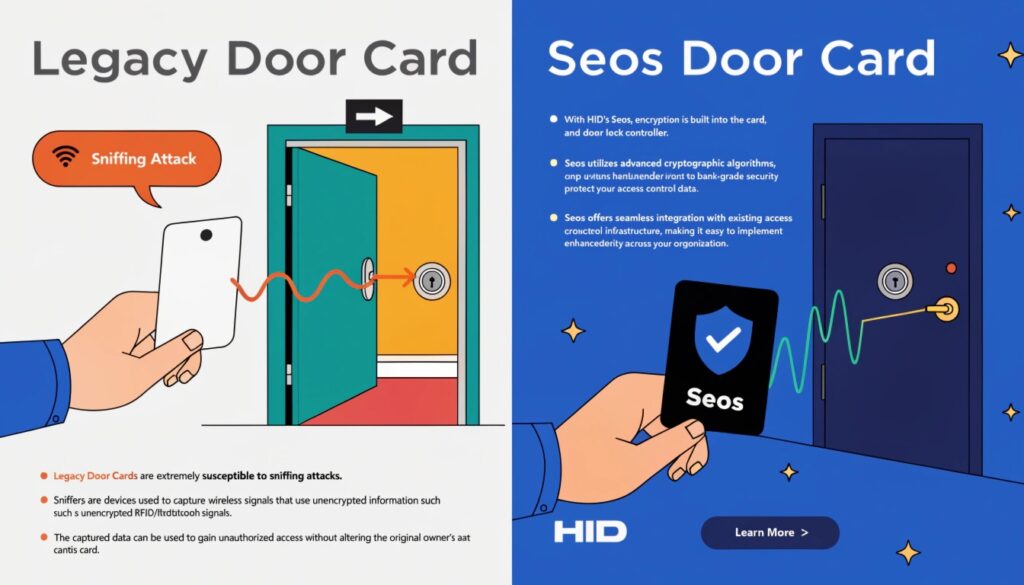
Here is the part integrators rarely lead with: Wiegand transmits credential data in clear text — there is no encryption and no authentication. The card simply broadcasts its facility code and card number, and any reader that speaks Wiegand can capture it. A handheld cloner that costs less than a dinner for two can read that payload and write it onto a blank card in seconds.
The consequence is not theoretical. Because the credential is just a number, a copied card is indistinguishable from the original at the door. There is no rolling code, no challenge-response, no per-card secret. As the Wikipedia overview of the Wiegand interface notes, the format was designed for an era when the threat model was a stolen physical key, not a $30 sniffer on a bus. For a 2026 threat model — opportunistic cloning, disgruntled ex-employees, and supply-chain espionage — clear-text credentials are a measurable, exploitable risk.
What OSDP Brings: A Secure, Bidirectional Standard
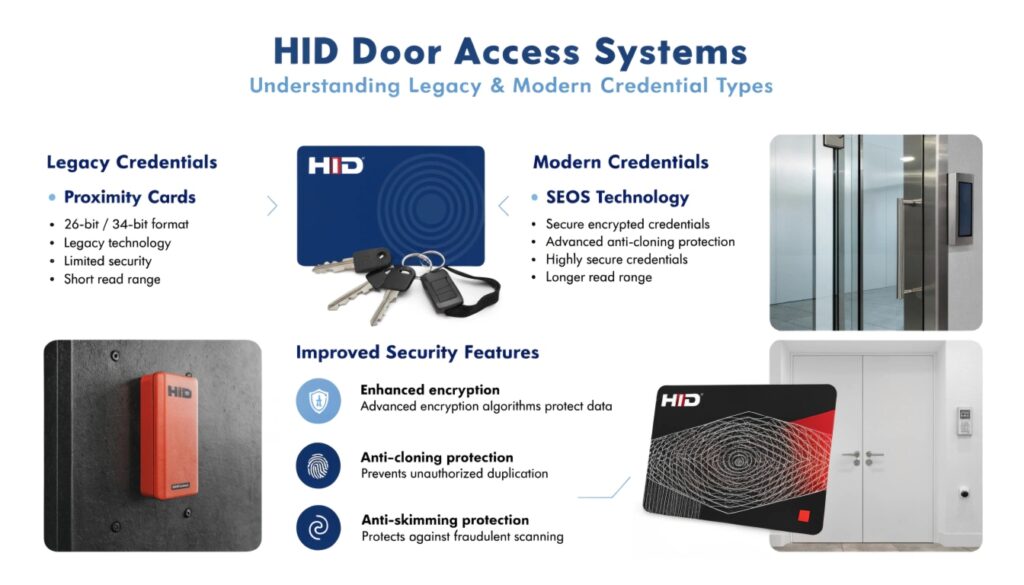
OSDP (Open Supervised Device Protocol) is an open standard maintained by the Security Industry Association (SIA). Where Wiegand is a one-way shout, OSDP is a conversation. The panel and reader exchange messages over a standard RS-485 line, and the protocol is built around three ideas Wiegand simply does not have:
- Encryption. OSDP’s Secure Channel uses AES-128, so credential data and configuration are not readable on the wire.
- Supervision. A continuous heartbeat means the panel knows within seconds if a reader is tampered with, disconnected, or spoofed — not days later when someone notices a door “just stopped working.”
- Two-way control. The panel can push firmware, configuration, and auditing to the reader, enabling centralized management across thousands of doors.
Because OSDP is an open SIA standard rather than a proprietary protocol locked to one vendor, you are not hostage to a single manufacturer’s roadmap. The SIA maintains the official OSDP standard resources, and an OSDP-verified product from one vendor will interoperate with a controller from another. For procurement teams, that interoperability is itself a risk-control measure.
OSDP vs Wiegand: A Buyer’s Comparison
| Dimension | Wiegand | OSDP |
|---|---|---|
| Encryption | None — clear text | AES-128 Secure Channel |
| Direction | One-way (reader → panel) | Two-way (panel ↔ reader) |
| Tamper supervision | None | Continuous heartbeat |
| Max cable distance | ~150 ft (46 m) | ~4,000 ft (1,200 m) |
| Addressing | Per-wire, limited | Logical, many devices per line |
| Vendor lock-in | Proprietary variants | Open SIA standard |
| Future-proofing | Legacy only | Active, certified, evolving |
The distance and addressing rows matter more than they sound. Wiegand’s short cable run forces controllers close to doors and complicates large campuses; OSDP’s longer reach and logical addressing let a single controller line serve many devices — a real reduction in equipment and wiring cost on big deployments.
When Wiegand Is Still Acceptable — and When It Isn’t
Honesty matters here: Wiegand is not always wrong. If you operate a stable, physically secured facility where the cards are low-value (a staff cafeteria tab, not a data-center door) and the readers are already installed, ripping it out has a cost that may not be justified by the risk. Wiegand is acceptable as a retrofit on an existing, contained estate — not as the foundation of a new one.
The line is clear: for any new access-control installation in 2026, specify OSDP. Wiegand should be confined to keeping legacy doors alive while you plan the migration, not chosen as the forward standard. If a vendor proposes Wiegand for a greenfield build, that is a red flag worth questioning.
How to Specify OSDP in Your Access-Control RFQ

Writing “OSDP” on a purchase order is a start, but it is not a specification. To make it bid-comparable and enforceable, state the following:
- Protocol version: “OSDP v2.2 (or later) compliant” — not just “OSDP-capable.”
- Encryption: “OSDP Secure Channel with AES-128 mandatory; clear-text mode disabled in production.”
- Supervision: “Continuous channel supervision with tamper/disconnect alerting to the panel.”
- Symmetry: “Both readers and panels must be OSDP-native on both ends” — a Wiegand reader behind an OSDP-to-Wiegand gateway defeats the purpose.
- Certification: “OSDP Verified (SIA) where available” so interoperability is independently confirmed.
This language also protects you on the card side. If your program uses contact or contactless smart cards, pair OSDP with credentials built to ISO/IEC 7816 (contact) or ISO/IEC 14443 (contactless) so the reader, the panel, and the card all speak modern, documented standards. For high-assurance environments, align the program with guidance such as NIST SP 800-116 Rev. 1 on credential management.
Migration Path: Running Wiegand Today, OSDP Tomorrow
You rarely flip an entire estate in a weekend. The practical path is dual-mode readers that accept both Wiegand and OSDP, deployed at the edge while you upgrade controllers behind them. Start with the highest-risk doors — data centers, executive floors, R&D labs — and move outward. The goal is to never strand the estate: each phase should leave you with fewer clear-text doors than you started with, on a defined timeline with a sunset date for Wiegand.
If you are also consolidating card technologies, this is the moment to align with a broader program — for example, reviewing MIFARE Classic to DESFire migration for the contactless side, or checking employee ID card reader compatibility before you buy. Standards work best when they are chosen together, not piecemeal.
Frequently Asked Questions
Is Wiegand still supported by reader manufacturers?
Yes — most readers still ship with Wiegand output for backward compatibility. That is a retirement convenience, not an endorsement. Treat it as a legacy mode, not your primary standard.
Can OSDP readers read my existing Wiegand cards?
Often yes, because the card itself usually carries a static number that any reader can capture. But reading the card number over OSDP does not make the card secure — the card format is still clear-text. OSDP protects the wire; cloning-resistant credentials (e.g., contactless smart cards with mutual authentication) protect the object.
Does OSDP cost significantly more than Wiegand?
The per-device premium is modest and shrinking as OSDP becomes default on modern readers. Against the cost of a single cloned-credential incident — re-issuance, investigation, and lost trust — the difference is negligible. Longer cable runs and shared lines on OSDP can also reduce wiring cost on large sites.
What does “OSDP Secure Channel” actually protect against?
It encrypts the data traveling between reader and panel, and the supervised heartbeat detects tampering or disconnection in near real time. That defeats the two cheapest attacks on Wiegand: sniffing the credential off the wire and cutting or spoofing a reader unnoticed.
How do I know a product is genuinely OSDP-compliant?
Look for SIA “OSDP Verified” certification rather than a vendor’s self-declared “OSDP ready.” Pair it with the RFQ language above — version, mandatory Secure Channel, and native OSDP on both reader and panel — so non-compliance is visible at bid time.
Specify the Standard Before You Buy the Hardware
The cheapest time to choose OSDP is on the spec sheet, not after a cloned badge walks into a server room. For any new access-control program, make OSDP v2.2 with AES-128 Secure Channel and SIA verification your default, and confine Wiegand to a dated, contained retrofit plan with a sunset date. Your cards, readers, and panels will outlive the threat model that Wiegand was built for.
Our team helps procurement and security leads turn this into a bid-comparable specification — and we can supply sample OSDP-ready credentials and a reader/panel compatibility check for your environment. Talk to us about your next access-control program, or review factory-direct vs reseller sourcing before you commit volume.