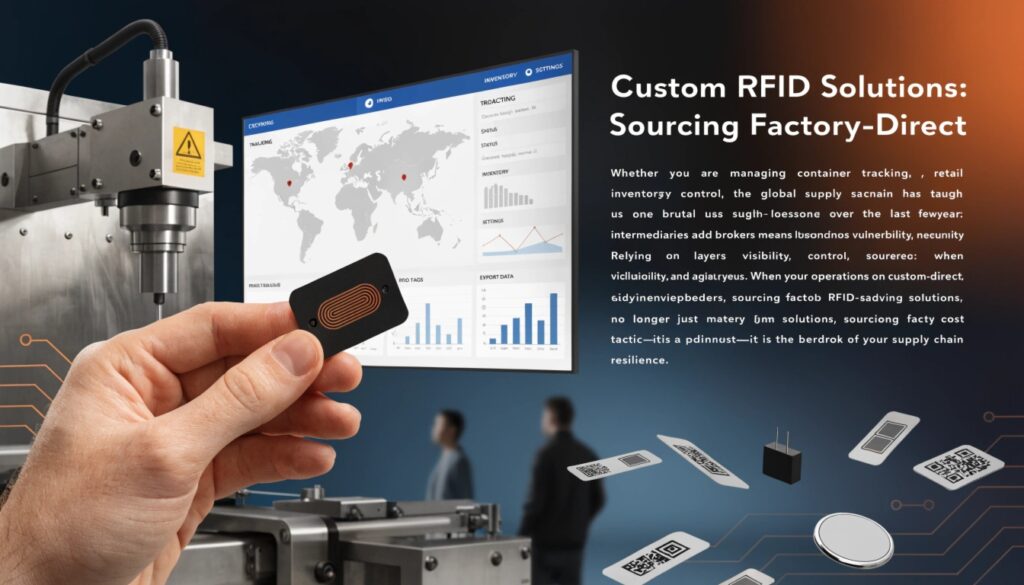
Whether you are managing container tracking, retail inventory, or high-security access control, the global supply chain has taught us one brutal lesson over the last few years: intermediaries add vulnerability. Relying on layers of brokers means losing visibility, control, and agility. When your operations depend on custom RFID solutions, sourcing factory-direct is no longer just a cost-saving tactic—it is the bedrock of your supply chain resilience.
Sourcing Custom RFID Solutions Factory-Direct Safeguards Operations
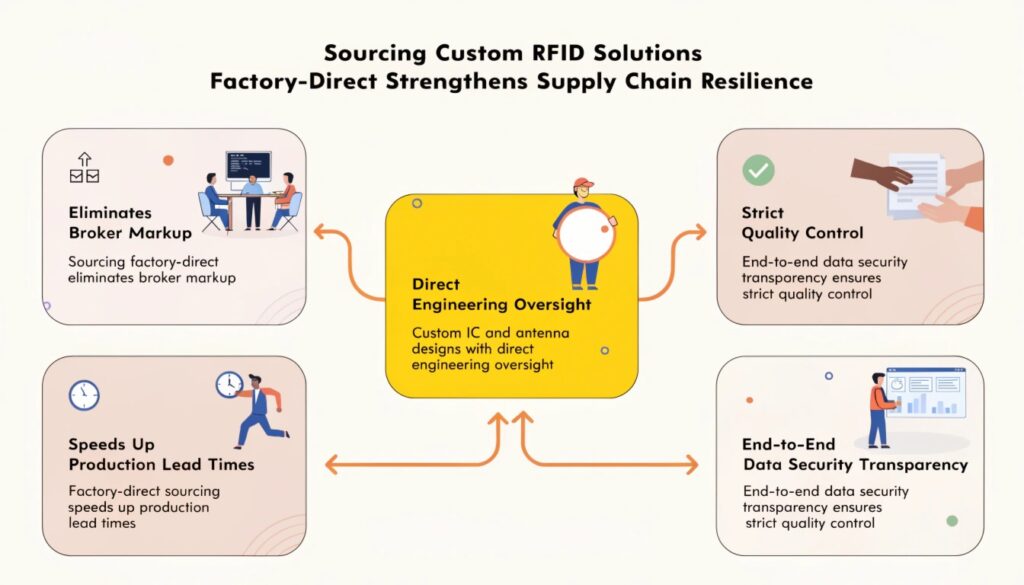
Sourcing custom RFID solutions factory-direct strengthens supply chain resilience by eliminating broker markup, providing direct engineering oversight for custom IC and antenna designs, speeding up production lead times, and ensuring strict quality control with end-to-end data security transparency.
Direct Engineering Control Accelerates Customization
When you partner directly with an actual RFID manufacturer, you bypass the “telephone game” of third-party sourcing. Custom RFID deployment is complex; it requires precise fine-tuning of antenna geometries, integrated circuit (IC) selections, and specialized substrates to match your exact RF environment.
Working with brokers often leads to miscommunicated technical specifications. A factory-direct relationship gives your engineering team immediate access to the production floor’s technical capabilities.
[Your Engineering Team] <---> [Factory R&D and Production] = Real-Time Calibration
[Your Engineering Team] <--> Broker <--> Trading Co. <--> [Factory] = Miscommunication & Delay
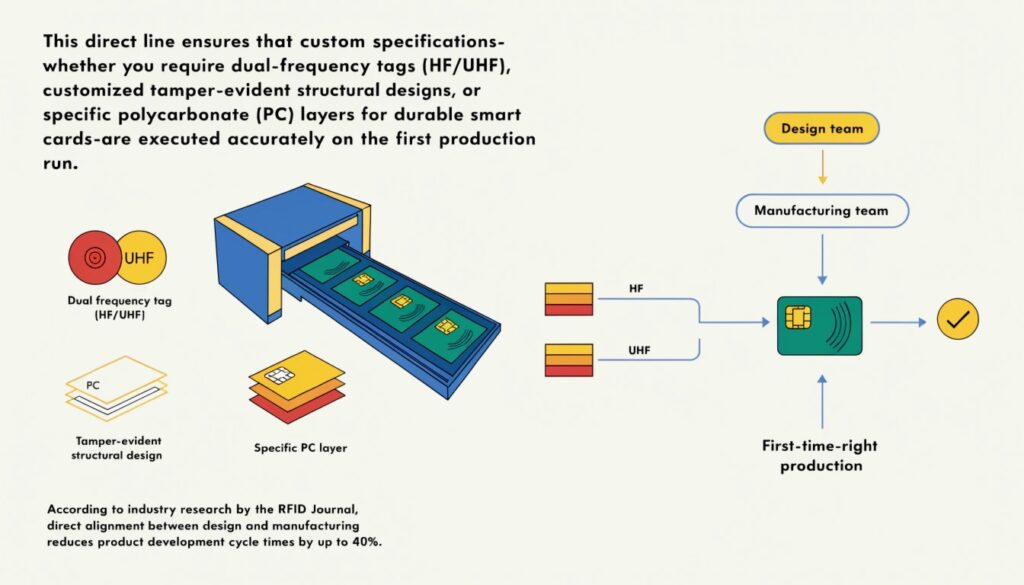
This direct line ensures that custom specifications—whether you require dual-frequency tags (HF/UHF), customized tamper-evident structural designs, or specific polycarbonate (PC) layers for durable smart cards—are executed accurately on the first production run. According to industry research by the RFID Journal, direct alignment between design and manufacturing reduces product development cycle times by up to 40%.
Supply Chain Transparency Mitigates Material Disrupted Risks
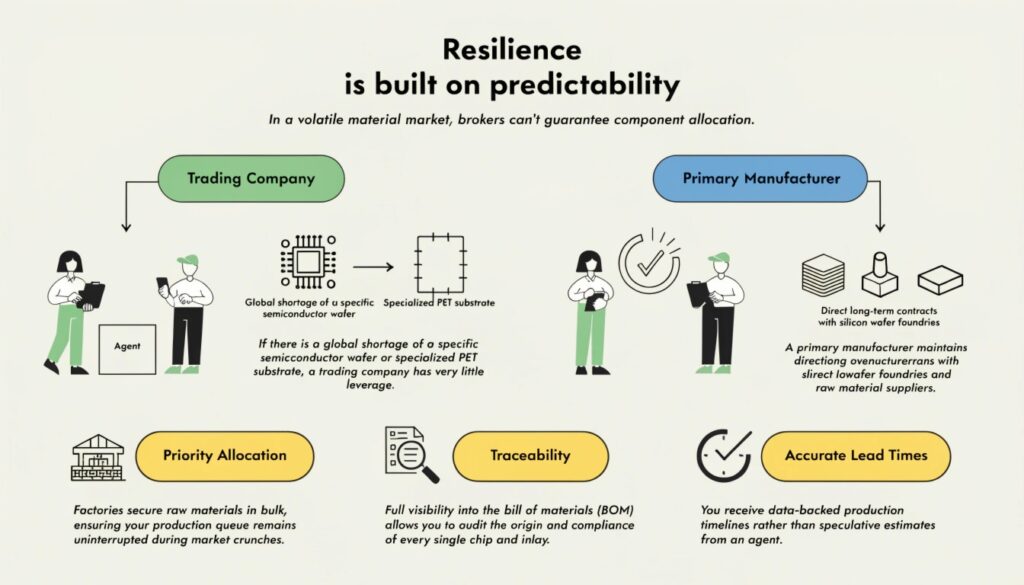
Resilience is built on predictability. In a volatile material market, brokers cannot guarantee component allocation. If there is a global shortage of a specific semiconductor wafer or specialized PET substrate, a trading company has very little leverage.
A primary manufacturer maintains direct long-term contracts with silicon wafer foundries and raw material suppliers.
- Priority Allocation: Factories secure raw materials in bulk, ensuring your production queue remains uninterrupted during market crunches.
- Traceability: Full visibility into the bill of materials (BOM) allows you to audit the origin and compliance of every single chip and inlay.
- Accurate Lead Times: You receive data-backed production timelines rather than speculative estimates from an agent.
Uncompromised Data Security and Inlay Quality Control
Custom RFID solutions frequently involve pre-encoding sensitive data, managing cryptographic keys, or printing variable data like sequential barcodes and high-security micro-text. Entrusting this data to a middleman introduces severe compliance and security liabilities.
+-------------------------------------------------------------+
|               FACTORY-DIRECT SECURITY PROTOCOLS             |
+-------------------------------------------------------------+
| [Data Ingestion] -> [Encrypted Secure Servers]              |
|                           ↓                                 |
| [Closed-Loop Production] -> [Chips Encoded on In-Line Mach] |
|                           ↓                                 |
| [Destruction of Waste]   -> [Scrapped Inlays Shredded]     |
+-------------------------------------------------------------+
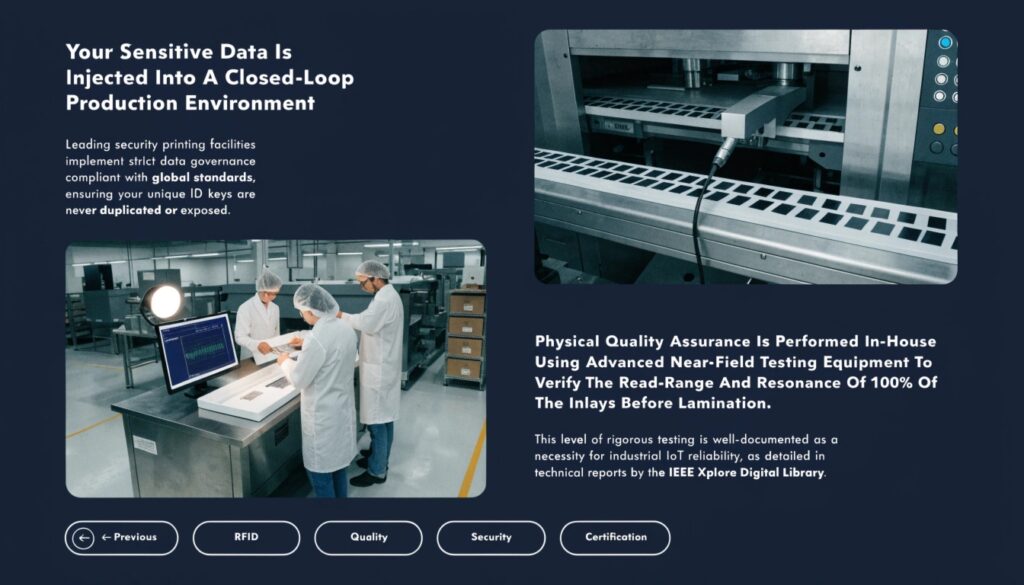
By sourcing factory-direct, your sensitive data is injected into a closed-loop production environment. Leading security printing facilities implement strict data governance compliant with global standards, ensuring your unique ID keys are never duplicated or exposed.
Furthermore, physical quality assurance is performed in-house using advanced near-field testing equipment to verify the read-range and resonance of 100% of the inlays before lamination. This level of rigorous testing is well-documented as a necessity for industrial IoT reliability, as detailed in technical reports by the IEEE Xplore Digital Library.
Eliminating Middleman Margins Maximizes Cost Efficiency
While supply chain resilience focuses heavily on reliability, financial sustainability is what scales it. Every intermediary that touches your product adds a percentage markup to cover their overhead and profit margins.
| Sourcing Variable | Broker / Trading Company | Factory-Direct Sourcing |
| Unit Cost Pricing | Inflated (Includes multiple layer margins) | Base Manufacturing Cost (High ROI) |
| MOQ Flexibility | Rigid (Bound by broker volume tiers) | Adaptable (Directly tied to raw material runs) |
| Tooling & Setup Fees | Marked up as an administrative cost | Transparent, one-time engineering fees |
| Remediation Speed | Slow (Requires claims negotiation panels) | Immediate (Direct factory rework protocols) |
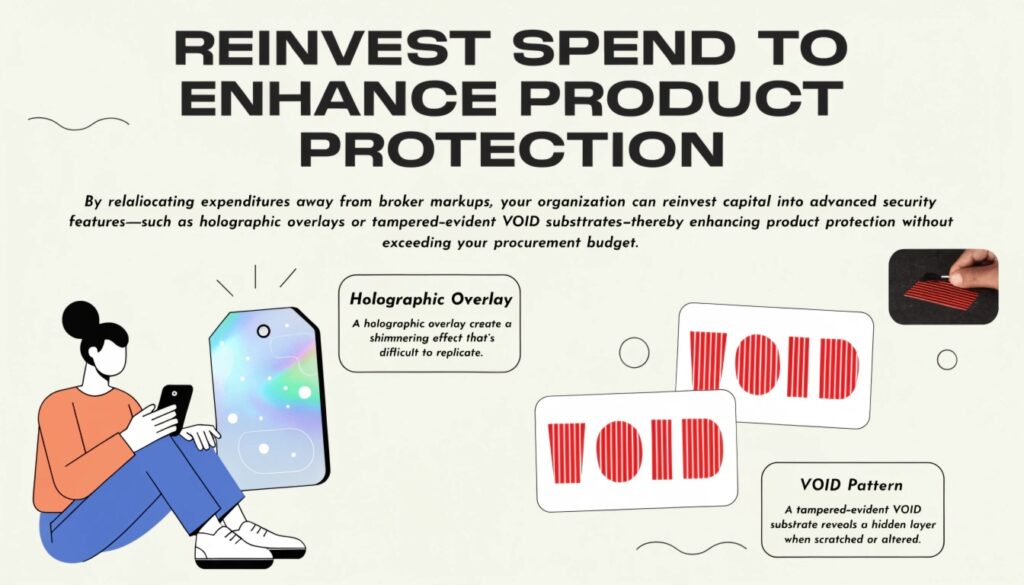
By reallocating expenditures away from broker markups, your organization can reinvest capital into advanced security features—such as holographic overlays or tampered-evident VOID substrates—thereby enhancing product protection without exceeding your procurement budget.
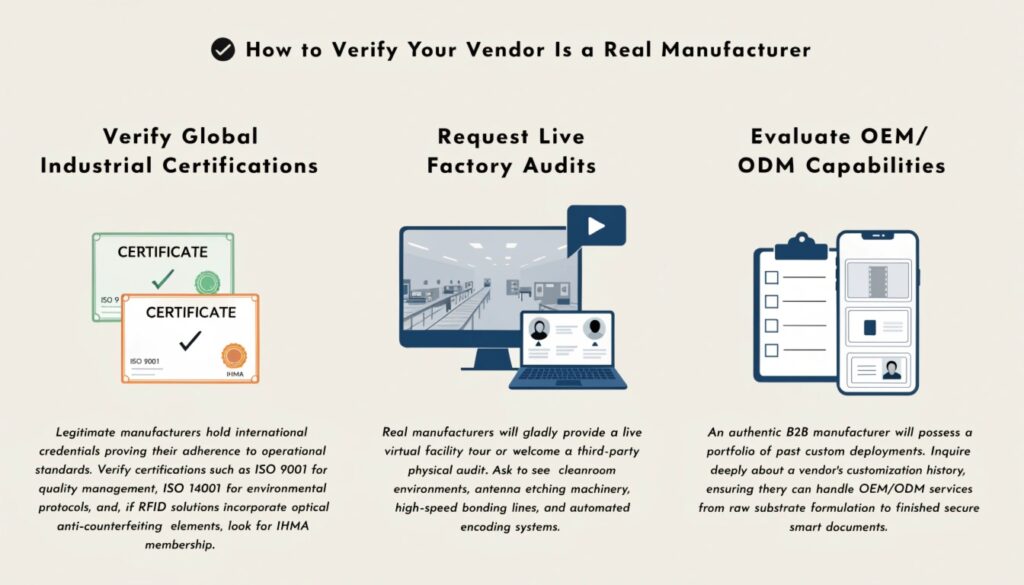
How to Audit an Authentic RFID Manufacturing Partner
To truly secure your supply chain, you must verify that your partner is an actual manufacturer and not a disguised trading company. Use these criteria during your vendor evaluation process:
1. Verify Global Industrial Certifications
Legitimate manufacturers hold international credentials proving their adherence to operational standards. Look for ISO 9001 for quality management, ISO 14001 for environmental protocols, and industry-specific security memberships like the International Hologram Manufacturers Association (IHMA) if your RFID solutions incorporate optical anti-counterfeiting elements.
2. Request Live Factory Audits
A real manufacturer will gladly provide a live virtual facility tour or welcome a third-party physical audit. Ask to see their cleanroom environments, antenna etching machinery, high-speed bonding lines, and automated encoding systems.
3. Evaluate OEM/ODM Capabilities
Inquire deeply about their customization history. An authentic B2B manufacturer will possess a portfolio of past custom deployments, demonstrating their ability to handle complete OEM/ODM services from raw substrate formulation to finished secure smart documents.