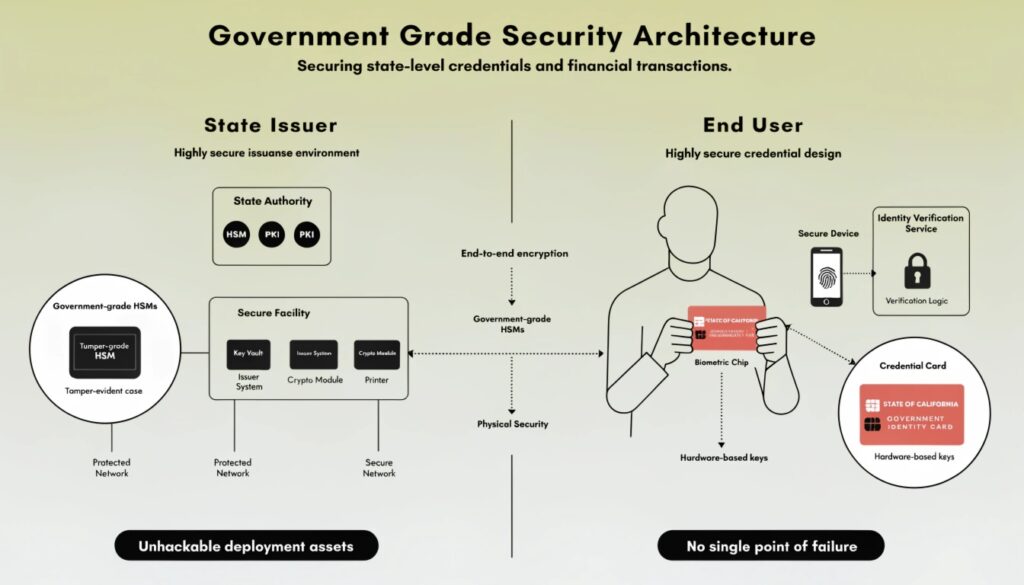
Protecting state-level credentials and financial transactions requires far more than standard digital encryption; it demands government-grade physical and logical architecture. For global procurement officers, choosing a card infrastructure with compromised protocols can lead to catastrophic data breaches and national security vulnerabilities. Understanding the precise protective mechanisms within these credentials ensures your institution deploys unhackable deployment assets.
The Quick Answer: How Do Smart Cards Secure Data?
High-Security Smart Cards protect sensitive data through a multi-layered defense architecture. This combines dedicated hardware Secure Elements (SE), robust cryptographic co-processors (AES, RSA, ECC), mutual authentication protocols, and advanced physical tamper-evidence—such as polycarbonate substrates and custom holographic overlays—to completely block unauthorized access and hardware cloning.
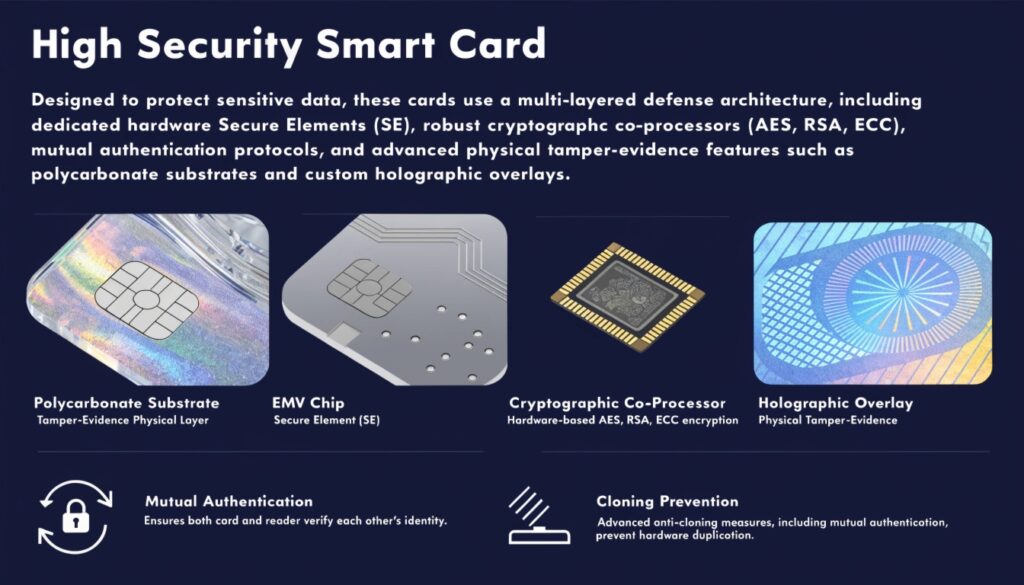
But how do these separate digital and physical defense layers coordinate to neutralize sophisticated brute-force, side-channel, or physical modification attacks? Let’s break down the underlying engineering that keeps elite institutional data completely invulnerable.
How Do High-Security Smart Cards Safeguard Critical Information?
At the core of every premium secure credential lies a sophisticated microcontroller capable of executing advanced computational defenses independent of the host reader. Unlike basic magnetic stripe or low-frequency proximity cards, high-security smart cards operate as micro-computers that actively defend their data storage registries.
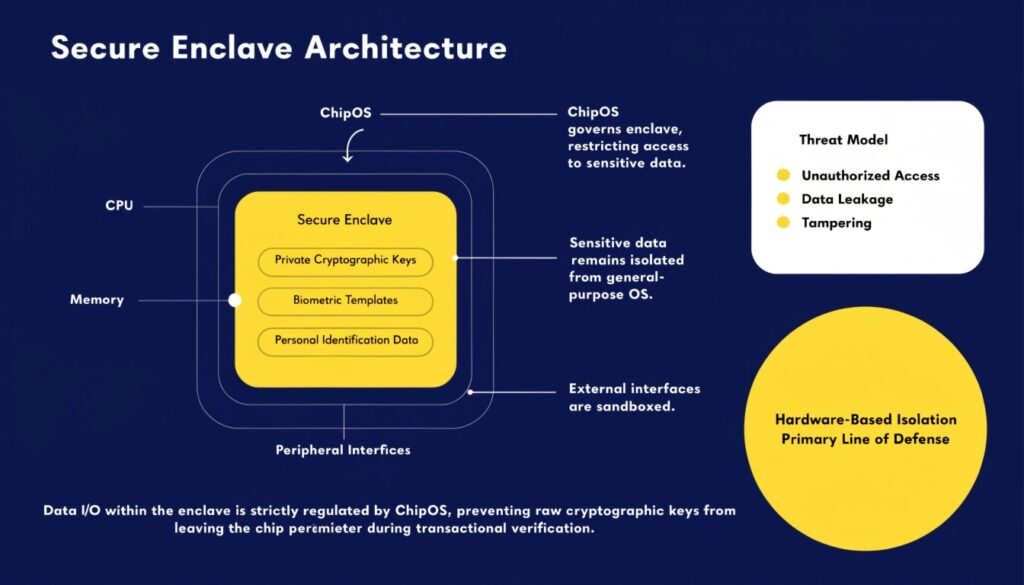
The primary line of defense is the execution of hardware-based isolation. Sensitive data, such as private cryptographic keys, biometric templates, and personal identification data, are stored within a dedicated secure enclave. This enclave is governed by a secure operating system (ChipOS) that strictly regulates data I/O, ensuring that raw cryptographic keys never leave the chip perimeter during transactional verification.
Furthermore, top-tier global manufacturers design these microchips to meet stringent international security mandates. Government-grade deployment typically mandates compliance with the Common Criteria EAL6+ certification, verifying that the hardware has undergone rigorous semi-formal testing against highly structured, state-sponsored cyber threats.
Logical Defense: Cryptographic Co-Processors and Mutual Authentication
Digital data protection relies heavily on asymmetric and symmetric encryption algorithms managed directly by on-chip cryptographic co-processors. When a high-security card interacts with a terminal, it does not simply broadcast its data; it initiates a complex cryptographic handshake.
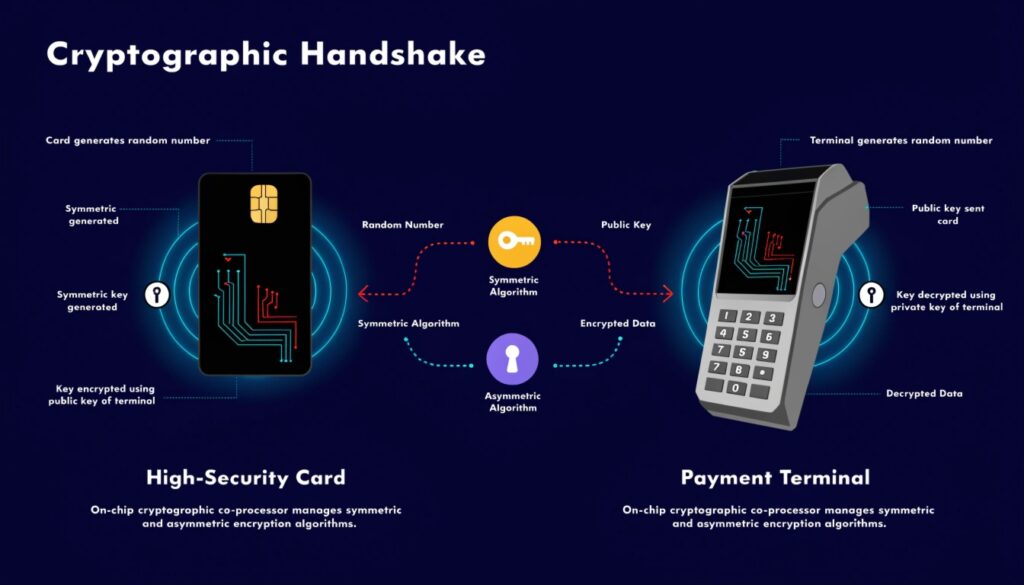
Through a process known as mutual authentication, both the smart card and the reader must prove their identities to each other using secure keys before any sensitive data registers are unlocked. This protocol completely neutralizes “man-in-the-middle” eavesdropping attacks, as the data exchanged during each session is uniquely encrypted using dynamic session keys that expire immediately after the transaction concludes.
Physical Defense: Polycarbonate Substrates and Tamper-Evident Layers
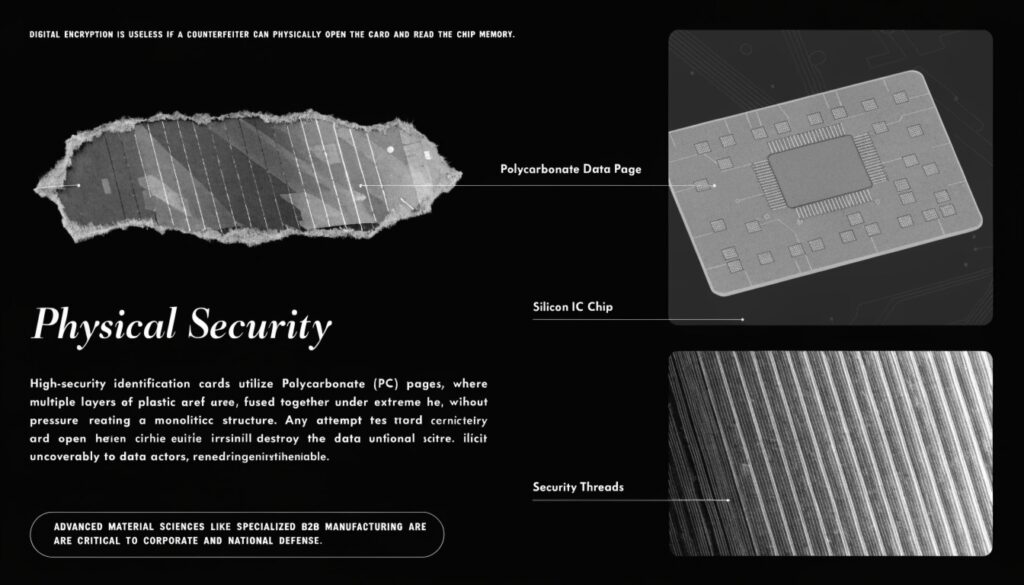
Digital encryption is useless if a counterfeiter can physically open the card and read the chip memory using scanning electron microscopy. This is where advanced material sciences, like specialized B2B manufacturing, become critical to corporate and national defense.
High-security identification cards utilize Polycarbonate (PC) data pages where multiple layers of plastic are fused together under extreme heat and pressure without adhesives. This creates a monolithic structure; any attempt to peel open the card to access the embedded silicon chip or security threads will irreversibly destroy the internal circuitry, rendering the data completely unrecoverable to illicit actors.
Key Security Mechanisms in Government National IDs and Passports
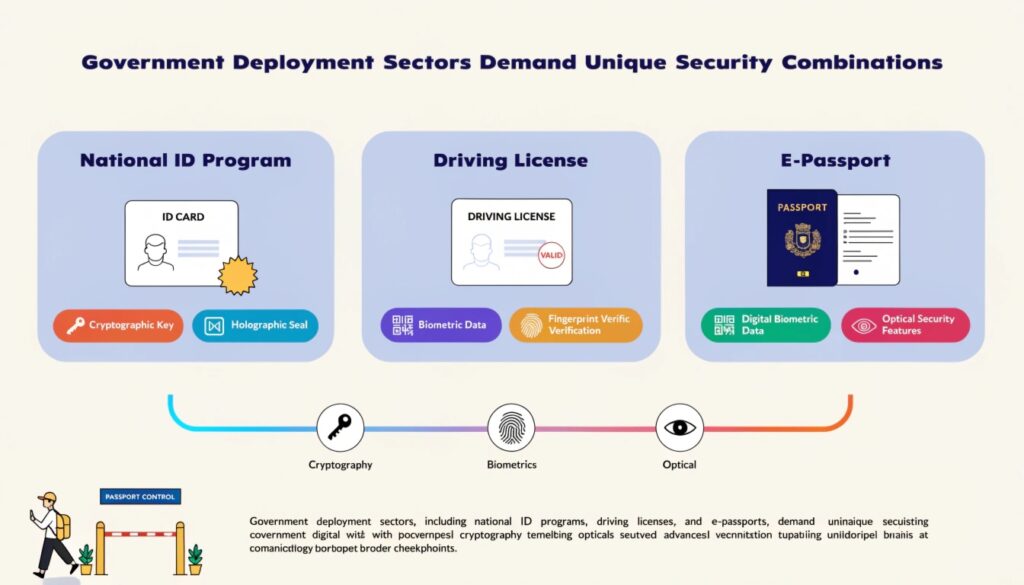
Government deployment sectors, including national ID programs, driving licenses, and e-passports, demand unique security combinations that bridge digital cryptography with advanced optical verification technology to prevent fraudulent duplication at border checkpoints.
Biometric Data Encryption and ICAO Compliance
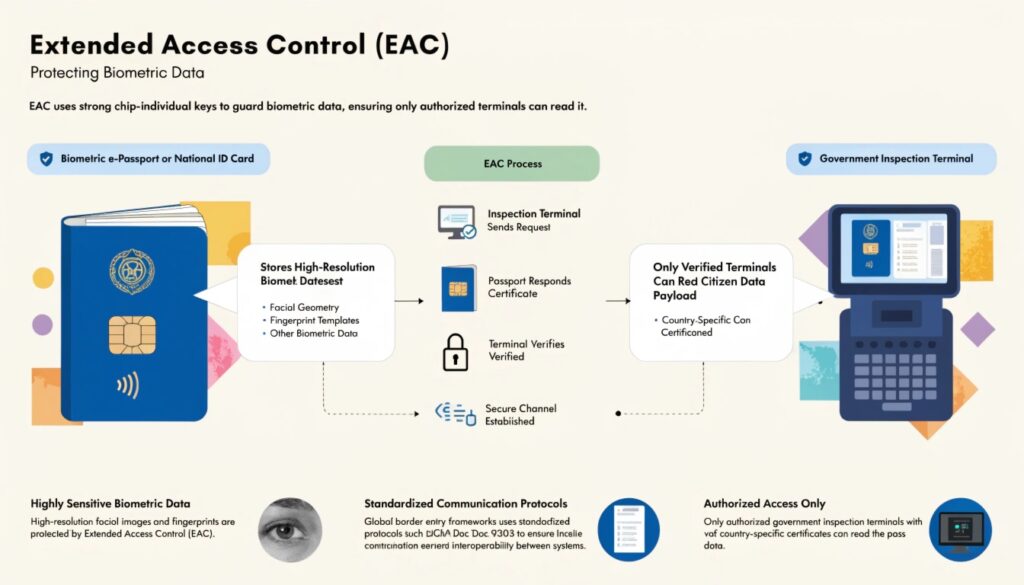
Modern electronic passports (e-passports) and national identity documents store high-resolution biometric datasets, including facial geometry and fingerprint templates. To protect citizen privacy, this data is heavily guarded using standardized international communication frameworks.
According to global border entry frameworks detailed by ICAO Doc 9303 specifications, these documents mandate Extended Access Control (EAC). EAC utilizes strong chip-individual keys to restrict access to highly sensitive biometrics, ensuring only authorized government inspection terminals equipped with verified country-specific certificates can read the card’s citizen data payload.
Optical Security Features: Holographic Overlays and Custom Micro-Text
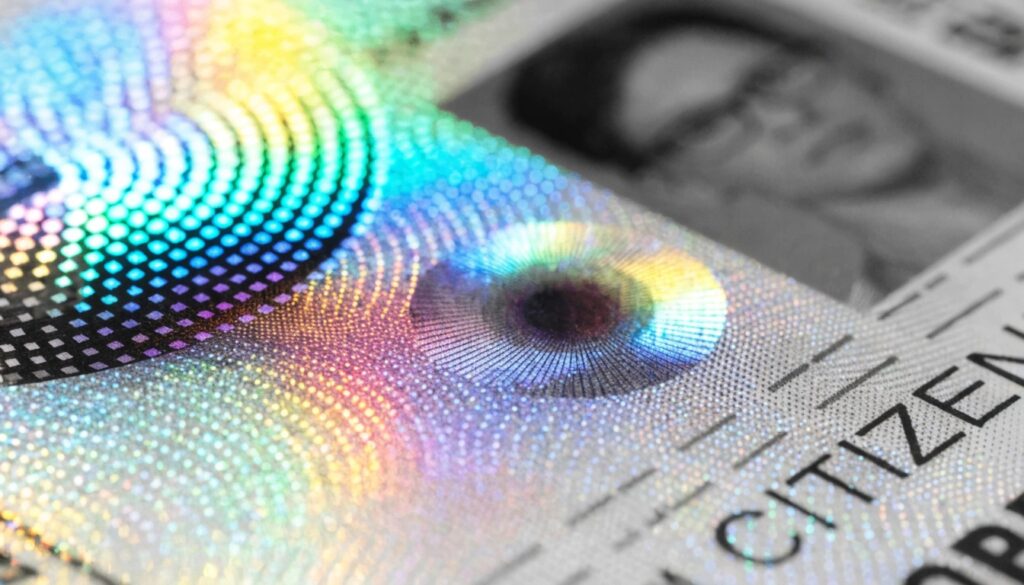
A comprehensive data protection strategy must also prevent visual alteration of the card’s printed surface. Sophisticated B2B suppliers integrate custom holographic overlays and security laminates directly over the personalized citizen data.
These ultra-clear protective layers utilize complex optical lithography to embed covert security features such as 2D/3D dot-matrix holograms, color-shifting inks, and micro-text printing that cannot be reproduced by standard commercial printers. Any attempt to modify the printed text or photo dynamically alters the underlying hologram, immediately alerting security personnel to a tampering attempt.
How Financial Institutions Prevent Smart Card Counterfeiting and Fraud
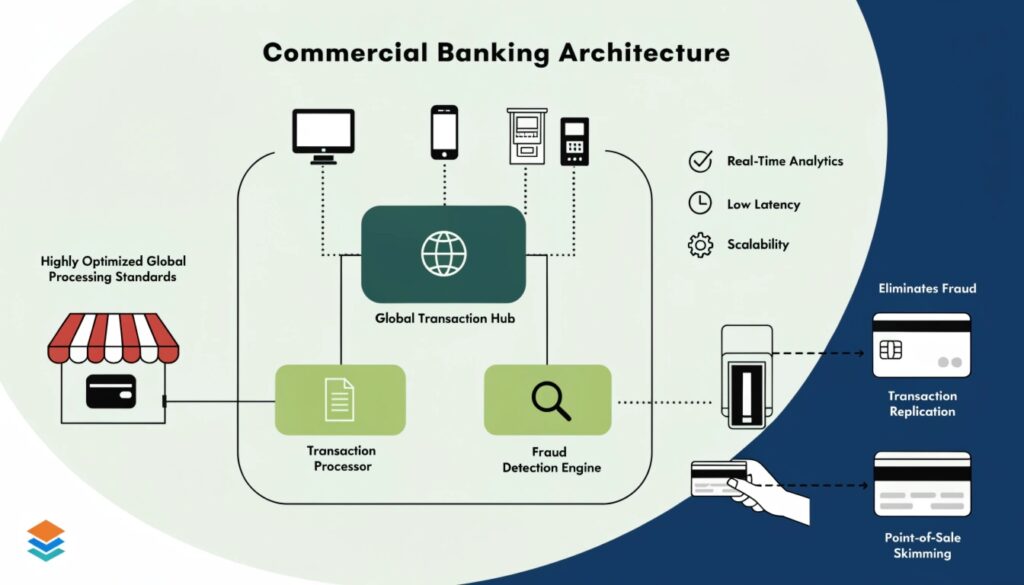
Within the commercial banking sector, security architectures focus heavily on eliminating transaction replication and point-of-sale skimming fraud through highly optimized global processing standards.
EMV Compliance and Dynamic Data Authentication (DDA)
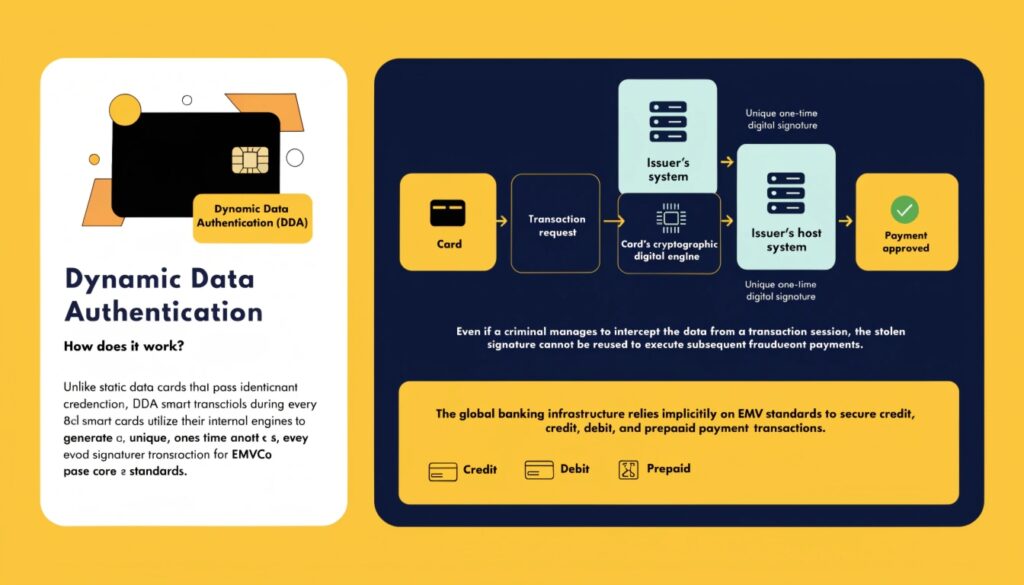
The global banking infrastructure relies implicitly on EMV standards to secure credit, debit, and prepaid payment transactions. High-security banking smart cards utilize Dynamic Data Authentication (DDA) to validate transactions in real-time.
Unlike static data cards that pass identical payment credentials during every transaction, DDA smart cards utilize their internal cryptographic engines to generate a unique, one-time digital signature for every single transaction based on EMVCo core standards. Even if a criminal manages to intercept the data from a transaction session, the stolen signature cannot be reused to execute subsequent fraudulent payments.
Dual-Interface Security: Protecting Contactless NFC Transmissions
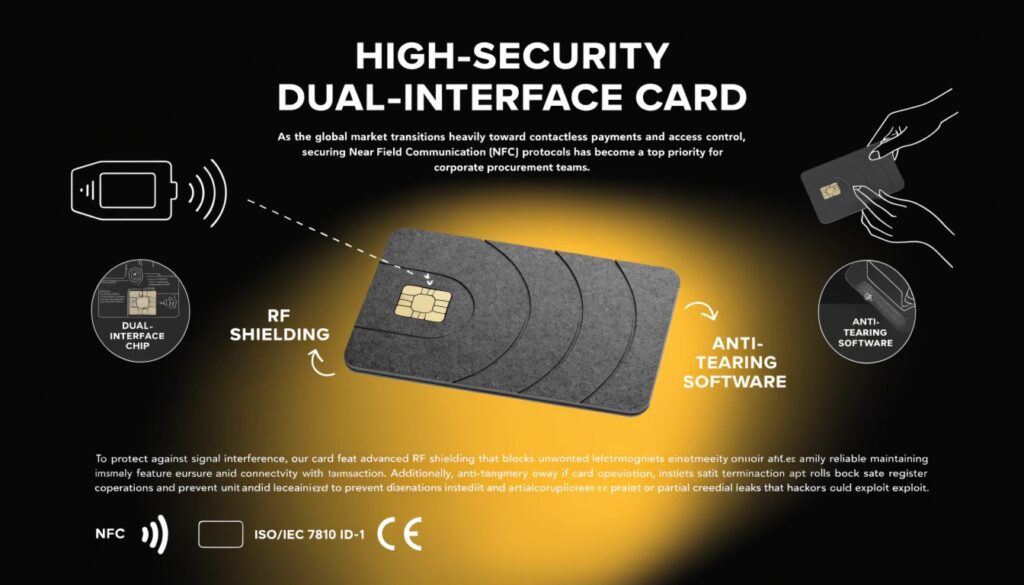
As the global market transitions heavily toward contactless payments and access control, securing Near Field Communication (NFC) protocols has become a top priority for corporate procurement teams.
High-security dual-interface cards feature robust RF shielding capabilities and sophisticated anti-tearing software algorithms. These features ensure that if a card is prematurely pulled away from an NFC terminal mid-transaction, the chip instantly safely terminates the operation and rolls back its internal state register, preventing data corruption or partial credential leaks that hackers could exploit.
Choosing a B2B Smart Card Manufacturer: What Procurement Officers Must Verify
When source-mapping large volume allocations for national or institutional smart card deployments, procurement managers must audit a manufacturer’s compliance, security protocols, and customization depth.
| Procurement Evaluation Factor | High-Security Requirement Standards |
| Material Integrity | Pure Polycarbonate (PC) construction with laser-engravable layers. |
| Optical Anti-Counterfeiting | Custom master origination holograms with tamper-evident (VOID) properties. |
| Cryptographic Standards | Support for hardware AES-256, RSA-4096, and ECC protocols. |
| Manufacturing Security | Strict facility data access control, non-disclosure compliance, and audited supply chains. |
Partnering with a dedicated B2B manufacturer that offers comprehensive OEM/ODM customization allows institutions to integrate customized security threads, invisible UV fluorescent fibers, and tailored chip operating systems. This tier of customization guarantees that your high-security smart cards remain resilient against the evolving global threat landscape.
Conclusion
High-security smart cards safeguard sensitive data by establishing an unbreakable chain of trust between robust hardware encryption, mutual authentication protocols, and advanced physical tamper-evidence materials like fused polycarbonate. By implementing these multi-tiered digital and physical defense systems, governments and financial institutions can completely insulate their critical networks from data forgery and cloning. Is your organization’s current card deployment fully optimized to withstand modern cryptographic attacks?